For my critical play this week, I played Pokémon Conquest. Pokémon Conquest was developed by Tecmo Koei for the Nintendo DS, and its target audience is fans of Pokémon, Nobunaga’s Ambition, and general strategy gamers. I played this game on the Delta emulator on Mac; the rom I used is one I personally backed up off of my physical cartridge of the game. The game is a spinoff of the main Pokémon series, and it’s actually a crossover with a strategy game called Nobunaga’s Ambition. Nobunaga’s Ambition is a game where you play as a feudal Japanese Warlord, and your goal is to conquer all of Japan. This is a very different premise from a traditional Pokémon game where a young kid needs to go on a journey to make friends and collect gym badges. As a result, the game pays careful attention to its worldbuilding to reconcile the gap between these two franchises to make a cohesive setting. This disconnect is part of what made me quickly give up on the game when my grandparents first got it for me when it came out.
I argue that Tecmo Koei is able to make players care about the world presented by adapting the themes of warfare and colonialism present in Nobunaga’s ambition into a narrative grounded in the Pokémon universe and by including mechanics which explicitly reinforce these themes.
The first thing the game shows is a cinematic which provides some of the background information of the world. Most important here though, it sets up the protagonist’s goal for the game–Conquer all 17 kingdoms of the game. This is very different from the goal of a normal Pokémon game, and it immediately indicates to the player that this is not going to share the premise of the other main-line Pokémon games. The cinematic then goes on to tell the player that conquering every kingdom will cause the rebirth of the legendary creator of the region.

This is a pretty traditional hook for a game, but when examined within the context of Pokémon players, it spells out a very different narrative than is usually present in a Pokémon game. Furthermore, instead of being called trainers as in other Pokémon games, the characters in Pokémon Conquest are referred to as Warlords and Warriors. This breaking of the Pokémon formula extends to specific moments in the narrative as well. One specific moment this happened was when a supporting character named Kiyomasa gives the protagonist a piece of advice:
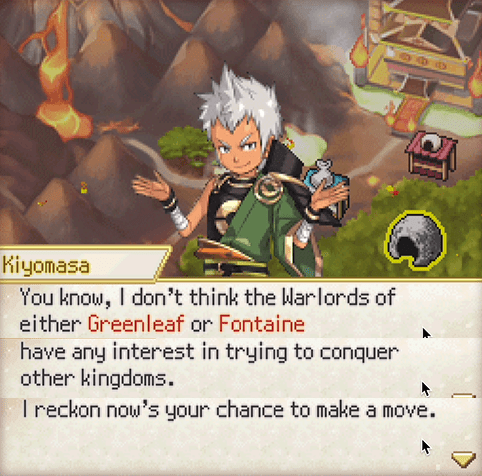
After reading this I was fully expecting one of the other characters to butt in and say something to refute this, and in any other Pokémon game they probably would have. In Pokémon Conquest though, the game immediately gives you a tutorial on how to start an attack on Greenleaf. This particular moment really serves to distance the player from the traditional Pokémon formula, and serves to immerse the player into their role and motivations as a Warlord.

These themes don’t stop at the narrative though, the mechanics and objectives of the game also play into this. The game has turn based tactical combat similar to a game like fire emblem, but outside of this the game also has complex resource management mechanics. The gameplay is not as simple as just waging war on other kingdoms, the player also needs to then manage and take care of their various kingdoms and warriors. To this end, the game has a month system, where every month each warrior can take an action. These actions include things like training against the wild Pokémon inhabiting the kingdom and the like. The interesting thing though is that these actions are very constrained by the kingdoms you have under your control. If trying to train on wild Pokémon, each kingdom has a limited amount, and so in order to train your warriors more you need to conquer more kingdoms.
The game also has complex mechanics around taxation and development. When taking over a kingdom you are able to tax the residents of said kingdoms, and can use these taxes to increase the standard of living. This also doesn’t happen in isolation, the opposing kingdoms are also able to develop themselves and even launch attacks on your kingdom each time a month progresses. These mechanics serve to make a fairly complex territory management game, and through allowing the player some expression fun through what kingdoms they choose to develop, they grant the player a feeling of increased ownership over this world. This in turn, serves to make the player care more about the world and it’s history, since the game allows the player some control over these things.
For my ethical analysis regarding this game, I want to discuss it within my larger argument because I think it is relevant to the point I’m making. Pokémon Conquest echoes a lot of themes of manifest destiny alongside many other historical examples where leaders used religious justification for conquest. In this game we are given a mission from god to conquer the entire continent in order to gain a portion of god’s power. I think this is a very interesting premise for a Pokémon game, because in this game our player character is on the right side of history in the sense that our stated motivation is to gain this power to keep it out of the hands of the other Warlords. This serves as a compelling motivation for the video game but it also reinforces the idea of colonialism as a force for good. The player is able to increase the quality of life of the other kingdoms through conquest, and I think this is a pretty harmful message to package into a Pokémon game that will be played by many children, even if it does make for a compelling way to make players feel invested in the world.