Note: This post contains spoilers for We Become What We Behold!
This week, I played We Become What We Behold (henceforth referred to as WB) on MacOS, a single-player point-and-click video game designed by Nicky Case and self-published in 2016. While the game has no specific age rating, its content suggests it targets a mature audience.
WB’s simple point-and-click mechanism and lighthearted style creates investment by at first granting the player autonomy to explore, then subverting both the formal and narrative elements to turn the same autonomy into complicity.
WB’s opening establishes a world worth exploring, creating investment through curiosity. With no instructions or introduction aside from a camera-shaped-indicator labeled “Point & Click,” the player is invited to explore the initial setting: filled with bouncing characters and a cricket-filled ambiance that feels alive. The core game loop of clicking to quickly receive a casually captioned photo is simply and fast. It encourages experimentation without consequence, establishing fun through exploration and granting autonomy from Self-Determination Theory. It also builds investment in the characters with each photo zooming in on the characters, encouraging investment.
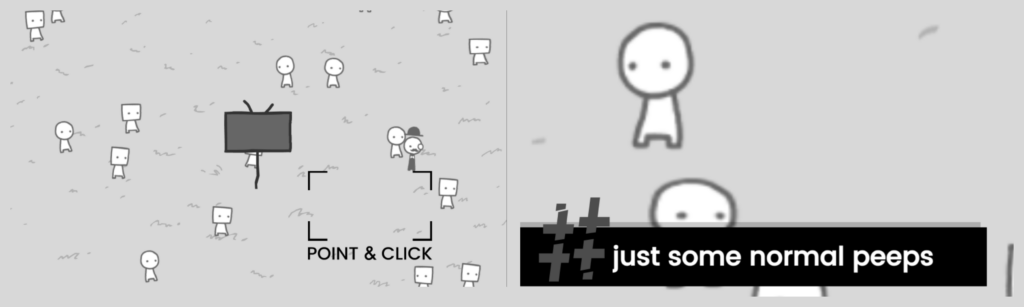
WB reinforces this investment by rewarding discovery. Photographing the same characters results in captions repeating, teaching the player to take photos of unique characters. For example, upon taking a photo of the Guy With A Hat, the player is rewarded with a special positive red caption, a new sound effect, and a new mechanic: the photos you take influence the characters in the world. The player begins to experience the enacted narrative as their choices now have visible consequences, transforming their relationship with the characters from passive to active. The minimalistic art style allows for the characters to clearly express their emotions, so the player can feel the weight of their actions.

The game then subtly introduces the consequences of this influence when a photo causes characters to discard their hats. While the reaction is trivial, the mechanic is not: the player’s agency can negatively impact the characters they’ve begun to care about. However, the positive reinforcement with sound effects, color, and plot advancement subtly encourage complicity to allow game progression.

By the time the beginning of the conflict (the angry square) appears, the game has solidified the enacted narrative and objective: find and take photos of viral content. Encouraged to photograph the square as the square’s shouts stand out against the otherwise quiet soundscape and the sassy captions goad the player, the player willingly complies to advance the game. Upon doing so, a sole character appears slightly concerned, but the core discovery mechanism continues to reinforce the motivation to continue exploring.

While this initial consequence may not cause the player to reconsider, subsequent photos rapidly build tension between the squares and circles. The captions switch from casual to sensationalized, taking relatively innocent interactions out of context. Characters’ reactions become stronger and more widespread. The same characters that were previously cheerfully going about their day now begin to despise each other.
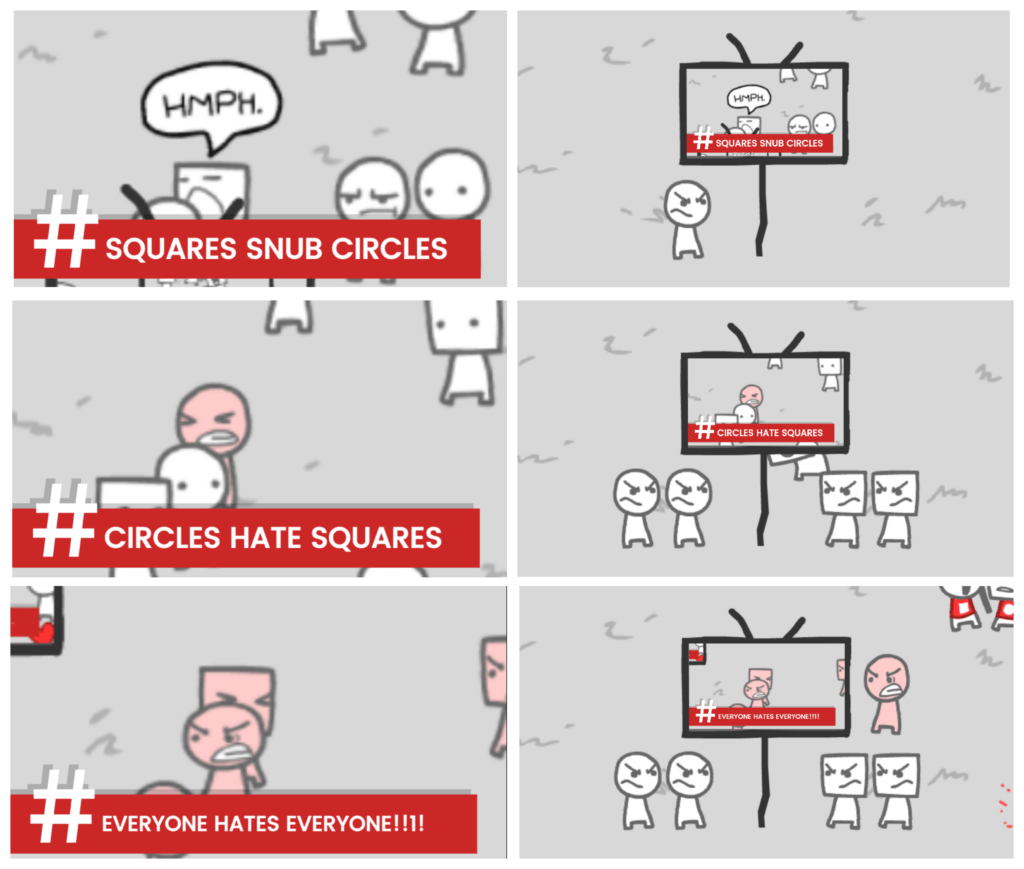
The game turns the mechanic that used to be a form of agency for the player into a form of control. The player has no control over either the captions or the resulting reactions of the people. Furthermore, attempting to fix the issues by photographing positive events only results in mocking captions and nothing changes for the better. At this point in time, the game has removed meaningful autonomy, but still ties the events to the player’s actions, creating a feeling that they are responsible for the subsequent consequences.
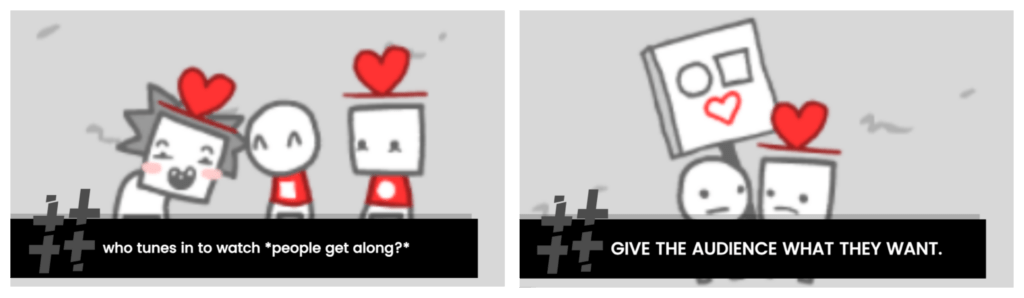
This all continues until the climatic event where the Guy With A Hat slowly walks across the screen, pulls out a realistically rendered gun, and shows the angry square, all while the player must helplessly watch.

WB weaponizes the player’s understanding of the world to subvert both the formal and narrative elements. The weapons’ realism contrasts with the established visual style and the quality of the screen begins to decay. Taking photos, the player’s only means of interacting with the world, only escalates the situation, with every photo captioned “BE SCARED BE ANGRY.” The game has fully removed the player’s autonomy while destroying the characters they built up.
Through its minimalistic core loop, simplistic style that emphasizes emotional legibility, and enacted narrative, WB effectively develops an engaging world through its characters and culture. It successfully subverts the player’s autonomy in a gradual way such that the player becomes invested and doesn’t realize what has happened until it is too late.
Ethics:
WB depicts both discrimination and outright violence, the latter of which appears very suddenly. While some may argue that such depictions may encourage players to repeat the behavior, the game clearly uses them as a deterrent to show the dangers of news cycles. The discrimination is effectively abstracted with squares and circles that emphasize the act of discrimination without targeting a specific group. One critique could be the use of violence in the context of an initially lighthearted game. The game warns at the beginning that it “contains scenes of snobbery, rudeness & mass murder.” While it tonally matches the game, it undercuts the seriousness of mass murder, which could potentially be damaging.