I played King of Tokyo, a tabletop game made by Richard Garfield, meant for people aged 8+ who are a fan of Japanese monsters, casual gaming, and competition. King of Tokyo is a game that is played with 2-6 players (2 minimum and 6 maximum). I played this game with another person from my group, Dom, for a total of 2 players on a physical tabletop. King of Tokyo uses simple mechanics, randomness, and emergent storytelling to form games that have excitement and suspense. However, its reliance on chance and limited worldbuilding weakens the narrative and strategy.
King of Tokyo uses strategic objectives, randomness, and direct player conflict to create fast-paced dynamics that keep players emotionally engaged. King of Tokyo has two winning objectives including gaining 20 victory points or eliminating other monsters. This lead to a dynamic of thinking strategically as I looked at Dom’s points and asked “will I win quicker by getting more points or killing Dom.” It also includes chance cards to produce unpredictability, resources to gain power-ups, and conflict by facilitating player-to-player combat using die rolls to serve as attacks and points. Each round, especially towards the end, I thought “I really hope that I get three attacks so I can win” (Figure 1), leading to suspense. Also, shifts in powers and revenge attacks lead to reactions like “Ha ha. Got you now!” Overall, these dynamics lead to the aesthetic of challenge as they try to balance their own survival with fighting other players. There is also a lot of fellowship as people interact with each other about interesting game play, leading to laughter and emotional responses.

Figure 1: I wanted three attacks but got two to win, leading to frustration/a dramatic emotional moment.
King of Tokyo relies on an emergent narrative to transform unpredictable gameplay moments into dramatic, emotional stories that make players feel personally invested in the game. This was incredibly apparent as I was ahead, thinking “I am going to win this game”, but Dom pulled ahead at the last second due to a powerful upgrade, which got him extra points (Figure 2). Beyond this, other dramatic moments create stories through events like a monster barely surviving with 1 life left and revenge attacks between players. Because of these moments, people become emotionally invested in the outcomes in the game, creating social dynamics and outbursts like “you shouldn’t have done that!” These moments encouraged roleplay and personal attachment as players projected their own personalities into monsters. This leads to aesthetics like fantasy as the symbolic background (like Godzilla) reinforces the feeling of being in a chaotic monster movie.
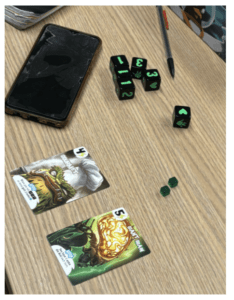
Figure 2: Dom pulled ahead of me and won using a “gain extra two points card if you roll triple 1s”, making me disappointed as I only needed 1 more point to win.
Compared to similar worldbuilding games like King of New York, Smash Up, and Munchkin, King of Tokyo is much easier to learn. In fact, Dom and I learned the game in around ten minutes. Thus, not only does this provide accessibility, but it also allows faster engagement, pacing, and excitement. However, because of its simplicity, it does not allow for meaningful development of the world, characters, and story. As a result, it invokes reactions like “this game is boring” from the player due to redundancy. More of the character and world could be unlocked by adding narrative cards, personal missions, and evolving abilities tied to identity. These missions could unlock more objectives, like roleplay and altering social relationships. The world seems more alive due to players’ choices, deepening narrative, and fantasy.
While randomness helps create excitement and suspense in King of Tokyo, the game relies a lot on chance which can weaken strategic making and make victories feel undeserved. Games depend on randomness, like dice rolls, which can lead to frustration, like “I was so close to defeating the player because they were low on lives but couldn’t because they randomly got extra hearts” (Figure 3). This means that strategies are overturned by luck and players win without much planning. Monsters could be given resources that enact abilities and choose between safer or riskier outcomes. This would make the game tied more to decision making, planning, and strategic resource management. Thus, aesthetics like challenge, mastery, and expression would become stronger because players would feel their choices matter more.
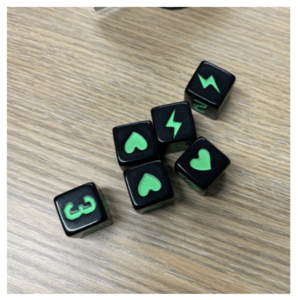
Figure 3: Dom kept getting hearts and energy boosts that were giving him more lives, leading me to rethink my long term strategy.
Throughout this game, bodies are depicted as key to physical strength and destructive capability. This is because monsters are defined through attacks, mutations, and health, showing how the body is associated with strength and linked to violence/competitiveness. The game does not show cultural or social identities and Tokyo does not have an active role in this game. Thus, if I were to change the game, I would emphasize cooperation and environmental responsibility instead of just strength. For example, monsters could gain some points for protecting the streets of Tokyo and helping monsters through alliances. This would reshape the magic circle of bodies by showing how bodies not only invoke strength and power but can also aid empathy and collaboration.
Overall, King of Tokyo creates fast-paced engaging gameplay through simple mechanics and emergent storytelling. Because of its accessibility, people get quickly invested in suspense, competition, and revenge. However, its reliance on randomness limits worldbuilding and narrative creativity. By introducing mechanics, the game could create more roleplay and better representations of power/the body.