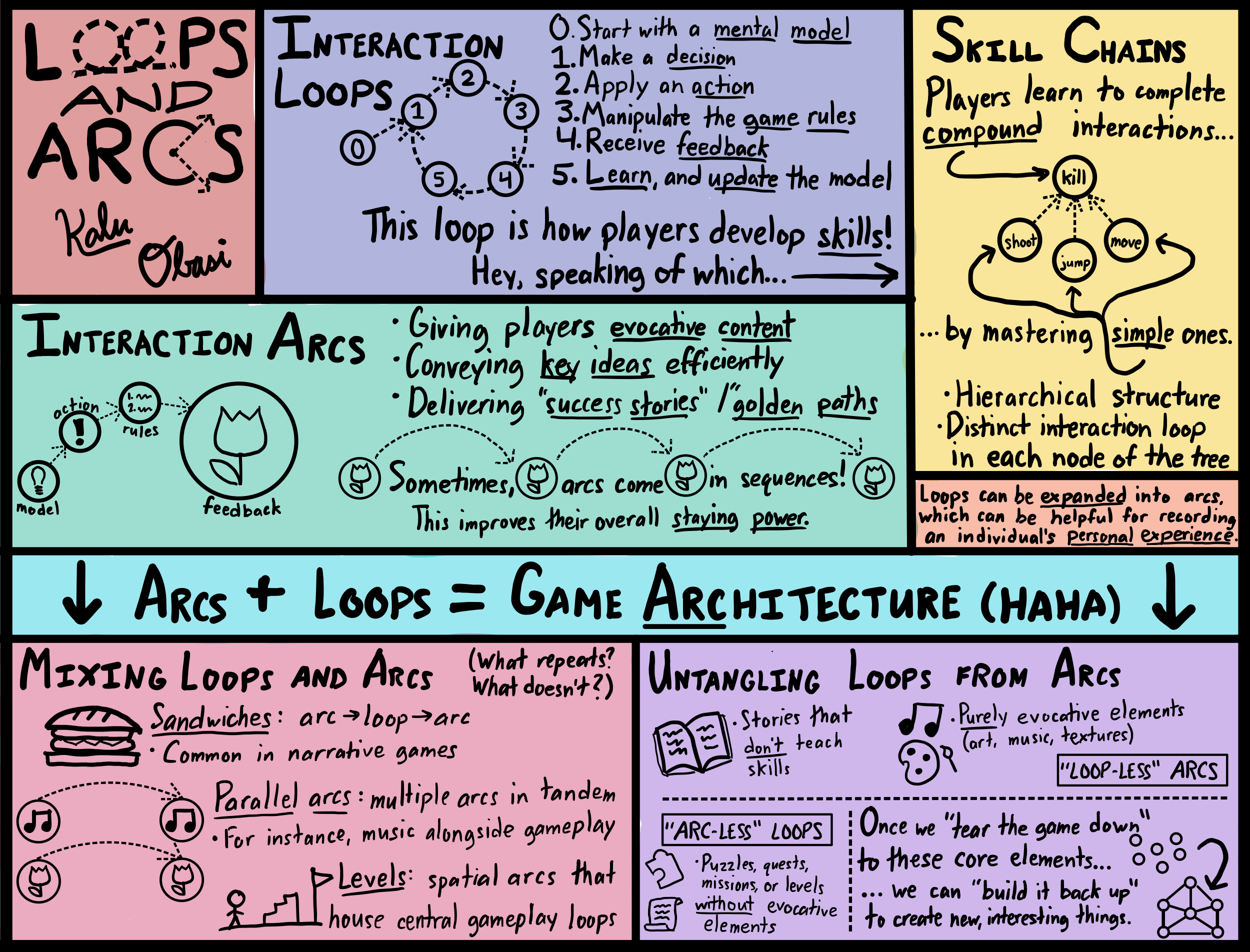
I think the games in the Mega Man series take an interesting, “multi-layered” approach to loops, arcs, and game architecture. I’ll use Mega Man X (released for the Super Nintendo in 1993) specifically to illustrate my point.
Mega Man X has eight core levels, which serve as “micro-arcs” that players must complete before confronting the endgame. Interestingly, though, players can complete these micro-arcs in any order they wish, giving them a great deal of freedom as to how the overarching narrative progresses.

The game’s eight main bosses can be fought in any order. However, Chill Penguin (first row, third column) is commonly thought to be the “easiest,” so new players tend to start there.
Each level in Mega Man X tests the player’s abilities using the same core interaction loop(s). The levels vary wildly in presentation, but the basic mechanics of moving, jumping, and shooting remain the same throughout. By familiarizing themselves with these simple interactions, players learn the skills needed to take on compound challenges, such as defeating the game’s various mini-bosses and bosses.
Ignore the fact that I very nearly lost to the “easiest” boss in the game…
The completion of each micro-arc grants players a new weapon or ability with which to navigate the rest of the game. This, too, is a “macro-arc” of sorts. Players arrive weak and limited but get stronger over time, transforming quite dramatically between the first and final levels. Naturally, new abilities also bring new actions, slightly adjusting the core interaction loop(s) each time.
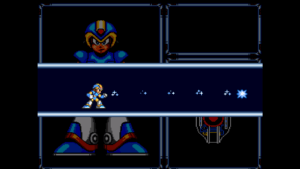
Beating Chill Penguin yields the Shotgun Ice, a new projectile weapon that freezes enemies.
Though Mega Man games usually operate on quite simple elements, there is always some clear intentionality behind the arrangement of those elements.