I played Pokemon Go, an AR mobile game for iOS or Android devices on my Android device. It was published by Niantic, in partnership with Nintendo and The Pokémon Company, in 2016. It is rated E and is designed to be played by players of all ages. The game even includes reminders for people playing with children.

While I believe video games clearly have negative impact, maybe some video game addictions aren’t actually too bad. Some things are bad in any quantity. Everything is bad in too high of quantities. But persuasive technologies that help users to form habits (addictions) can probably be judged by their fruits. Pokemon Go incentivizes daily walking and time outdoors with daily and monthly goals (1 km/42 km). It even exposes you to interesting elements of your local community.
The same techniques that are used to create addiction in many games, daily/weekly tasks, streaks, and cooldown timers, are present in Pokemon Go. However, the impact of these mechanics is substantively different from other games that incentivize solo staring at a screen inside. When I see notifications that my family is playing Balatro, I internally worry about them and hope that they are not missing out on greater fulfillment, but if I saw notifications that they were playing Pokemon Go, I wouldn’t have the same reaction. The mechanics are similar to many live service games but, the dynamics of daily walking and returning to local places are dramatically different because of conscious choices by the designers. These dynamics produce aesthetics of discovery, collection, submission, and even care for one’s physical environment.
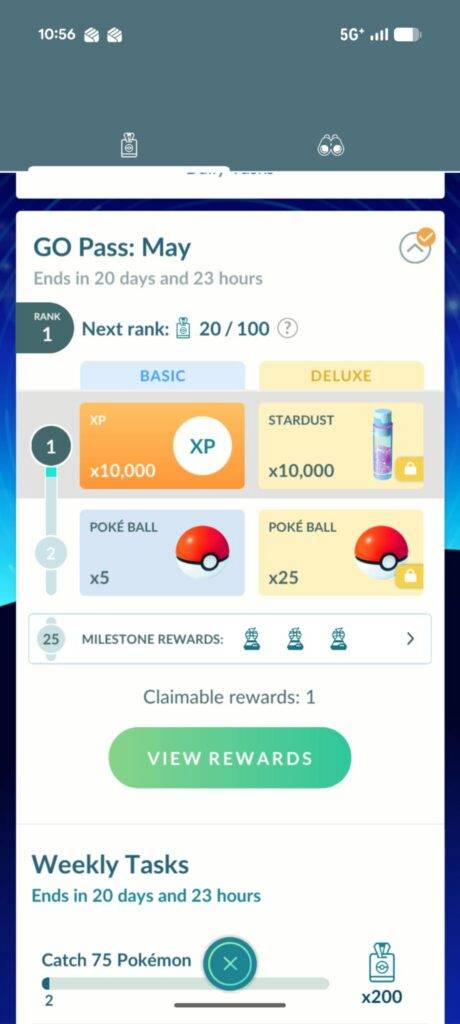


Pokemon Go shows player empathy as it is designed to thoughtfully protect the players. The app regularly checks on user safety including confirming that users are not playing and driving, children are being supervised, and even that I was okay given the local heat advisory. While Pokemon Go has opportunities to spend money, the design feels different from others. In many games, monetary purchases are at the top of the store where users must scroll past them. When I went looking for opportunities for monetary purchases for sake of this critique, the fact that I had to scroll to the bottom of menus after clicking several times, illustrates designers’ decision to have lower pressure to purchase in the app.


Similar to addictive games, Pokemon Go does include significant elements of chance. Everything from the prizes you gather when visiting a location, to the Pokemon that populate the world and your capacity to catch them is affected by some element of chance. However, unlike many games of chance where a disappointing random interaction incentivizes people to pay to play, the chance in this scenario does not have a clear path to payment. Even though some rewards are more valuable than others, there is not a shortage of any of them. Even though Pokemon might spawn into the world slower than you would like or escape your Pokeball, you can’t pay for more Pokemon.

I lost patience with the randomness of capturing Pokemon. The system does not reveal details about Pokemon capture. I still lack a good mental model for the interaction. The player can give Pokemon berries to increase the chance a Pokemon is captured but the player does not know by how much. The player’s throws are rated and I assume it is harder to escape an excellent throw, but that is never confirmed. Despite the repeated interaction loop, the mechanics are sufficiently hidden. But the emotions it elicited were quite different from the average slot machine.

In agreement with Sid Meier’s conclusion that “Math is not the problem”, I expected that an excellent throw at a Pokemon who had eaten berries would always succeed but it did not. I felt compelled to keep trying but there is no real cost for this behavior.

One of the more surprising elements Pokemon Go includes that is similar to addictive games was sensory fun. It includes coin spinning and ball throwing that reminds me of dice throwing in craps or spinning a wheel in roulette. It also includes elements of submissive fun are players grind to “Catch Them All” with hundreds of Pokemon to catch. The sense of accomplishment with the constant stream pop up achievements is also addictive. Pokémon Go works partly because it is a good toy before it is a good game. Throwing Pokeballs and watching Pokemon appear in familiar spaces are pleasurable even before the player completes the larger goals of leveling up or filling the Pokedex.

When chance is used for balance that creates fun then it is clearly permissible. It would be an odd position to claim that any game that uses dice or cards is unethical. However, games that manipulate players’ perception of chance through manipulated reels or perceived near misses to extract money are predatory and unethical. The interesting subquestion to me would be is it morally permissible to use chance to manipulate people’s actions if those actions are a moral good. Just because exercise is good for us doesn’t mean that people should force you to exercise. Persuasive technologies have the potential to do significant social good but it is important that the ends don’t justify the removal of people’s agency.
Pokemon Go’s ethical status changes depending on whether we evaluate its role, look and feel, or implementation. Its role in the player’s life may be beneficial. It encourages walking, outdoor time, and local exploration. Its look and feel is playful, cute, and low-pressure. However, its implementation includes behavioral technologies such as streaks, cooldowns, notifications, random rewards, and monetization pathways. The ethical question is whether the positive role is enough to justify the persuasive implementation.