
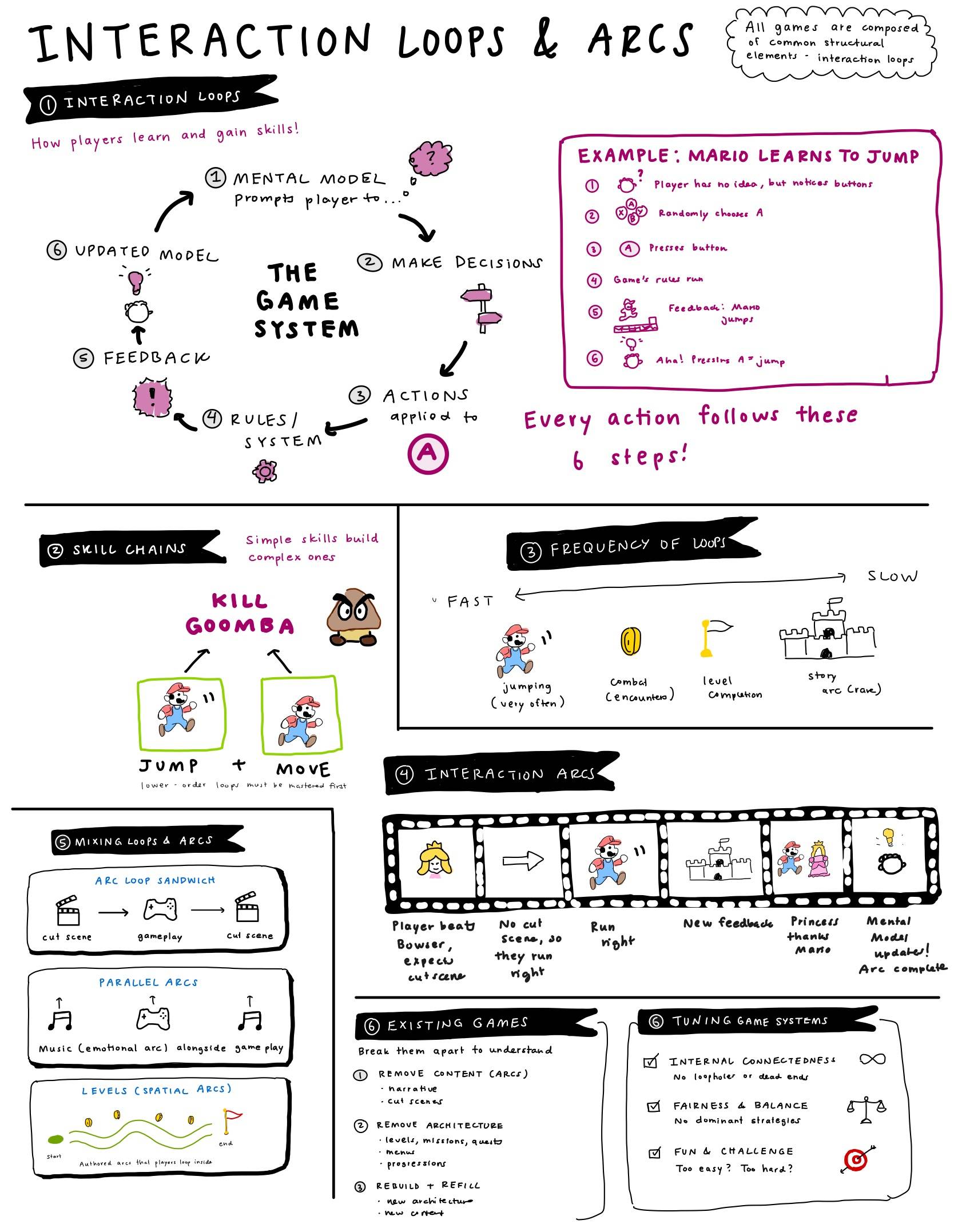
A game I enjoy is League of Legends. It is a very complex game built around many repeating interaction loops that gradually develop skill over many matches. At the smallest scale, players cycle through: observe, deciding, acting, getting feedback, and adjusting. Something simple like landing a skillshot follows this pattern, with each attempt refining timing, spacing, and prediction through repetition.These loops build into more complex skills. Basics like movement, last hitting, and cooldown tracking combine and players learn higher level play like wave control, jungle tracking, and objective set ups. These advanced skills can only be learned after lower level loops are learned.
The game also operates across multiple time scales: seconds (dodging, trading, using abilities), minutes (laning phase, fights, taking objectives), and full games/seasons (ranked progression, mastery, etc.). On top of this loop structure, LoL layers parallel arcs through visuals, audio, and progression systems. Fights over objectives, ranked climbs, and team fights feel dramatic because of music, cinematics, announcers, and visual intensity.
Overall, League’s design is a system of nested gameplay loops supported by long-term progression. Its replayability comes from the fact that these systems continuously produce new situations to learn and improve from.