
Undertale by Toby Fox is, as he describes it, “the RPG game where you don’t have to destroy anyone”. It’s suitable for players ages 10+, and is available on all computer operating systems, as well as PS4, Xbox One, Nintendo Switch, and their successor consoles.
Undertale invites the player to care about the world it creates by skillfully presenting each of the layers of worldbuilding (as described by Pereira) in the proper amounts from the very beginning of the game, and building them up in tandem with each other throughout it.
When Undertale starts up, the player sees a brief intro cutscene that establishes the setting and society of the game world. Where many games might bog you down in hours of expository dialog and text box reading, Undertale‘s intro is only a minute and a half, and tells you everything you need to know. Humans and monsters lived in peace. There was a war. Humans won. The monsters live underground. A human (obviously you) fell down a big hole, and now you’re in the land of the monsters. Then the game begins, because you already know everything you need to know to understand the rest of the game. Setting: Underground. Society: The monsters live down here. Boom.
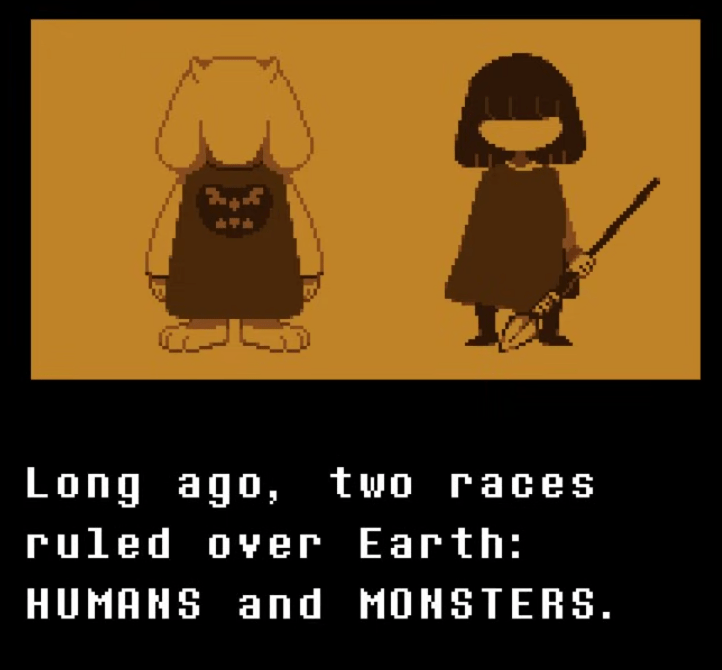
This is all you need to know about the story of Undertale.
We immediately meet our main character (it’s a little complicated, but let’s call them “Frisk”). Because Frisk is only implied to talk (we don’t see text of what they say, but do read other characters’ reactions to it), they are set up perfectly to be a lens through which the player views the world. There is minimal description of their personality beyond what the player ascribes; therefore, there is nothing to get in the way of the player experiencing the world through them. As the player plays the game, the main character develops naturally; the character’s growth is a reflection of the player’s growth.
The supporting cast is partially why Undertale became so massively successful. It’s made up of unique, well-written, and incredibly memorable characters. The surroundings of Undertale are equally unique, well-developed, and memorable. Cleverly, new members of the supporting cast are presented almost in tandem with new areas of the world, ensuring that the player is never overwhelmed with too many new things at once, and is instead given time to explore the character and environment the game is currently presenting to them. By letting the player interact with anything in the environment to learn more about it (or encounter a good joke), Undertale lets them experience the world at their own pace, incrementally and to whatever extent they like.
The characters and surroundings are also matched perfectly to the difficulty of the game, which increases gradually to ensure that the player can’t just breeze past any part of the experience. You meet nurturing Toriel in the linear and tutorial-ish Ruins, the charming skeleton brothers in the charming Snowdin, the mysterious Undyne in the murky waterfall, the difficulty ramps up as you enter the puzzle-laden Hotland and meet Alphys and Muffet (and you begin to understand that the characters, too, are more complex than you might have assumed), before entering the CORE and battling the menacing Mettaton, and finally entering New Home, which introduces you to the ASGORE you’ve been hearing so much about this whole time, who (along with the environment) is meant to remind you of the beginning of the game.
Undertale puts the player on a carefully designed path which is quite linear, but packed with memorable details, characters, and settings. By developing all of these elements of the world together as the player progresses, the game is somehow never boring.

Despite the obvious linearity and clear divisions, the world feels fluid and expansive.
ETHICS:
Undertale exists largely in the realm of fantasy, and is largely abstracted from any realistic depictions of what we might call “touchy subjects” (the body, race, violence, politics, etc). However, the depictions of the game’s characters still serve to break down harmful real-world tropes. The characters of Undertale, other than the player character, are known as monsters, though this doesn’t mean they are “monstrous”. The game takes great pains to demonstrate their friendliness. The opening cutscene tells you that these monsters live in relative peace in their lands underground after a war with humans, and the first monster you interact with, Toriel, is basically a loving mom who bakes you pies and tries to keep you safe. Right out of the gate, Undertale subverts the typical trope of associating something’s appearance or species with its behaviors, and this is something that is reinforced constantly throughout the game. Consider the depiction of monsters in Minecraft; they are your stereotypical evil creatures like zombies, skeletons, and spiders. They’re hostile, brainless enemies that only want to kill you, and can only be dealt with via your sword or bow. In Undertale, as the tagline suggests, you don’t have to destroy anyone (and for most players, the game is far more enjoyable if you don’t). In Undertale, monsters are (to varying degrees), intelligent and sentient. Because of this intelligence, they can be talked with and shown mercy. They include molds, spiders, airplanes, robots, big eyeballs, and even carrots; the variety of monsters, each with its own unique dialog, behaviors, and attack patterns, highlights their individuality and personhood…or, monsterhood. Undertale serves to teach the player that the typical “monster –> bad –> kill –> level up” mentality taught by so many other games is not a necessary way to play (or design) a game, and that it’s far more interesting if you can let the player proceed in other ways.