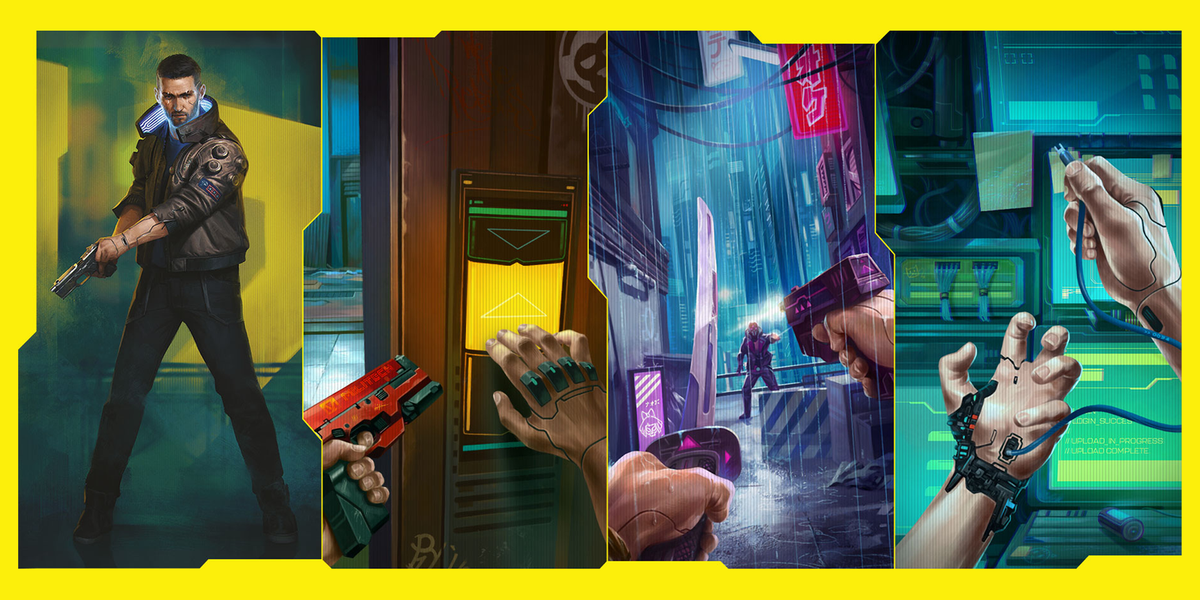
Cyberpunk 2077 is an open-world RPG developed by CD Projekt Red that targets mature players who enjoy RPGs, combat, and most of all, exploration! The world is set in the futuristic Night City, following the main character, V, who navigates a society shaped by corporations, cybernetic modification, and gang violence. Though Night City is far from perfect, I found myself charmed by the world because it felt largely immersive and real. Cyberpunk 2077 invites players to care about its world by enriching Night City’s environment and characters through environmental storytelling, immersive mechanics, and the constant, imperfect tension between its people and technological modification.
My first impression of the game is that I start in the world knowing absolutely nothing, from who I am to the people I’m dealing with. Instead of learning about the world outside the player’s perspective, the game focuses on using narrative and formal elements together so that the player learns through physical and emotional interactions with the world. This is an ecological approach to worldbuilding, where the game builds its world outward from the perspective of the characters themselves. Very quickly, I was thrust into the mechanics of cybernetic upgrades, hacking systems, and dialogue choices. This created not only a steep learning curve that showed the reality of adapting to Night City, but also created dynamics of dependency and risk, which produced aesthetics of anxiety and empowerment.
One strong aspect of this approach to worldbuilding is that V became a filter for my experience of the city. Instead of learning from the setting alone, I engaged with everything around me through the emotions and perspective of my character. Despite the million choices in this game, players have a predetermined sliver of the story meant for them. V’s character gifts players with a direction on how they should interpret the stories. Thus, even when players may feel overwhelmed by combat or lonely in quieter scenes, their perception of the world has been endowed with a layer of purpose, objectives, and even loyalty to past connections.
As I was out and about, I found that every location in Night City communicated something about the society the players live in. There was a stark contrast between the bright neon advertisements covering buildings, while poorer districts had broken infrastructure and unsafe cybernetic clinics. In some ways, it evoked parallels to the real world as an evocative environment, making everything feel real at stake.
Another form of worldbuilding was the technology right in my character’s body. Here, my character V is using a quickhack scanner on enemies in a dark neon alleyway.
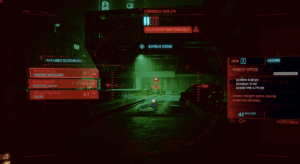
The hacking interface overlays directly onto my field of view while scanning enemies in the environment. The key thing is that the UI isn’t separated from gameplay when it’s integrated into the overall narrative. In this case, I am seeing through cybernetic eyes because of the advanced technology available in the city, so each mechanic is justified by the world. The technology on V’s body was the lens through which I experienced the city, and it became clear with small details like the RAM counter and target scanning system that the only path to survival was augmentation and information control.
One of my favorite aspects of this game is what I learn through the supporting characters. In class, we learned that they either help establish the status quo of a world or disrupt it. Characters like Viktor and Jackie (shoutout my goats) make Night City feel emotionally grounded because they show what ordinary survival looks like inside this dystopian society. Viktor’s clinic is a great example of an intimate environment that contrasts with the massive scale of the city. Despite the corporations and violence, the game places players into smaller personal spaces to make the world feel human.
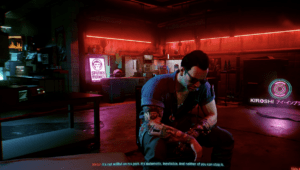
Viktor’s clinic is cluttered, worn down, and personal. These spaces are relaxed parts of the story arc where I can calm down and observe the details of the game. The red neon lighting and scattered equipment make cybernetic modification feel everyday. In this particular scene, I’m getting a wisdom drop on class and survival, which opens an emotional reality of Night City. A lot of people are treated like products in the world, but Viktor treats V with humanity, and he also teaches V how healthcare has become tied completely to status and money.
Ethical questions surrounding the body are actually one of the most interesting parts of the game, since Cyberpunk 2077 presents a world where the human body has become commercialized. Wealthier characters often have advanced cybernetics, while poorer characters rely on dangerous modifications. This draws parallels to the real world, especially in healthcare and health infrastructure, where wealthy areas have cleaner hospitals with more well-trained staff that can make a life-or-death difference. We also see ethical concerns with developing technologies like Neuralink that can potentially enhance human knowledge and capabilities beyond our biological bodies, yet the first to be able to afford the neural chip would be the wealthy. It also brings to question what makes us human, are we just our consciousness?
The game has a heavy theme on the fear of losing individuality within systems of technology and corporate control. V’s conflicts are not only person versus society through fighting corporate systems, but also person versus self as they struggle with identity and survival. One scene that emphasized this tension for me involved Jackie.

Despite all the futuristic technology surrounding him, Jackie is still vulnerable and human in this scene. There’s a contrast between his body and the cold, mechanical environment. Technology may change the body, but human emotion and mortality still remain. His relationship with V makes the player emotionally care about Night City beyond just its visuals or mechanics, but also the individual characters who walk between morally gray lines to survive.
If I were to modify the game’s mechanics, I would create a stronger psychological system tied to cybernetic augmentation. Perhaps, too much body modification affects dialogue or perception over time, rather than only providing combat advantages. This would make players feel the emotional consequences of replacing too much of their bodies.
Cyberpunk 2077 is absolutely a thrill to play, and I think it goes above and beyond to create a real and complex society that holds deep themes. I can’t wait to keep experiencing the world!