

For this week’s Critical Play, I played Storyteller, a single-player storytelling puzzle game published by Netflix and available through the mobile Netflix app. The game is divided into a number of themed levels, each of which asks the player to construct a narrative out of various characters and settings. Given this and the game’s occasionally violent content, Storyteller primarily appeals to players who are teenagers or older and who are familiar with popular storytelling tropes. Through its main mechanics, which include rearranging characters and settings through dragging and dropping, Storyteller allows players to experience the fun of expression and discovery as they recombine evocative narrative elements in creative ways, although this experience is sometimes hindered by unclear level designs.
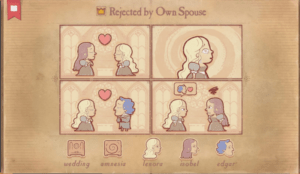
For each puzzle in Storyteller, the player is given a short description of a narrative, a series of comic-style panels, and a set of characters and settings which must be arranged into a sequence that enacts the narrative. Part of what made this mechanic enjoyable was that even though each puzzle had one or more “right answers,” it still felt as if the player had some degree of autonomy when designing each story, which, by the SDT framework discussed in lecture, is an important factor in the game’s enjoyability. Consider the puzzle in the first image, in which the player is asked to create a story in which amnesia causes a character to unknowingly reject their own spouse. While the “correct” arc of the story is fixed, the rearranging mechanic gives the player the opportunity to remix the characters and settings, exploring how different permutations play out and creating fun as the player discovers how the game interprets different sequences of events.
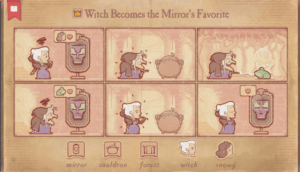
The game also uses environmental storytelling cleverly, using settings to evoke story beats and provide useful information to the player. Consider the second image, in which a story about a witch is told partially in a dark forest, which feels evocative not only because of the setting itself, but because of its associations with familiar stories like Snow White. The game’s environments and embedded details also play an important role in the game’s architecture, helping to guide the player toward a solution. A cauldron, for instance, is there not only to characterize the witch, but also to suggest that the witch must use the cauldron to concoct something before, say, turning somebody into a frog. These embedded details are clever because they leverage players’ existing cultural knowledge (say, of witches) to help them contextualize the different story elements and understand how they fit together.
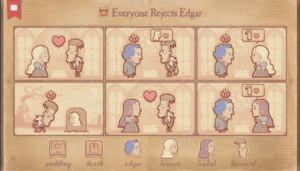
At the same time, the quality of the puzzles does vary. In many cases, I experienced a flash of joyous realization, what this week’s reading called a “V8 Moment,” after finding the solution. Discovering how each story worked was one of the game’s chief pleasures, and a significant portion of the time, the designers are able to balance challenge and solvability well. However, some puzzles were rather long and their elements ambiguous in ways that made it tempting to “brute force” a solution. Consider the third image, which shows a puzzle entitled “Everyone Rejects Edgar” and which involves a long series of marriages, rejections, and deaths. While the final solution makes logical sense, the large number of panels and small number of environments made the narrative hard to grasp; this was not helped by the fact that some settings, like the chapel, could contain either weddings or rejections depending on the prior panels. Eventually, I had to brute force a solution by trying different permutations of people and events until the game registered a solution. I was reminded of traditional jigsaw puzzles, where the proper position of each piece is near-impossible to discern at a glance, and where the player is often left to pick out pieces at random and try them until something clicks. The game developers could address this by adding more specificity to the prompt, changing it to something like “Everyone Rejects Edgar, even After Remarriage” or by making more settings and actions available.
For the most part, Storyteller was an inventive puzzle game whose drag-and-drop mechanics created an experience that was expressive, surprising, and rewarding and that used its architecture in clever, multifaceted ways.
One ethical issue that occurred to me as I was playing was the accessibility of the game, particularly regarding its reliance on existing cultural narratives. While Netflix is a global property with content made by and for people all over the world, this game relies primarily on Western tropes and archetypes, such as witches, the works of Shakespeare, and classic fairy tales. To a Western, English-speaking audience, these elements are far from obscure and come from a narrative tradition that is practically second-nature, but this is not necessarily the case for everyone. Different cultures have different narrative traditions with their own tropes and templates, and stories that one person considers basic and archetypal might not be as obvious to somebody who grew up in a different cultural environment, which could make the game’s puzzles less accessible or enjoyable depending on the player’s background.