


It was in my sophomore year I took TAPS 103: Introduction to Improvisation. In that class, more than improv, we learned about mindset — how to pay attention, show up, and find joy in what’s present. Through this class I found my wandering friends — we’ll call them “David” and “Jacob.” The three of us spent nights roaming campus: catching frogs by the lake and watching moonrises on Kite Hill. When we felt more adventurous, we drove west into the hills, finding ponds, rock walls, and bird nests. The point was never to find something extraordinary, but to find joy in what was there. It was beautiful.
When David and Jacob graduated, those nights disappeared — not because I lost the desire to wander, but because I lost the conditions that made it feel possible. They carried away something less visible: a sense of safety, the ability to move through the world as a “looker,” to observe rather than remain alert.
Oddly enough, A Short Hike returned some of that feeling. I argue that the game functions as a feminist piece by offering a fantasy of wandering without risk, while simultaneously presenting that freedom as neutral and universal. By deemphasizing its protagonist’s gender, the game exposes our gendered assumptions around who gets to wander.
At the beginning of the game, the player — a little bird named “Claire” — is dropped off for the summer and encouraged to explore, especially to reach Hawk Peak for cell service. However, in reality, the game is not so goal-oriented. Instead, Claire wanders and roams, chatting with strangers along the way. While these strangers present small tasks, none are urgent and all are optional. Even these side-quests — such as collecting 15 shells or learning to fish — all encourage further exploration. In this world, curiosity is safe, encouraged even. Claire can go anywhere — no matter how far or secluded. Claire can meet anyone. Claire can wander, linger, and look.
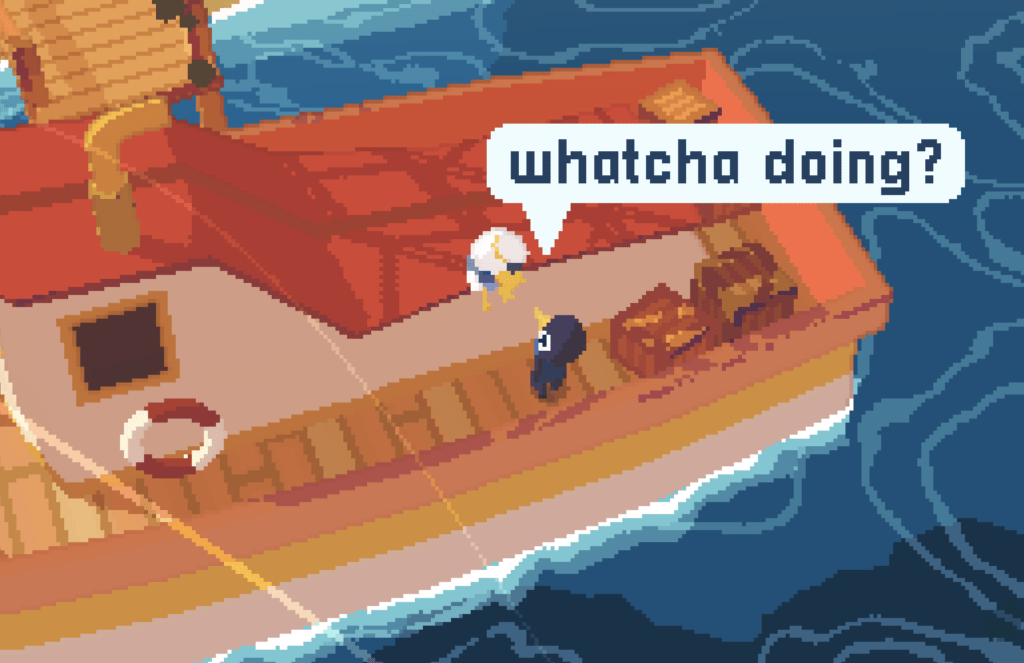

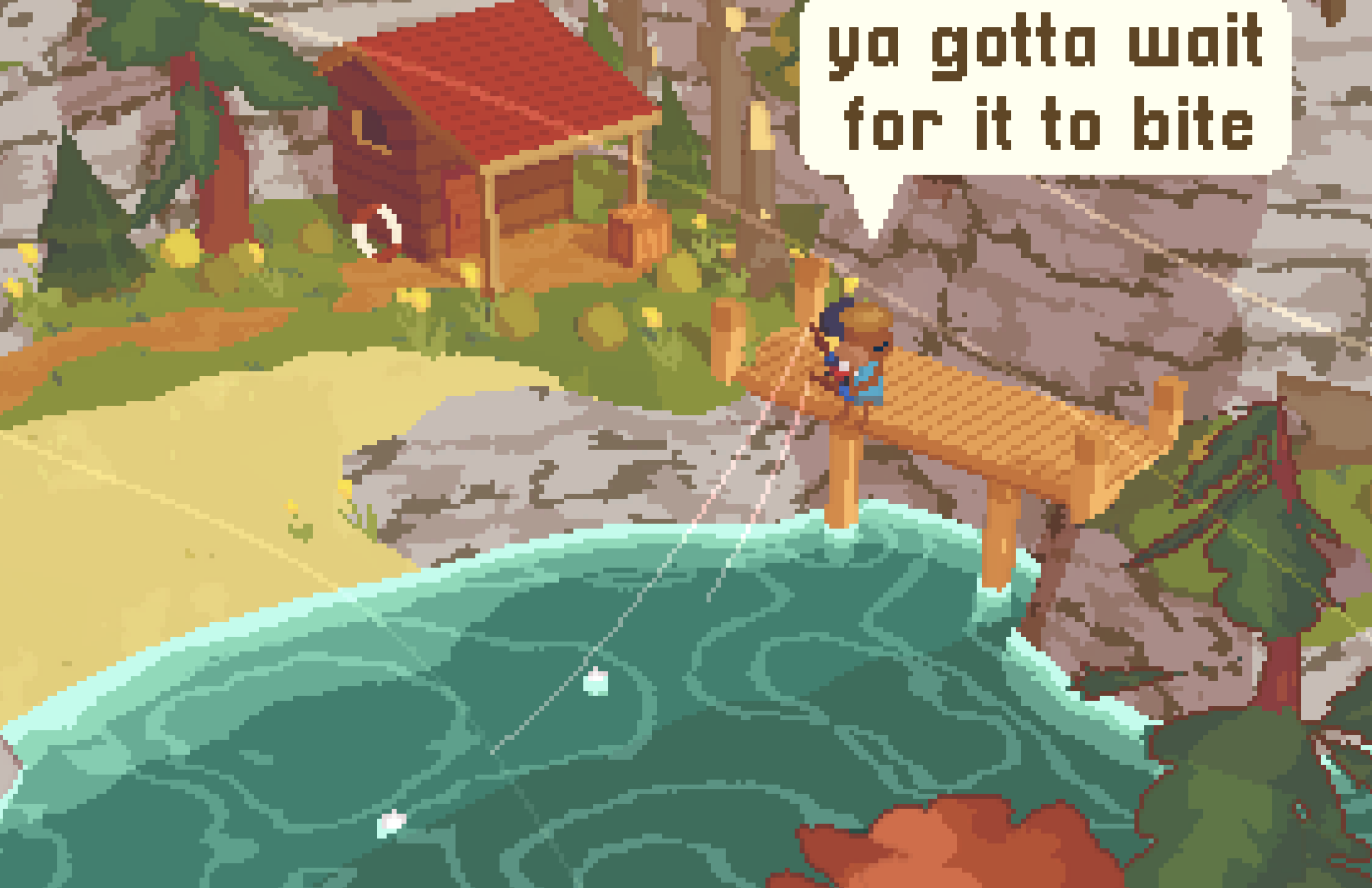
As mundane as it sounds, this is my fantasy. Early on, Claire learns to fish from a stranger by the water, and, in the game, this interaction is gentle, sweet. However, it is difficult to imagine myself outside the game, alone, sitting beside an unfamiliar man by the water. Similarly, the game invites players to wander off-trail, explore dark corners and tunnels, climb as high as they like without consequence.
As author Melissa Kagan explains in “Wandering Games,” historically, there have been two types of wanderers: “the Anglo-Germanic wanderer and the French flâneur,” (https://direct.mit.edu/books/oa-monograph/5445/Wandering-Games). The former is “associated with the early nineteenth-century rural adventuring of young, artistic, upper-class men who are seeking something ineffable from the natural world. The flâneur, alternately, is associated with urban cosmopolitanism and the detached, aimless observation of modern life,” (https://direct.mit.edu/books/oa-monograph/5445/Wandering-Games). In both cases, the wanderer is pictured as a (white) man. Women can’t “possess the artistic temperament or subversive marginality of the idling flâneur; women are there to be looked at, not to look themselves […] Women were not granted the scopic agency to be considered flâneurs themselves because, when they tried, they were aggressively observed by men already in that space,” (https://direct.mit.edu/books/oa-monograph/5445/Wandering-Games).

As Kagan describes so beautifully, women are not allowed to be wanderers — they cannot disappear, they cannot live in the world without being attached to their gender. A wandering woman is “inexorably enmeshed in the network of consumption: she must be either buying (shopping) or selling (her body) — as a prostitute […] or eligible bride if upper class,” (https://direct.mit.edu/books/oa-monograph/5445/Wandering-Games).
However, to me, what makes A Short Hike a fantasy is not just the fact it has a female wanderer — but how it doesn’t flaunt it. In most games, one doesn’t have to wonder if a character is female — designers make it exceedingly obvious. Female characters — even animals — are given eyelashes, voluptuous hair, curves, etc. Their femininity is loudly announced and, ideally, sexy. However, A Short Hike doesn’t code Claire in any obvious way. Thus, for much of the game, I just assumed her to be male. While I did go back and realize she was initially introduced as “Claire” — if other players are anything like me, they forgot that very early on.
Thus, when her name is mentioned again toward the end of the game, I was caught off guard. Usually, players project themselves onto the protagonist, yet I defaulted to male. If wanderers are historically male, then even in a stereotypically “feminine” game, I still imagine them that way. Even as a wanderer myself, I perpetuated this bias.
Of course, that bias doesn’t exist in isolation. It is shaped by real-world structures (as explained earlier) as well as by how women are typically written into games. Oftentimes, strong female characters are filtered through that familiar “empowerment” arcs that signal their exceptionality — that show us “girls can do it too.” However, frankly, and maybe this is a hot-take, but I’m tired of the “girl-boss” arc, the insistence that women can also be strong, loud, or defiant. Of course they can, but I’m sick of seeing female characters whose primary function is to be a woman doing something surprising. Women have more stories to offer.
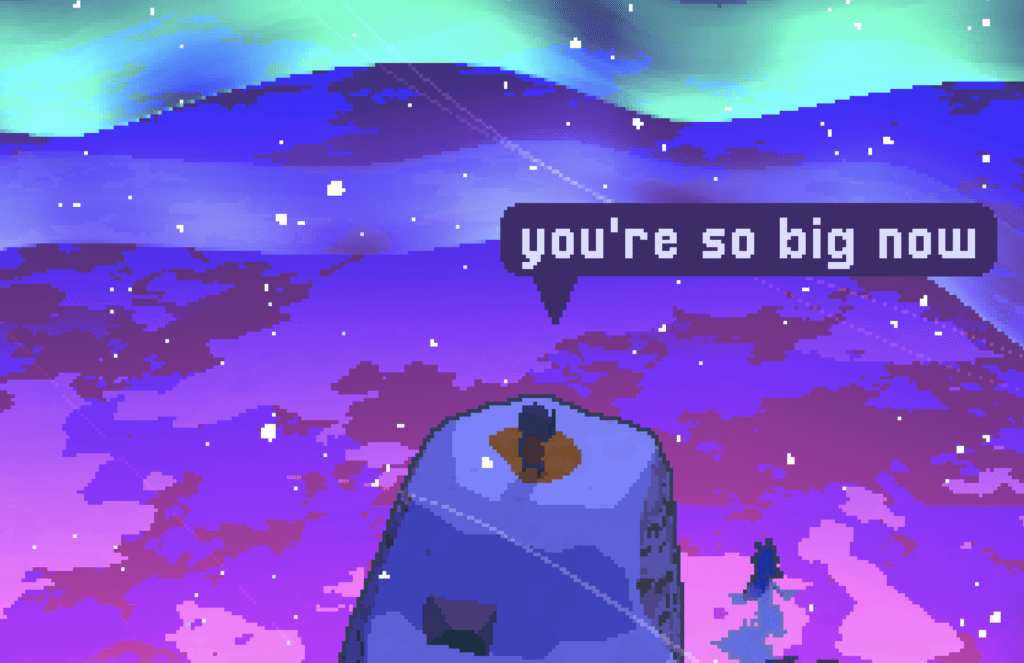

Claire is presented as strong and capable. Not a strong and capable woman. Just strong and capable.
Claire is not framed as remarkable for being able to wander alone. She simply does. In doing so, A Short Hike acts as a feminist work. The game does not argue that women should have access to this kind of freedom — it behaves as though they already do.
