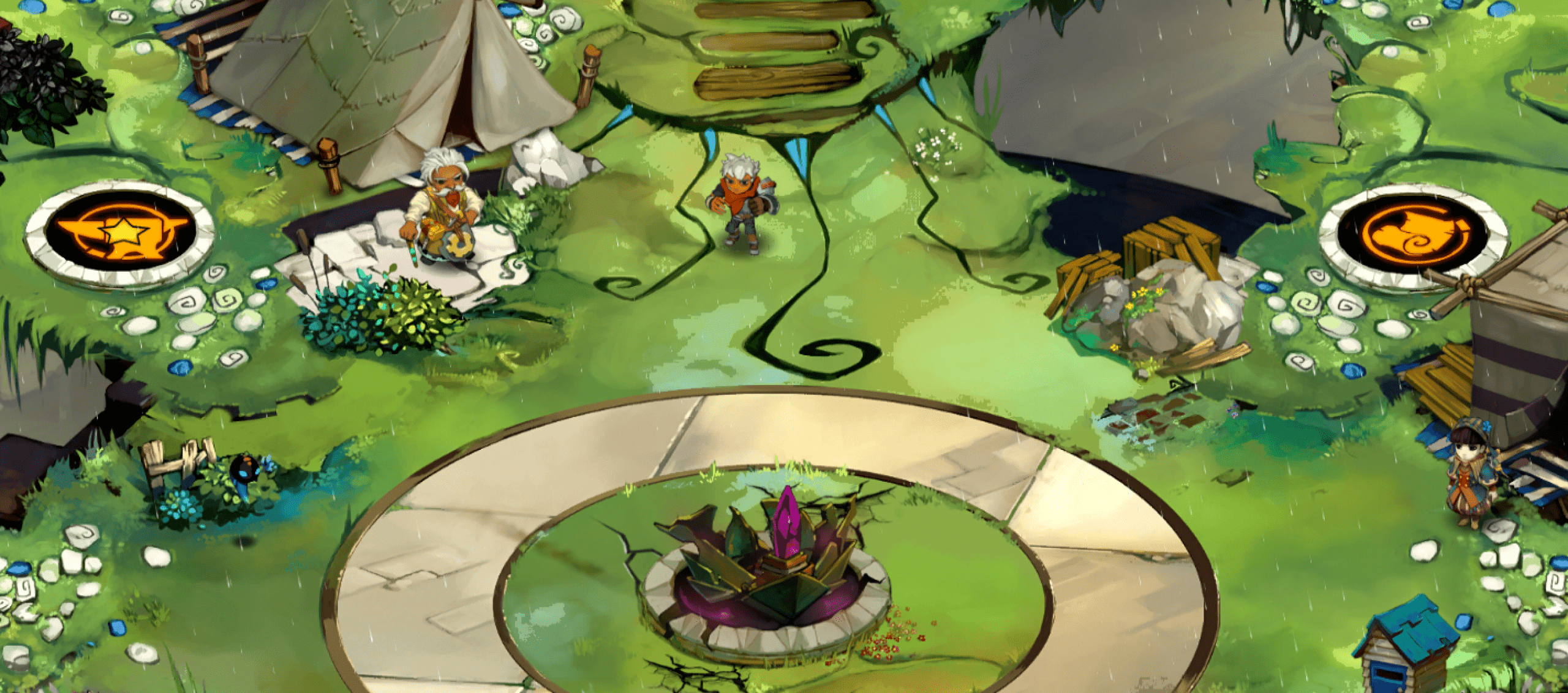
Going into Bastion, I expected to feel emotionally pulled into restoring the world. The narrator, Rucks, clearly tries to make that happen. From the beginning, his calm, almost comforting tone builds a sense of nostalgia for Caelondia, this lost world before the Calamity. He basically frames it as something worth saving, something tragic that shouldn’t have happened. But for me, that pull never fully sat right. If anything, I felt more detached the longer I played.
Clarkson argues that Bastion prioritizes scenario over story, meaning the worldbuilding is far more developed than the characters themselves. That felt completely true while playing. I learned so much about Caelondia, its structures, its conflicts, even its downfall, but I never really felt connected to the people in it. I never heard Zia or Zulf directly, because I only got Rucks’ interpretation of them and their thoughts. It began to foster this distance that made everything feel filtered, like I wasn’t being asked to understand the world, but to accept his version of it which didn’t feel right.
There were moments where Rucks would describe the Ura or justify the violence in ways that felt off, like he was trying to convince both me

and himself. Mitchell describes this kind of figure as an “ascetic priest,” someone who reframes reality to make suffering and destruction feel meaningful. This interpretation began to make sense as Rucks constantly pushed the idea that everything can be undone, that the Bastion will “fix everything,” and that what we’re doing, including the killing, is somehow justified because it’ll be reversed. But this logic felt hypocritical, especially when I was actively struggling through the game.
I died a lot, and instead of becoming more invested in restoring the world, I honestly just wanted it to end. When Zulf destroys the Bastion and you’re forced to go collect the shards again, it didn’t feel like a meaningful narrative twist, but more than anything it felt frustrating. And that frustration broke whatever emotional attachment I was supposed to have. While Rucks is talking about memory, loss, and rebuilding, I’m just trying to get through the level without dying again.
Mitchell argues that Bastion ultimately teaches players to let go of control, that it’s an ethical experience about accepting reality. He draws on Nietzsche’s idea of the eternal return, asking whether we could accept our lives exactly as they are: “Do you desire this once more and innumerable times more?” Basically, choosing to restore the world is actually a form of denial, while choosing to move forward is an affirmation of our reality. I actually agree with that reading, but only partially.
Because for me, I didn’t arrive at acceptance through some deep philosophical realization, even though it did play a role. I arrived at it because I was already detached. I wasn’t emotionally invested enough to want to restore anything. So when Mitchell says that “Evacuation… grants them freedom by depriving them of control”, I get the idea, but my experience was less about relinquishing control and more about never feeling like I had it in the first place.
That’s where I think Clarkson and Mitchell together create a really interesting tension. Clarkson would argue that the game’s scenario is so immersive that it pushes players toward nostalgia. Mitchell would argue that the game uses that nostalgia to teach you to let go. But what I experienced is that this only works if the player is actually pulled in by the world. If you’re not, whether because of skill level, frustration, or even your own perspectives on things like colonization and violence, the message doesn’t hit the same.
In fact, Caelondia itself felt hard to sympathize with. The game hints at its role in colonization and conflict, and Rucks’ attempts to frame it as something worth restoring made me more skeptical. When he talks about the railroad or the expansion, and I’m actively struggling through those sections, it almost feels ironic. Like, this is the world you want me to bring back? At some point, it just became easier to accept that the world is broken and move on.
So I’d argue that Bastion both succeeds and fails at the same time. Its design does align with Mitchell’s claim that the game teaches players to accept reality rather than control it. But that lesson isn’t universal. For players who are deeply immersed and skilled, the emotional journey from nostalgia to acceptance might feel powerful. For players like me, who struggled mechanically and felt distanced from the world, acceptance comes from detachment, not transformation.
This contrast in experiences is so important, because it shows that Bastion’s message isn’t just shaped by its design, but it’s shaped by the player. The same game can guide one person toward a philosophical realization, while another simply moves on because they were never convinced in the first place.
In that sense, the game doesn’t just challenge control within its world. It reveals something about games more broadly, which we’ve continuously explored, that meaning isn’t fixed. It really depends on who’s playing, how they’re playing, and what they bring with them.
Sometimes letting go isn’t a lesson you learn. It’s just something we were already ready to do.