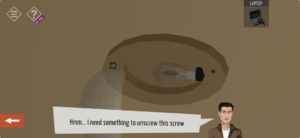
The game I played was Tiny Room Stories: Town Mystery, created by Kiary Games and is a one player game. It is available on mobile/iOS/Android and Steam. The target audience is players who enjoy escape rooms, mystery games, point-and-click puzzles, and environmental storytelling. In the game, the player is a private detective who travels to the empty town of Redcliff after receiving a message from his father. The player searches rooms, collects objects, unlocks doors, reads clues, and slowly pieces together why the town has been abandoned. The mystery is not just told through dialogue or cutscenes. It is built into the way the player moves through space.
One idea from the “playing like a game designer” video is that a designer should not simply call a game “good” or “bad,” but should explain how the pieces work together to create the player’s experience. The video says that designers should pay attention to menus, buttons, camera choices, and breakpoints because those choices reveal what the creators thought was important. I used that approach while playing Tiny Room Stories where instead of only asking whether the puzzles were fun, I looked at how the interface, camera, room layout, and object interactions shaped the mystery.
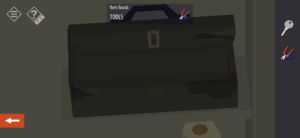
The narrative is woven into the mechanics because almost every action feels like an investigation. The player uncovers the story by opening drawers, rotating rooms, collecting tools, and figuring out what each object does. In the early chapters, I found tools in a toolbox, used them on a broken electrical box, turned off the power, and then used the traffic-control console to clear the road. These actions are small, but they make the player feel like they are restoring access to the world. The story moves forward only when the player understands the environment, so the mystery feels earned rather than simply explained.

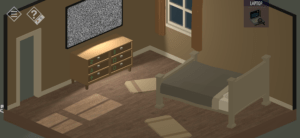
The game also uses embedded narrative, where story information is hidden inside the setting. The empty house, broken systems, locked doors, static television, coded drawers, and missing people all suggest that something happened before the player arrived. The player is not watching the main event happen. They are reconstructing it from what was left behind. This makes ordinary rooms feel suspicious. A bedroom is not just a bedroom when the TV is showing static, the drawers have symbols on them, and the laptop is locked behind another puzzle. The setting becomes evidence.
The architecture of the game controls the story by limiting where the player can go, what they can understand, and what they can see. Instead of giving the player the whole town immediately, Tiny Room Stories breaks the world into small spaces, almost like chapters. The player can only progress after solving the spatial problem in front of them: a locked door creates suspense, a broken control panel creates an obstacle, and a console that opens a barrier transitions the player to the next part of the story. The isometric room design adds to this because the player can rotate the environment, making perspective part of the mystery. A clue may be invisible from one angle but obvious from another, so looking becomes gameplay. The camera is constrained, but that constraint becomes part of the game’s identity, making the player feel like they are examining a miniature crime scene from every angle.
One clever design choice is that the game rarely separates puzzle-solving from story progression. When I fixed the electrical box and opened the traffic barrier, I was not just completing a random challenge. I was making the road usable so the character could continue. The objects are not abstract puzzle pieces; they belong to the world. The pliers, key, laptop, drawers, and control panels all make sense inside the setting. This helps the game avoid feeling like a checklist of disconnected puzzles.
A missed opportunity is that the game could connect the mystery more deeply to the detective’s relationship with his father. The player comes to Redcliff because of a message from him, but early on, the puzzles focus more on opening spaces than on revealing who the father is or why he matters. The house and town could include more personal traces, like old photos, notes, or objects that show their relationship. This would make the player’s motivation feel more emotional, not just investigative. The setting already controls the story well, but it could also do more to make the player care about the person they are trying to find.
One issue raised by the game is accessibility in visual puzzle design. Tiny Room Stories relies heavily on small objects, hidden clues, symbol matching, color changes, and precise tapping, which can create barriers for players with low vision, colorblindness, motor difficulties, or attention-related challenges. Some important objects are tiny or visually similar to the background, and the game often expects players to notice small details in dimly lit rooms. The use of color, such as red and green indicators on switches or consoles, can also be a problem if color is the main signal that something has changed. he hint system helps players avoid getting completely stuck, but it still assumes they can visually inspect the room and tap small objects. A stronger design would include high-contrast mode, larger clickable areas, text descriptions for visual clues, and puzzle alternatives that do not rely only on color or tiny symbols. The issue is not that the game is intentionally exclusionary, but that when “noticing” is the main mechanic, the game needs to consider who is being allowed to notice.