

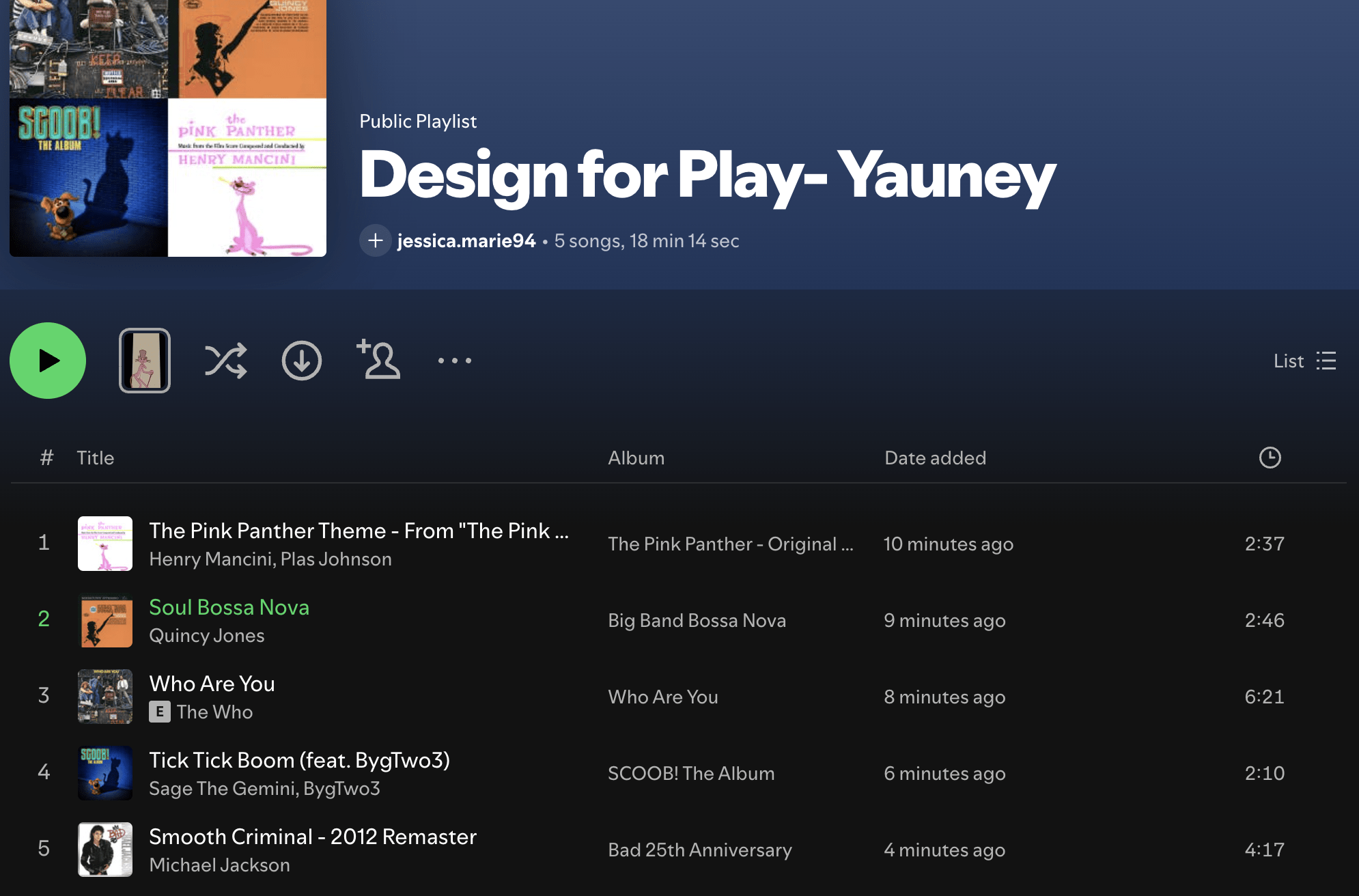
My playlist does it best to balance a whimsical and comedic tone with establishing urgency with allusions to both criminal activity and detective work.

Mood Board elements created with ChatGPT and Canva
Narrative Directions
Direction 1 – Team v Team Board Game
Our initial idea for the game is to set up opposing teams, one trying to get away with a heist and one trying to catch the thieves. One team prepares by making plans, gathering resources, choosing a target, planting misdirection, and coordinating roles, while the other team collects clues, builds a case, identifies the likely target, and attempts to expose the crew before they escape. Both teams solve puzzles under time pressure because the faster, better-coordinated team wins. The story is created through play as teams improvise plans, set up stings, discover false leads, identify an inside person, or realize too late that they were chasing the wrong target. Narratively, this direction works best as an emergent narrative system: the board, clue cards, role powers, hidden objectives, and time limits create a story-rich architecture that produces betrayal, bluffing, deduction, surprise alliances, and last-minute reversals. It also includes enacted narrative, because players perform recognizable heist and investigation roles through accusations, trades, reveals, and strategic choices. This game would have the potential to include many types of fun including Competition, Challenge, Fellowship, and Narrative. Competition comes from adversarial teams and clear win conditions. Challenge comes from puzzles and time pressure. Fellowship comes from team coordination. Narrative comes from the dramatic arc of setup, suspicion, reveal, and escape. The key design implication is that the mechanics should generate readable drama, not just abstract progress: clue cards should create accusations, alibis, contradictions, and choices, so a successful round feels like a story players can retell afterward.
Direction 2 – Heist Puzzle Box
Rather than players planning a metaphorical heist, they devise a way to open a locked and guarded compartment in a physical or hybrid puzzle box. The box represents the target (i.e. a miniature vault, gallery pedestal, casino safe, locked evidence case, or guarded archive). Players solve a sequence of traditional puzzles, such as ciphers, pattern matching, logic locks, hidden compartments, and spatial manipulation, alongside “people puzzles” that contribute to the heist narrative, such as identifying which guard can be distracted, which guest has the keycard, which artwork is a decoy, or which clue reveals the real access code. The embedded narrative of the puzzle box becomes a physical story space, where drawers, symbols, mechanisms, notes, and hidden objects allow players to reconstruct the plot by handling and decoding the artifact. The primary kinds of fun are Discovery, Challenge, Sensation, Fantasy, and Narrative. Discovery comes from opening secret layers and connecting clues. Challenge comes from solving the puzzles. Sensation comes from the tactile pleasure of sliding panels, turning dials, unfolding maps, and revealing hidden compartments. Fantasy comes from inhabiting the role of a stylish heist crew cracking a guarded object. Narrative emerges as players realize what the box is, why it is protected, and what the job really means. The design implication is that the box should not simply contain puzzles. Every mechanism should carry story meaning (i.e. a lock can feel like a security system, a torn map can reveal the route, a mismatched art label can expose the fake). It would feel like a major success if the final compartment could recontextualize the entire heist.
Direction 3 – Caper Comedy Party Heist
Instead of a traditional murder mystery, players are assigned roles as part of the heist team, as detectives, or as partygoers with other objectives. Players are given personas (i.e. mastermind, detective, artist, rival thief, casino host, curator, tech specialist, or getaway driver) along with character quirks they must embody (i.e. speaking in acronyms, always getting lost, dramatically misreading clues, refusing to break character, or trying to look innocent while clearly behaving suspiciously). Each player also receives a personal objective (i.e. getting accused of lying, determining who is on the heist team, secretly swapping a artwork, creating a distraction, or convincing another player to trust the wrong person). Players solve light puzzles, bluff, trade information, improvise explanations, and escalate comic misunderstandings when things go wrong. Narratively, this direction leans into enacted narrative and performance-based emergent narrative. The dominant kinds of fun are Fellowship, Expression, Narrative, and light Challenge. Fellowship comes from social play and shared absurdity. Expression comes from roleplay, quirks, disguises, and improvisation. Narrative comes from secrets, reveals, accusations, and comic reversals. Challenge comes from light puzzles that support the party dynamic rather than dominate it. The design implication is that the mechanics should reward theatrical behavior as much as correct answers, giving players incentives for maintaining quirks, misleading others, staging distractions, making convincing accusations, and inventing funny alibis, so the game produces memorable stories (i.e. the detective solved the case only because the getaway driver got lost and accidentally revealed the fake painting).


