Artists’ Statement
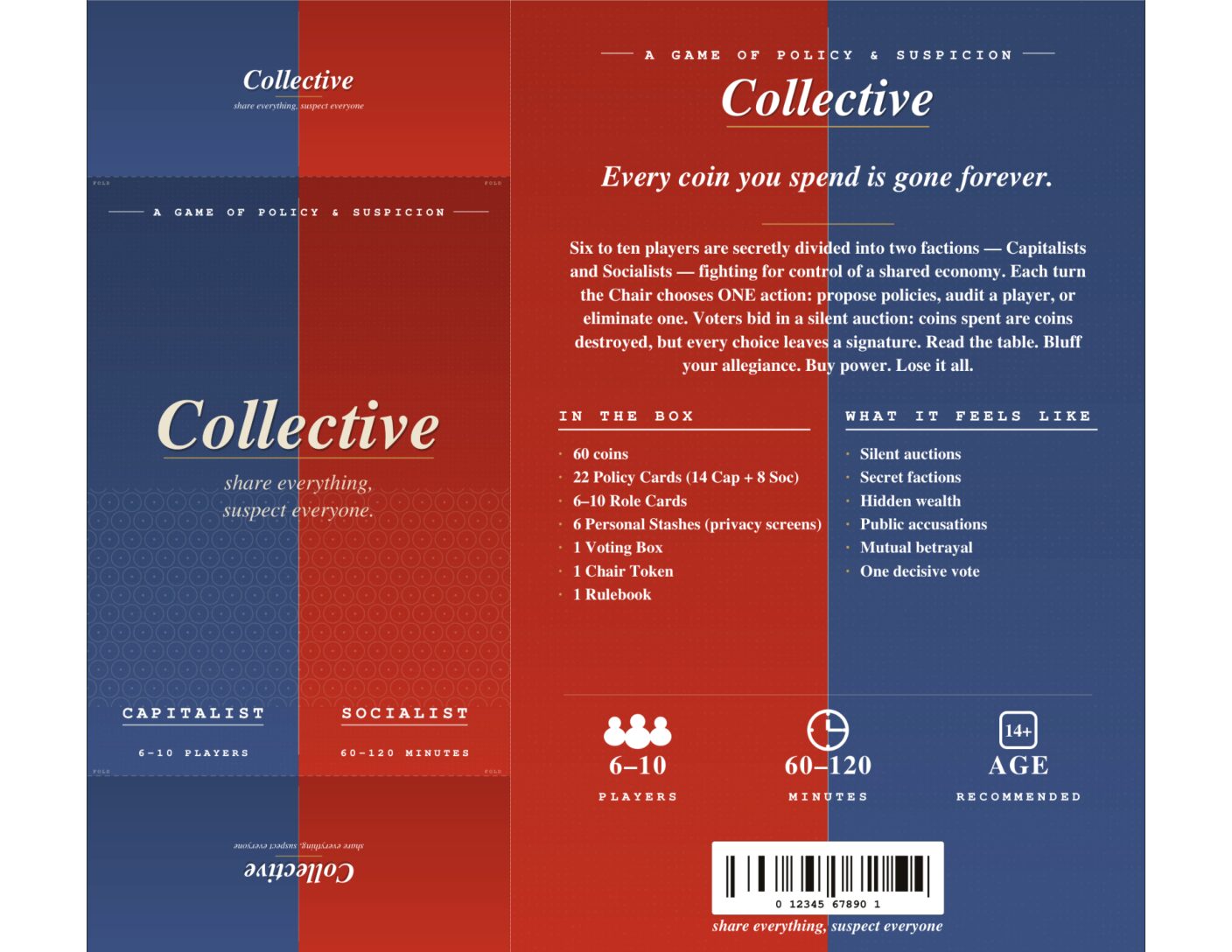
Collective is a social deduction game about the quiet violence of money in democratic life. Six to ten players share a single legislature and a single economy, voting on policies through silent coin auctions where every coin you spend is destroyed. Hidden among them, Capitalists work to hoard wealth past a secret threshold while Socialists struggle to flatten the table. The game argues that capitalism corrodes collectivism not through villains but through incentives, where the rational move and the cooperative move pull in opposite directions. Democracy and the economy are not really two different things. Money buys votes, votes protect money, and the line between the two is mostly a story we tell ourselves. We’re not the first to try to make this argument through a board game. Monopoly began life as The Landlord’s Game, designed by Elizabeth Magie in 1903 to teach Americans the evils of wealth concentration. Unsurprisingly enough, American players realized how fun it is to hoard money and properties. We’re trying to finish what she started. The game Secret Hitler works because Nazism carries an undeniable social stigma, so players feel the weight before they’ve made a single move. By putting Capitalists and Socialists in that same structure, we’re making the argument Monopoly failed to make: that hoarding is not just a winning strategy. It is the thing you should be afraid of being caught doing.
See our Print & Play!
Who it’s for
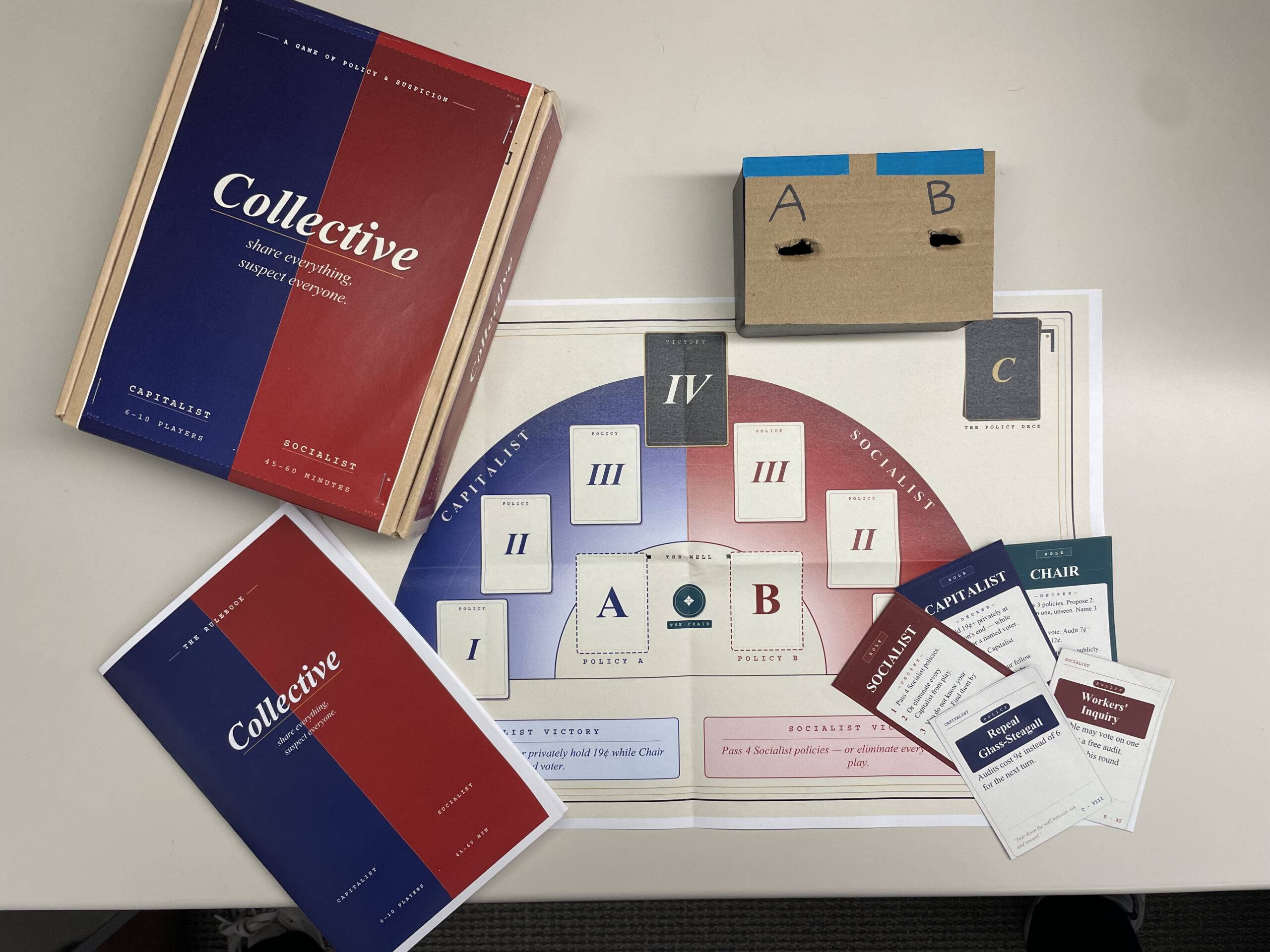
Collective is aimed at the social deduction crowd, players already at home in Secret Hitler, Avalon, or Mafia. Teens aged 14+ through adults, people who enjoy a 60-90 minute game with a point of view.
We designed it to land for people outside that core too. The rules are self-contained; no prior experience needed. The Chair role naturally mentors new players through the turn structure, and the bidding mechanic lets even quiet players shape every vote without having to command the table verbally. That mattered to us. A common failure mode in games like Mafia is that loud players run the show and quieter ones get steamrolled. In Collective, spending coins is itself speech, so a player who barely talks can still be driving the game.
Concept Map
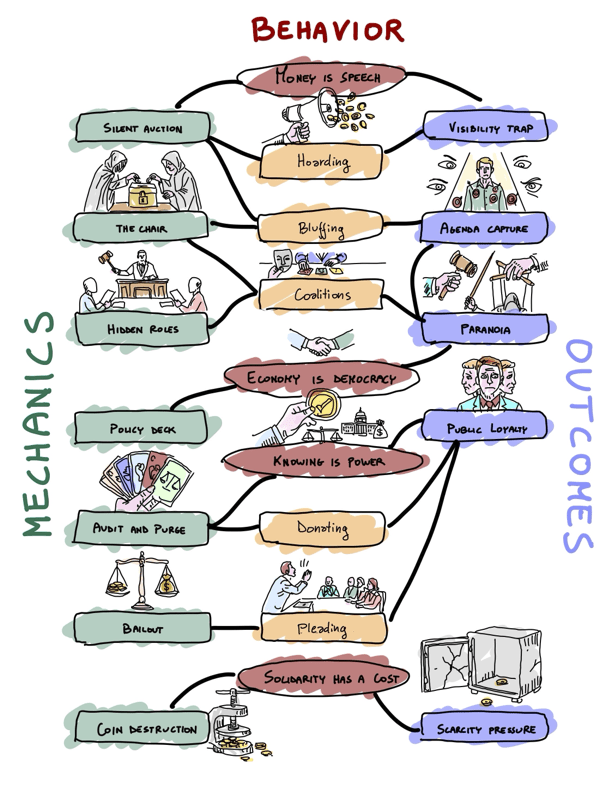
The map traces how each mechanical system produces a player behavior, which in turn drives one of the game’s five thematic outcomes. Mechanics on the left: the silent auction, the Chair, hidden roles, the policy deck, the audit system, the bailout, and coin destruction feed into behaviors in the center like hoarding, bluffing, coalition-building, and pleading. Those behaviors then produce the outcomes on the right: the visibility trap, agenda capture, paranoia, public loyalty, and scarcity pressure. Reading left to right is reading the game’s argument: the rules create the incentives, the incentives create the politics, and the politics make the point. We also updated the map with illustrated icons for each mechanic, making the relationships easier to parse at a glance than the earlier text-only version.
Iteration History
Each step taught us something, usually by failing in a specific, diagnosable way. We ran three formal playtests, all three times with six players pulled from our classmates. The groups were intentionally mixed, including regular Secret Hitler players alongside people who’d never touched a social deduction game. That mix told us early on that our original rules assumed too much prior knowledge.
Initial Decisions:
v0 — The Monopoly skeleton
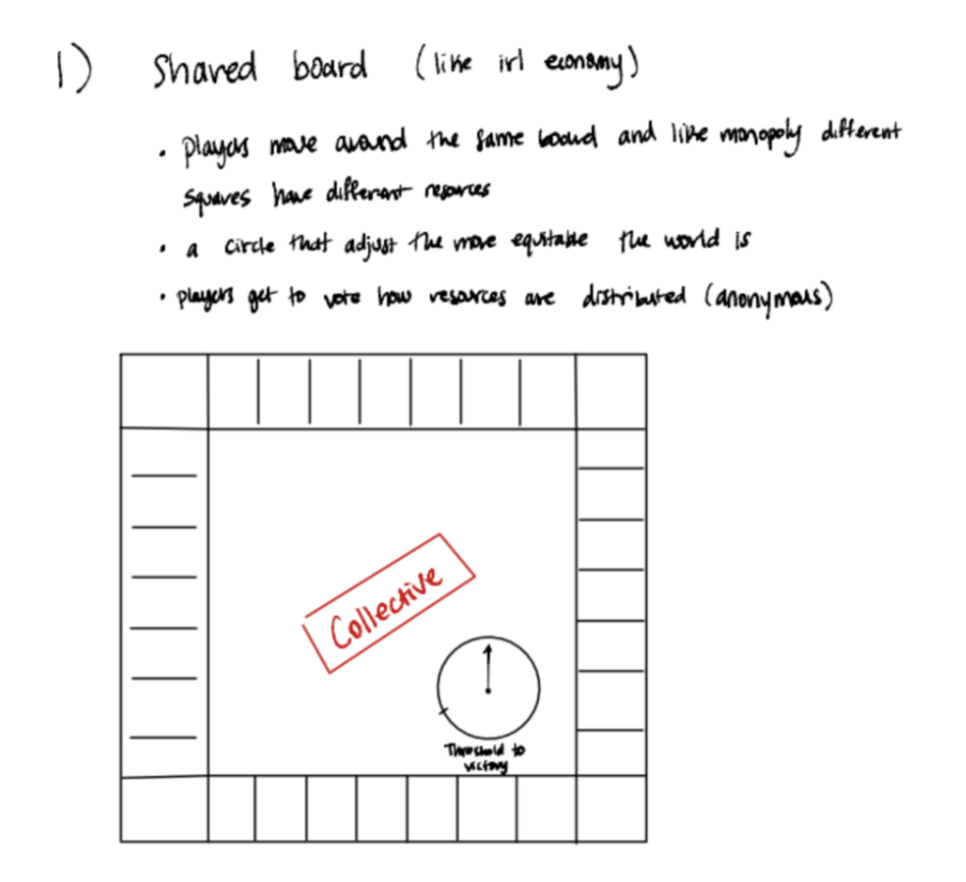
We started with the concept of a board like Monopoly. Players would move around it, accumulate wealth from squares, and a hidden Capitalist would try to siphon resources while everyone else built an equitable society. The early docs leaned hard into this with industry control, public budget meetings, profession cards, even a famine mechanic where farmers would no longer produce resources. The board was doing nothing for us though. It added a ton of overhead without serving the deduction or the politics, and wealth on a shared board is inherently public, which meant the Capitalist was visible the moment they started winning. We scrapped it after the first iteration.
v1 — Avalon with policies that bite
We pivoted to a Secret Hitler structure, where the whole game lives in policy votes and table talk. But a thumbs-up vote felt wrong for a game about money. Votes had to cost something. So we made bidding the vote, and put money on the table for everyone to see. Public money killed deduction instantly. Whoever’s pile was growing was obviously the Capitalist. We weren’t even getting to the interesting part of the game before someone got read.
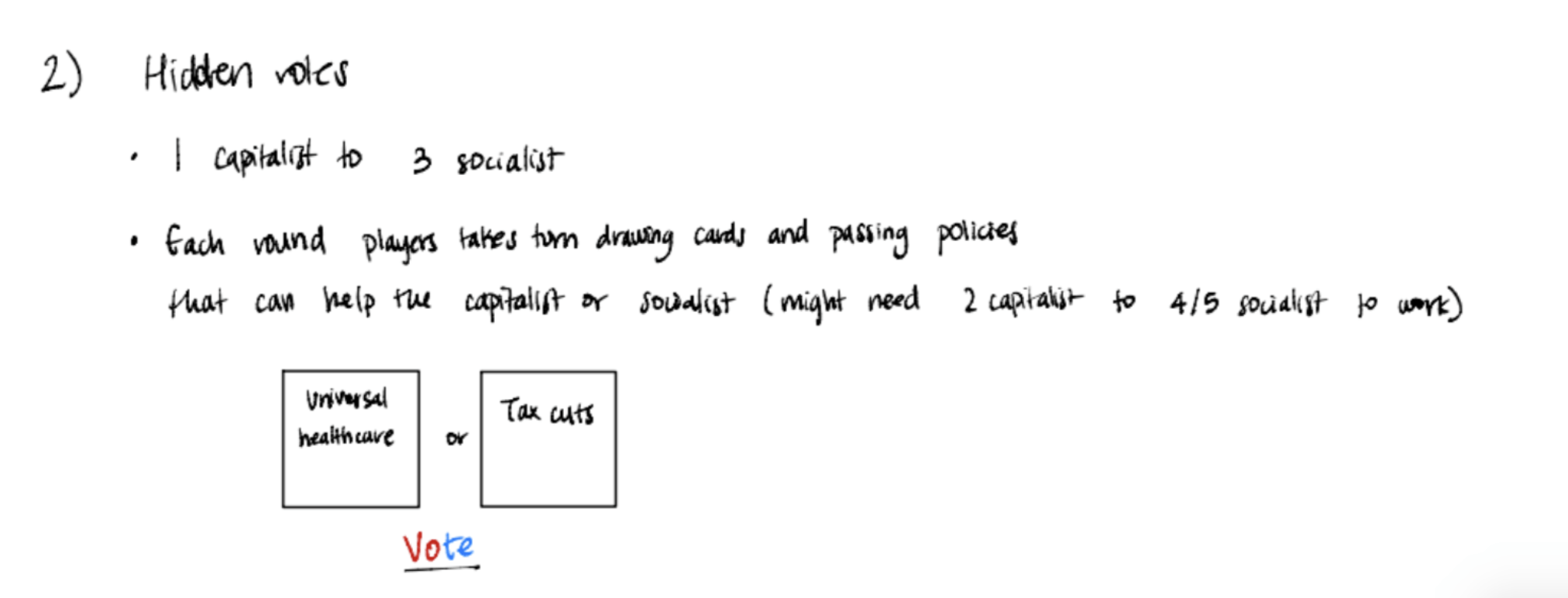
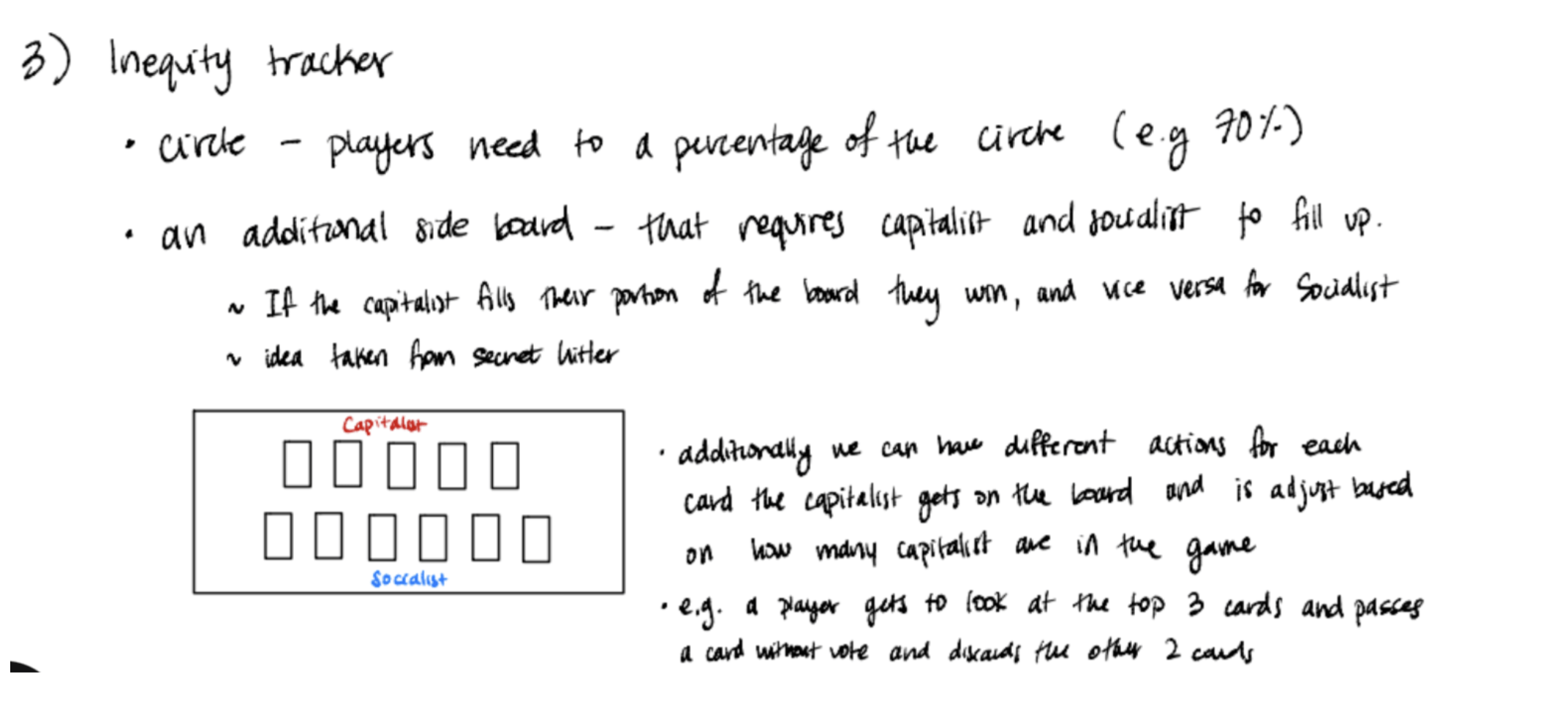
v2 — Hide everything you can
Money went behind privacy screens. Bids went into opaque bowls. We thought that was the fix.
It wasn’t though. Even with hidden bids, the result of the bid was public. You could see Policy A got 7 coins and Policy B got 3, and with only a few voters, players just back-solved the math. This is the version we took into our first real playtest, and the feedback came back sharp. From the Round 1 notes: “The math is tricky when players try to expose or sus each other. They count up the votes and reverse-engineer who bet what.” We watched the table do a literal roll call after each vote, saying things like “you spent 2, you spent 1, so you spent 4,” and pin the Capitalist in a single round.
v3 — Enter the Chair
We added the Chair to give Capitalists an asymmetric edge. The Chair draws three policies, picks two for the ballot, and chooses exactly three voters. Suddenly Capitalists could coordinate quietly by stacking the voter list.
This helped, but the Chair was now the tell. If Capitalist policies kept winning narrow victories, or the Chair kept tie-breaking the same way, their role was obvious. Every public Chair decision was a tiny confession. Playtesters also flagged a related complaint, “voting should probably involve every player each round, to avoid the same three people being chosen repeatedly,” which we pushed back on because the voter selection asymmetry is load-bearing for the Capitalists, but added a rule that prevented the same exact people from being selected round after round.
v4 — Private counts, private ties
We hid the vote totals. Only the Chair sees what’s in the bowls, and they just announce which policy passed. Ties get broken silently so no one even knows there was a tie. The Chair just picks.
Roles got genuinely hard to read for the first time. But the game now tilted toward Socialists. With only a couple of Capitalists and a roughly even deck, an honest Capitalist Chair couldn’t generate enough cover for their decisions. Showing two capitalist policies looked guilty no matter what. Playtesters confirmed this directly, telling us “the game feels too hard for the Capitalist. There’s no real incentive for a Socialist to bluff and vote with the Capitalist, so it’s very easy to pinpoint who the Capitalist is.”
v5 — Where it lives now
We rebalanced the deck to roughly 12 Capitalist policies and 8 Socialist ones. That gives about a 1-in-4 chance that the Chair draws three Capitalist policies in a row purely by luck, which is the plausible deniability the Capitalists needed. We also raised the cost of audits and eliminations so those actions stay rare and consequential rather than spammy.
Almost every channel of information is now partially obscured. Money is private. Bids are private. Vote totals and tie breakers can be announced. The deck is skewed enough that draws are ambiguous. What’s left visible, who the Chair picks as voters, who donates to a fundraising effort, who pleads poverty, who refuses to bail someone out, has become the real deduction surface. The game finally asks players to read each other instead of reading the math.
Round 2 playtest feedback was mostly about structural problems rather than clarity. We revised the rulebook to explicitly state that the chair must clear the voting box after their turn, and clarified that voters can vote nothing or any amount they desire. The core was directionally right, but the rules needed tightening.
Round 3 playtest feedback was mostly about clarity rather than structural problems, which was itself a signal that the core was working. Players asked for reference cards, a cleaner rulebook, and shorthand like “A” and “B” instead of “Policy A” and “Policy B.” They liked the bidding concept and the overall design. The main remaining friction was procedural, not conceptual, which is a much better problem to have than the one we started with.
Playability and Onboarding
The biggest shift between our first two playtests was how quickly new players got oriented. The first playtest included 6 players (2 capitalist & 4 socialist). We dropped players into the full ruleset cold, and they spent the majority of the turns confused about when they could act and how the auction was resolved.
2nd playtest: 6 players (2 capitalist & 4 socialist) and the majority of the players were invested in the game right away. A player who was a chair was confused about whether or not they were supposed to clear the auction before passing it on, so the next chair saw the number of votes. Thankfully, they were both socialist, so they were telling the truth about the voter count. From this, we revised our rulebook to explicitly state that the chair must clear the voting box after their turn. Players still needed to adjust to the rulebook, but by the 4th turn they were referencing the rulebook less, roughly the same onboarding curve as Secret Hitler. Players were asking things like “Can I just vote nothing? Because I’m not going to vote if that’s the case” and “Ohh I thought you could only vote 1 chip at a time.” Thus, we decided to include in our rulebook that voters can either vote nothing or any amount they desire.
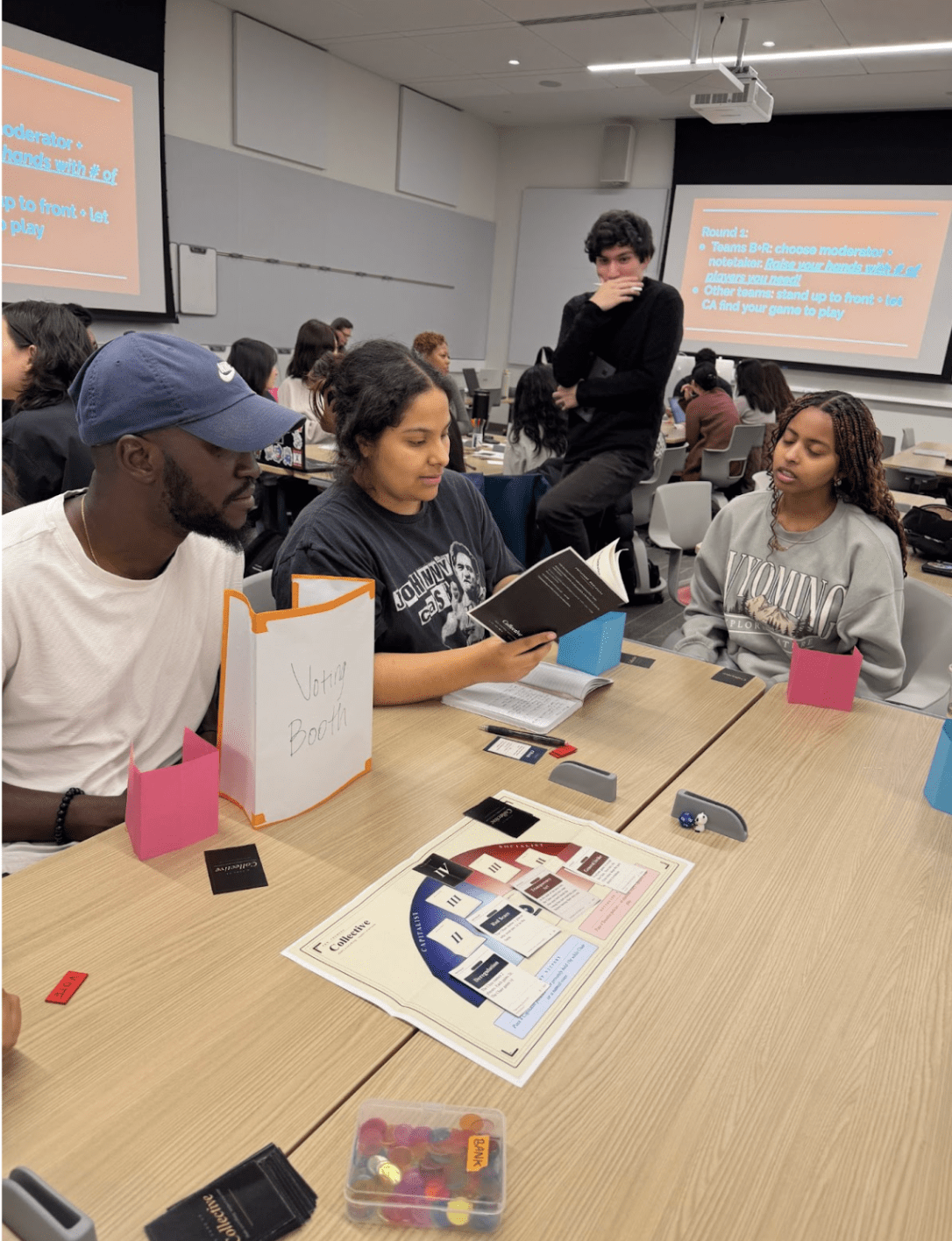
3rd playtest: 6 players (2 capitalist & 4 socialist), all players were interested in social deduction. The onboarding process was quicker than the previous 2 playtests; people understood the flow of the game but needed reminders about how to proceed through the different scenarios they encountered. We also introduced reference cards for turn phases where players can always reference what the chair can do and the win condition for the role they were assigned.
We noticed it was smoother after we changed the indicator for voting on the policy from “Policy A and Policy B” to “A” and “B” during play. We also iterated on our rulebook to make things more explicit; for example, players are not allowed to shake the voting box, the chair “can” share the number of votes each policy got, and we clarified that the chair has 3 actions they can perform through “Flow of game: 1a, OR 1b, OR 1c,” instead of “1 or 2 or 3.”
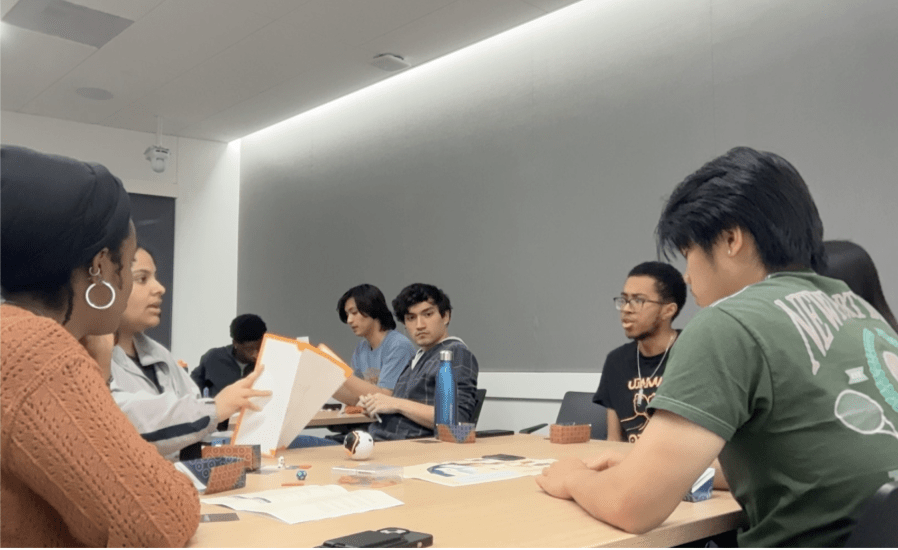
Concentrating decision-making in the Chair each turn sounds intimidating but actually makes the game easier to teach, because only one player is thinking about everything at once. And despite being the most mechanically unusual part of the game, the silent auction was the part new players reported feeling most comfortable with. Physicality helps. Dropping coins in a bowl is a concrete action, not an abstract rule.
Formal Elements & Values
The Collective is built for six to ten players, split into two hidden factions. Capitalists are the smaller group and know each other from the start. Socialists are the larger group and don’t know who their teammates are. The asymmetry is intentional because Capitalists need fewer people since they coordinate, while Socialists need more bodies because they’re playing partially blind. Below six, there isn’t enough social cover for hidden roles to stay hidden. Above ten, the rounds get too long and the silent auctions slow to a crawl.
Each faction has two ways to win, and either one is enough. Capitalists win by passing four Capitalist policies or by having a single member privately hold 19 or more coins while seated as Chair or named voter. Socialists win by passing four Socialist policies or by eliminating every Capitalist. The dual-win structure was the most important objective decision we made. A pure policy race would have ignored the economic theme entirely, and a pure wealth race would have been too abstract to play. Holding both as live threats means a Capitalist sitting on 17 coins changes the whole table’s behavior even if no one knows for sure they’re Capitalist. The threat is the game. If neither faction triggers a win after seven turns, the game ends and the faction with more passed policies takes it, with ties going to the Socialists since they’re the structural majority and that reflects the default state of a society without organized capital.
The turn loop itself is draw, propose, select voters, silent auction, resolution, policy effect, rotate. The Chair runs everything, drawing three policies, picking two for the ballot, naming three voters, and resolving the auction privately. The Chair token rotates clockwise every turn so power moves around the table. The procedure that does the most thematic work is the silent auction, where voters put coins into one of two bowls behind a privacy screen. Zero is a legal bid. Splitting across both bowls is legal. Only the Chair sees the totals. Everyone else just learns which policy passed.
What’s hidden and what isn’t
The most load-bearing rules in the game are about information. Money is private. Bids are private. Vote totals are private. Tie-breaks are private. Roles are private until elimination. What’s public is who the Chair picks as voters, who donates to a fundraising effort, who pleads poverty during a bailout, and which policy ultimately won. That asymmetry is what the deduction game runs on, and getting it right took us five versions. A few smaller rules carry weight too. Voters can’t decline being named. The Chair can fundraise from the table to fund audits or eliminations. A false economic win claim instantly loses the game for that faction.
Coins are the only resource and they’re scarce by design. Each player starts with 12, and the system is deflationary, since every coin spent in the auction is destroyed rather than returned to the bank. Policies inject some coins back in but the net trend is downward, and by turn five or six, players are noticeably squeezed. This deflation is the engine of the whole game. If coins were plentiful, spending wouldn’t signal anything. Because they’re scarce, every coin you put in a bowl is a real sacrifice and therefore a real piece of evidence about your loyalties.
A player who hits zero coins triggers a bailout. They get to plead their case to the table, and other players can donate coins to keep them alive. If the plea raises at least three coins, the player survives with whatever was donated. If it falls short, they’re eliminated and their role is publicly revealed. The bailout is one of the most socially loaded moments in the game. Who donates, who refuses, and how much each person gives are all public acts, and they tell the table where loyalties might lie.
MDA
The mechanics of The Collective are:
- Hidden coins behind privacy screens
- Silent bidding into opaque bowls
- A rotating Chair with agenda control and voter selection
- A deflating economy where every spent coin is destroyed
- A policy deck skewed roughly 12 Capitalist to 8 Socialist for plausible deniability
- Audit and elimination as Chair-only actions that can be crowdfunded from the table
- A bailout system that turns going broke into a public moment of pleading
Each of these was chosen to close a specific gap between what the game was doing and what we wanted it to be doing. The privacy screens exist because an earlier version had public money and the Capitalist was obvious within two turns. The opaque voting bowl exists because an earlier version had visible bid totals and the table back-solved the math. The skewed deck exists because an earlier version had a balanced deck and Capitalist Chairs couldn’t generate plausible deniability for their draws. Almost every mechanic is a direct response to a way the game was breaking, which is something we only noticed in hindsight when we lined them up.
What emerges from those mechanics is a constant negotiation between visibility and effectiveness. Spending a lot of coins moves policy but paints a target on you. Hoarding keeps you safe but lets your faction lose. Donating to a Chair’s audit fundraiser tells the table where you stand, and refusing to bail someone out potentially tells them your allegiance or suspicions. The real game becomes reading patterns over many turns rather than catching anyone in a single moment, which is a meaningfully different kind of deduction than what Secret Hitler or Avalon ask for. Those games reward sharp single-round analysis. Ours rewards slow accumulation of soft evidence, the way you might actually come to suspect something about a coworker or a neighbor.
The second dynamic we didn’t fully anticipate is how much the Chair becomes a social lightning rod. Because the Chair is the only player who can initiate audits and eliminations, and the only player who sees true bid totals, the Chair is simultaneously the most powerful seat and the most suspected seat every turn. Watching the Chair role rotate feels like watching accusations rotate with it. This is a feedback loop we didn’t design explicitly but which the mechanics produced on their own, and it’s one of our favorite emergent properties.
The experience we’re after is mostly Fellowship and Discovery in Hunicke’s words (Hunicke et al., Proceedings of the AAAI Workshop on Challenges in Game AI, 2004), with an edge of Challenge underneath. Fellowship comes through constantly negotiating, accusing, and making secret deals, and because the bailout and donation mechanics make solidarity a visible public act rather than an abstract idea. Discovery happens as every turn reveals a little more about who’s actually in the room with you, and the reveal at the end functions as a kind of collective rereading of everything that just happened. Challenge reveals itself as a deduction that is genuinely difficult once the privacy systems are working, and because the dual-win structure means you’re tracking two separate threats at once.
Links Reference:
Link to Print & Play: Print & Play!
Link to Playtest 2 Audio: Playtest 2 audio
Link to final Playtest: Link to final playtest
AI Acknowledgement: Our team utilized AI tools like Claude for assistance in brainstorming, team organization, generating early prototype skeletons, and refining rough ideas into tangible starting points during early design stages.