On Display – CS247G Team Bilby
Aanika Atluri, Matthew Cortez, & Sarah Park
April 25th, 2026
Artist Statement
On Display is a drawing and judging game for 4–9 players. We designed it as a short, low-stakes social game that friends, classmates, or strangers could easily set up and play casually during downtime at a gathering or event. Our goal was to create a game where players could laugh, perform, and learn more about one another without needing to be “good” at drawing.
Our target audience is casual social players, including quieter players, social players, confident artists, and people who claim they cannot draw. Our game is aimed at drawing in players who enjoy friendly, soft competition. Each round, one player would be designated the ‘museum curator’ who selects the prompt and challenge cards and reads them aloud to the rest of the players, designated ‘artists.’ The artists then have 1 minute to create a masterpiece that both follows the prompt and adheres to the round’s challenge. After the drawing phase, artists will have one minute each to pitch their art to the curator, convincing them that their art is the best. The curator will choose their top two favorites, awards ribbons, and the cycle repeats!
Concept Map and Initial Mechanics
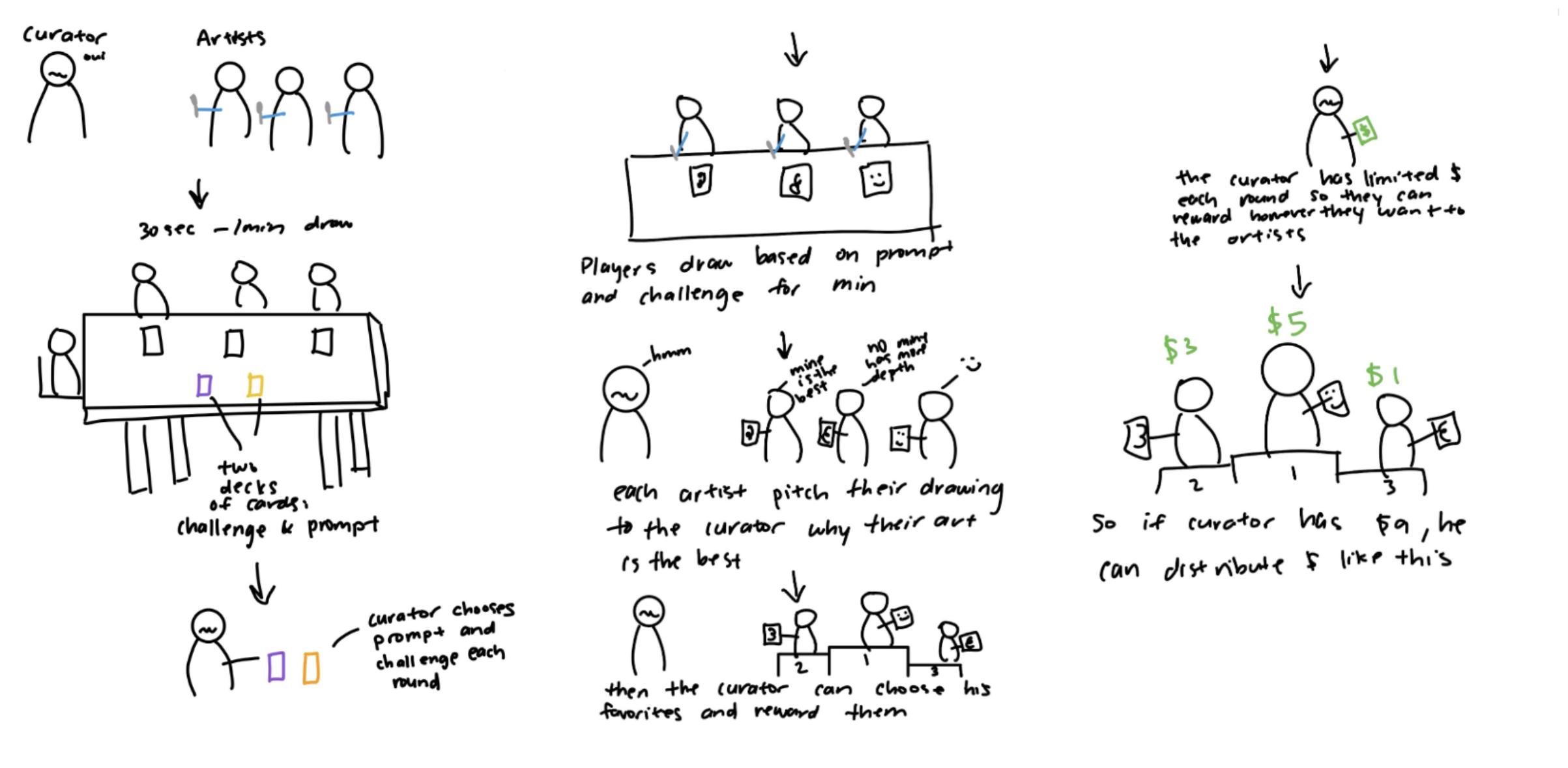
Our initial ideas for game mechanics related to scoring and deciding roles in the game.
Our initial concept for On Display centered around the expression and fellowship types of fun, taking the form of a playful museum show. We included elements of improvisation, judging, and creativity to create a low-stakes but fun experience for both complete strangers or close friends alike. Each round, one player becomes the museum curator while the other players act as artists. The curator draws one prompt card and one challenge card, and the artists have a limited amount of time to create a drawing that responds to both. After the drawing phase, each artist presents their piece to the curator and gives a short pitch explaining why their artwork deserves to be chosen as the winner.
We were inspired by social judging games like Quiplash and Cards Against Humanity, as well as drawing games like Gartic Phone. However, On Display adds a museum/gallery twist. Instead of simply choosing the funniest answer or best drawing, the curator decides which artwork deserves to be put “On Display.” This framing makes the game feel less like a traditional drawing contest and more like a silly art show where personal interpretation, humor, and storytelling matter as much as drawing skill. At the end of the game, players can admire all the work they have done by displaying their ‘On Display’ winners on the provided board.
We designed the basic round structure to be easy to learn: draw, pitch, judge, display, repeat. We wanted players to quickly understand what to do while still leaving enough room for surprise and creativity by means of drawing and pitching. Our prompt cards were made to be more open ended, instructing artists to try drawing ‘a red flag’ or ‘capitalism,’ which we hoped would foster relationship building and allow artists to learn more about one another in a safe and low-competitive environment.
From the beginning, we wanted the game to combine drawing, performance, and judging. The drawing mechanic gives players a visual object to create, while the pitching mechanic turns that object into a social performance. Players are not only trying to make a good drawing, but also trying to explain, exaggerate, or defend their choices in a funny or convincing way. This made expression one of our main design goals. We hoped that players could share great laughs hearing each other’s pitches and looking at their unique takes on the prompts. In addition, pitching would encourage persuasion and social reading: players must know their curators well in order to maximize their chances of being put ‘On Display.’
Because drawing games can sometimes favor confident artists, we added challenge cards to make the playing field feel more fair. These constraints make drawings intentionally imperfect, limiting experienced artists while making non-experienced artists feel more at ease. Plus, challenges helped break the repetitive game loop in a traditional drawing game, adding more entertainment as players try to draw under the chosen challenge in limited time. In addition, the pitching mechanic offers another avenue for victory: a messy piece can still win through humor, interpretation, or a strong pitch.
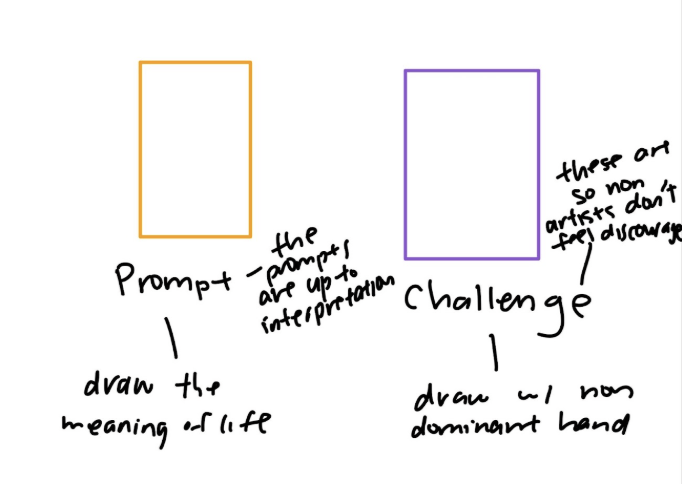
Our initial card concepts
Overall, our initial mechanics were built around a simple social loop where players create artwork, perform their interpretation, and respond to the curator’s judgment. The goal was not just to win points, but to create memorable moments where players could laugh at each other’s drawings, learn how others think, and build a shared gallery unique to each group over the course of the game.
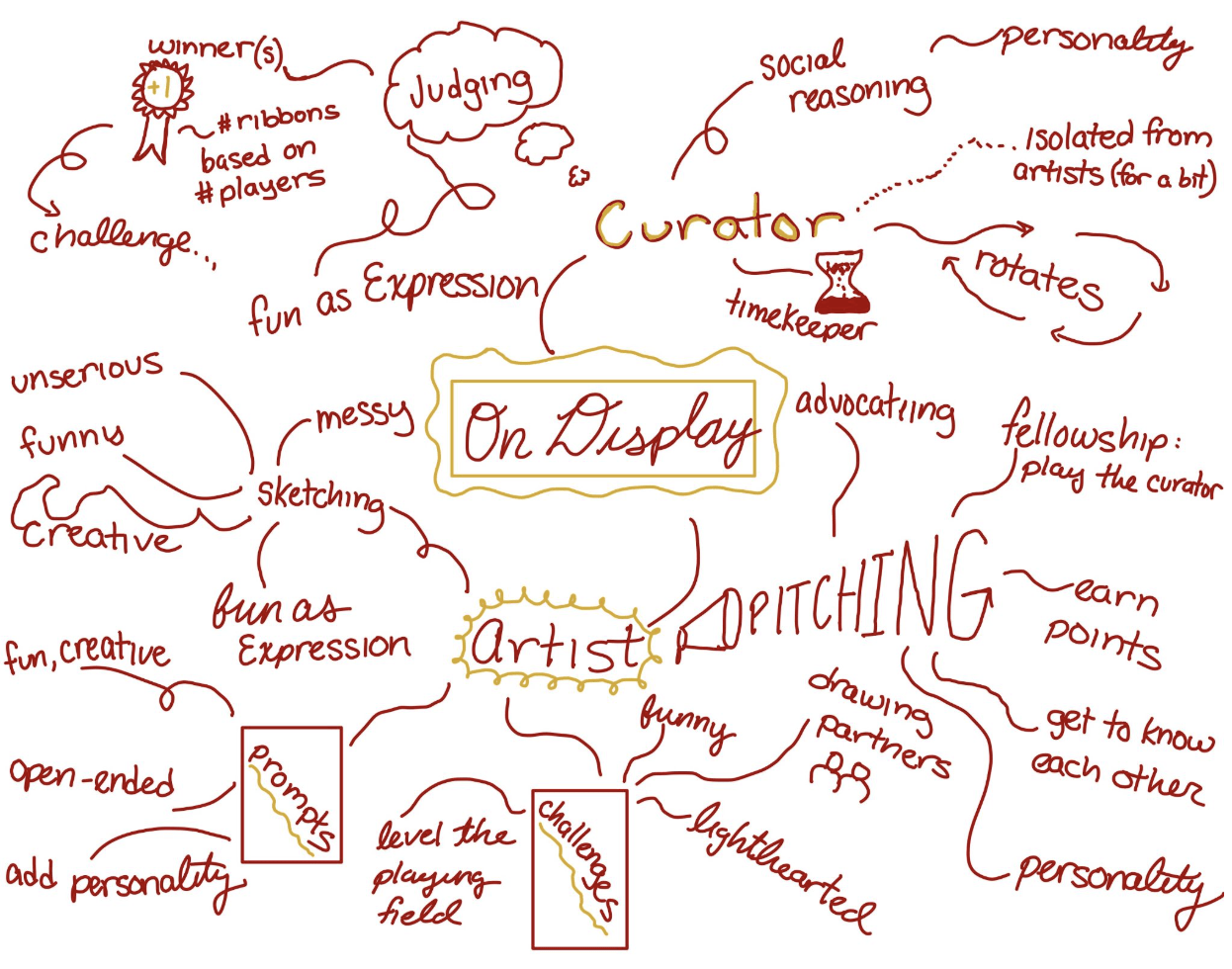
Our concept map
Testing and Iteration History
Initial Decisions
At the start, we were interested in how much creative freedom players could handle before the game became confusing. We leaned into abstract prompts like “society,” “capitalism,” and “technology” because we thought broad concepts would lead to more surprising drawings and more interesting pitches. Our assumption was that the harder a prompt was to interpret, the funnier and more creative the explanations would become.
We also wanted the reward system to match the museum theme. Our first idea was to give the curator a budget of fake money that they could distribute to different artists. We thought this would make the game feel like an art sale or commission system, while also preventing one player from feeling left out every round. Instead of one winner taking everything, several players could receive some amount of recognition. This was changed prior to the first playtest as we learned that using money as points could make players incorrectly assume they can spend it for in-game benefits. This was later replaced with 1st, 2nd, and 3rd place ribbons, which still fit the museum theme and better represented awards to track artist’s progress.
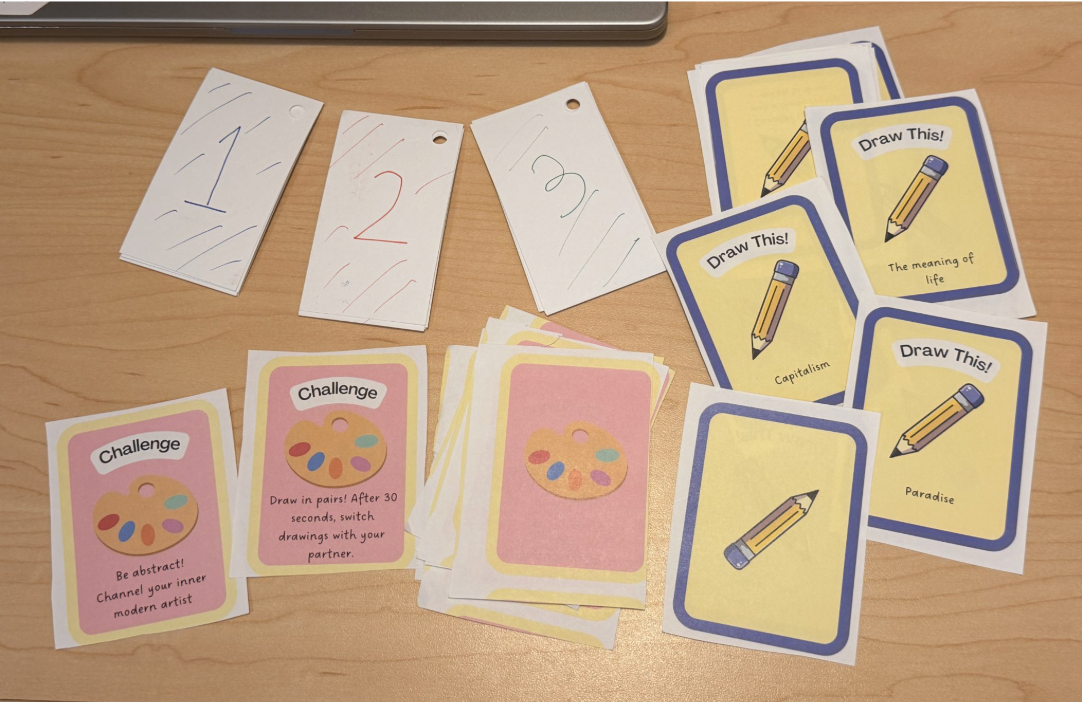
Initial Card and Ribbon prototypes and aesthetic for “On Display”
First Playtest
Playtest 1, conducted in class by Aanika and Matthew, showed that the core social loop was working, especially during collaborative drawing and pitching. The pair challenge cards were a major hit. Players said working in pairs was fun, and we noticed that these rounds created a lot of laughter. This confirmed that shared drawing could add fellowship and surprise to the game. We also noticed that players liked having different colored pens from the others around them, for it allowed everyone to see clearly the different contributions made to pair drawings during judging.
However, the same pair cards also created the biggest rule confusion. Players were unsure who should pitch the drawing: the person who started it, the person who finished it, or both players together. They were also unsure who should receive the ribbon if the drawing won. This group chose to pitch in pairs, but their solution exposed a larger issue. If both players pitched and both received points, the mechanic could become unfair, especially in odd-numbered groups where one player might have to pitch twice or be attached to multiple submissions. Additionally, our phrasing of the pair cards did not adapt well to groups of odd numbers. Since the cards specified having a ‘partner’, people were unclear as to who their partner should be and how to handle situations where someone was left out.
Because we wanted On Display to work smoothly for 4–9 players, we simplified the pair mechanic. Instead of having players work with assigned partners, we changed the card to “pass your drawing to the person on your left.” We also clarified that the person who last contributed to the drawing is the one who pitches and receives any award. This kept the collaborative surprise of the mechanic while making it easier to use in both even and odd-numbered groups.
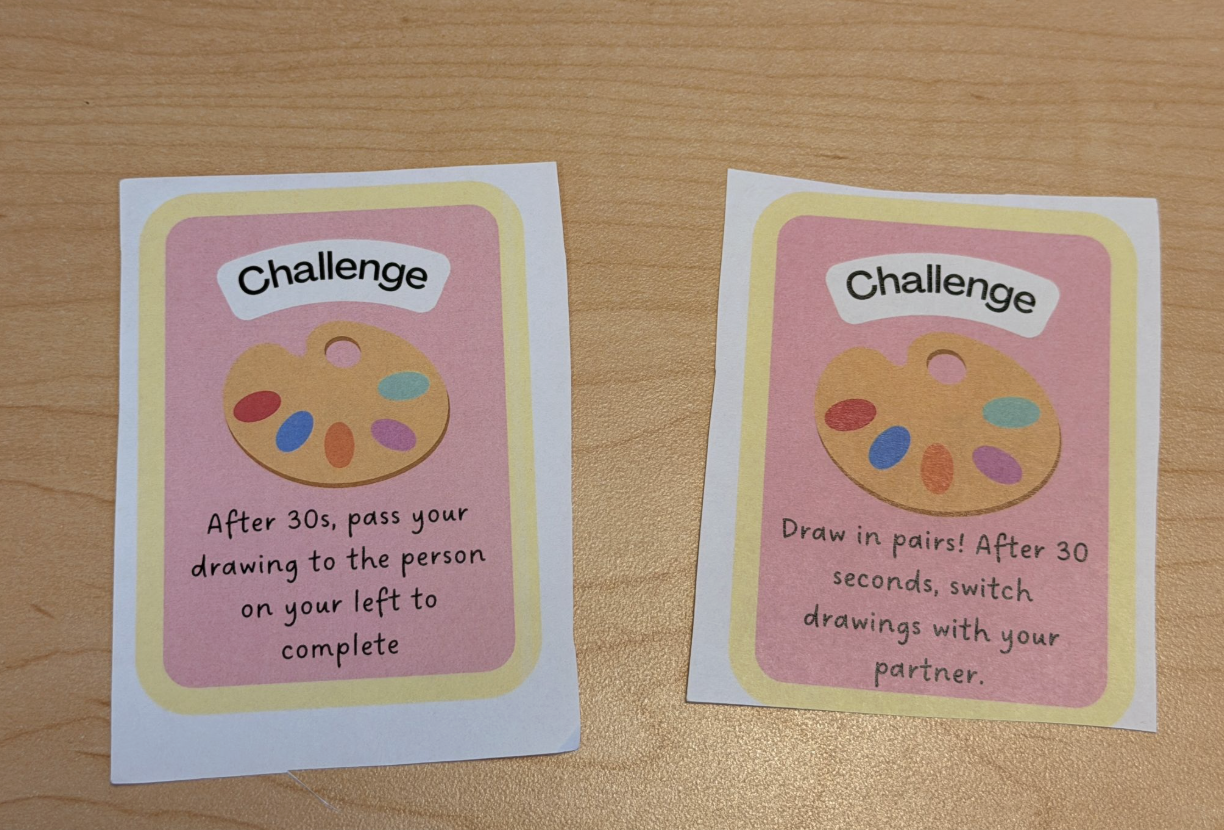
Revisions made to our partner challenge prompts to reduce ambiguity
In addition to the pair cards, players during this playtest were concerned regarding the fairness of points if there is no way to earn points while being the curator. They expressed that the first person to be the curator would be at a disadvantage if the goal was to reach a certain number of points the quickest. This led us to reflect on our scoring mechanism and win conditions for the game, inspiring us to consider other ways to win beyond a point threshold. To fix this problem, we decided to change the win condition to be the player with the most number of points after everyone in the group has been the curator once. This method balances out the disadvantage of being unable to earn points as the curator since everyone experiences this condition exactly once in the game.
This playtest helped us realize that the pair mechanic was worth keeping, but only if the rules around pitching and scoring were simple. Since players found collaborative drawing more engaging than solo drawing, we decided to include more passing-style challenge cards in later versions. We also adjusted our scoring system and win conditions to ensure fairness across all players regardless of their starting roles in the game.
Second Playtest
The second playtest (conducted by Sarah) confirmed some of the same strengths from our first playtest. Players continued to enjoy the challenge cards because they made the drawings feel more playful and lowered the pressure to draw well. The passing mechanic also remained one of the most engaging parts of the game because it added surprise and forced players to respond to someone else’s unfinished idea.
However, this playtest also showed that some parts of the game still felt too open-ended. Players said there was “too much freedom” and a “lack of direction.” One player said, “I didn’t know what I was drawing for and selecting for.” This helped us realize that the issue was not just about what players were drawing, but also about how the curator was supposed to judge.
After this playtest, we considered adding curator themes, such as “pick the funniest drawing,” “pick the most creative drawing,” or “pick the drawing that best follows the prompt.” We thought this might give the curator clearer criteria and help players understand what kind of drawing or pitch would succeed. However, we ultimately decided not to add this extra layer because it could make the game feel more convoluted and complicated.
Instead, we revised the prompt deck itself. We removed or changed prompts that felt too vague, like “capitalism,” “philosophy,” “progress,” and “technology.” More personal prompts, like “your worst fear,” worked better because they gave players a clearer starting point while still leaving room for funny or unexpected interpretations. These prompts also gave players the opportunity to get to know each other, for they were able to showcase their personalities and experiences through the prompts. This playtest taught us that ambiguity can be fun, but only when players still have enough direction to begin.
For the third playtest, we focused on making the curator role feel clearer and more active. In earlier versions, the curator had to judge the drawings at the end, but they did not have much to do during the drawing phase besides wait. We also wanted to give the curator more ownership over the round without making the rules too complicated.
During this playtest, someone suggested that instead of drawing only one prompt card, the curator could draw multiple prompt cards and choose the one they liked best. This felt like a strong solution because it gave the curator more agency while still keeping the game simple. It also helped with the prompt issue from the second playtest. If one prompt felt too vague or awkward with the selected challenge card, the curator could choose a different one that seemed easier or more fun for the group to respond to.
This change also fits the theme of the game. Since the curator is supposed to shape the “gallery,” it made sense for them to have some control over what kind of art the artists would make. This change gives the curator an active role throughout the round, allowing them to set the tone for the round rather than be a passive judge.
After this playtest, we decided to add this rule to the final version: the curator draws three prompt cards, chooses one, and then reveals the challenge card. This kept the round quick and easy to understand while giving the curator a more meaningful role in the game.
Final Playtest
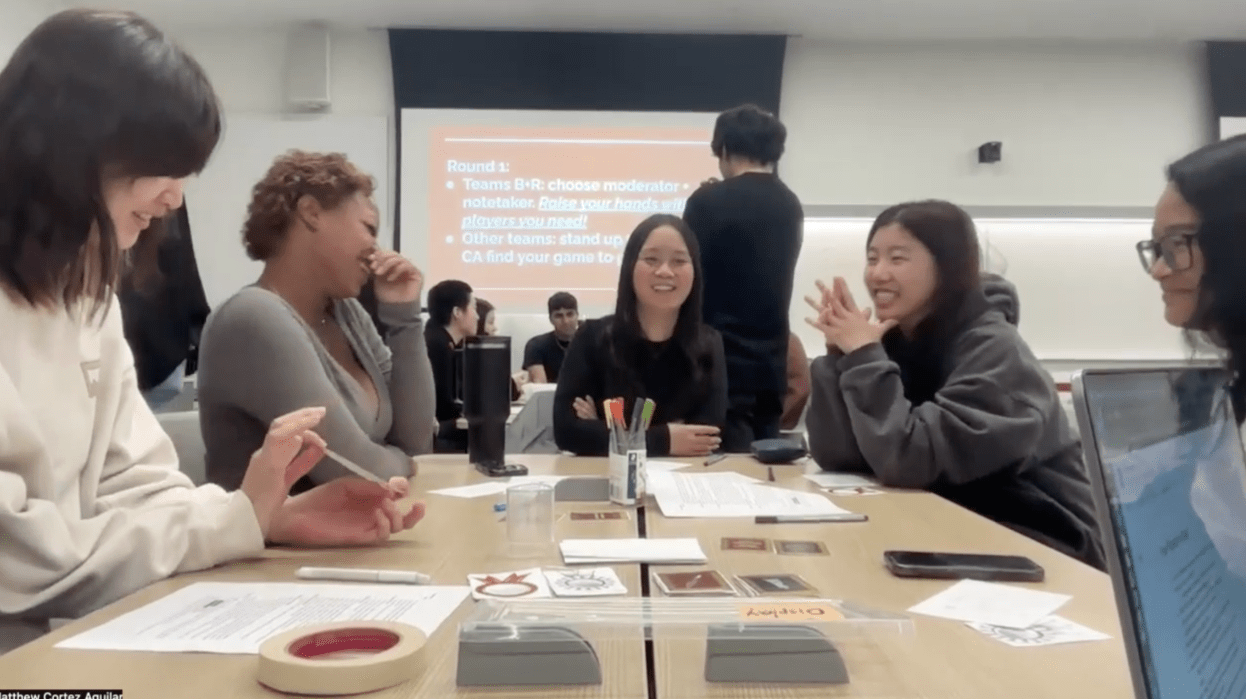
Playtesters shared laughs while pitching their masterpieces
The final playtest went particularly well: our playtesters shared lots of laughs trying to draw and pitch their wacky drawings in response to the prompts. Our revisions to the prompt cards and challenge cards were widely accepted, and allowing the curator to pick the best prompt out of three was very popular. Our playtesters enjoyed being able to pick the silliest prompts to match with the drawn challenge card for the round. The video will be embedded below.
We would like to highlight the first 20 minutes of the final playtest, as it contains the most engaging moments. Our group really enjoyed our prompts, especially the ‘red flag’ prompt, as well as the challenge cards that they were constrained to. In addition, our decision to give the curator more agency in picking prompts was a success: curators in the final playtest had lots of fun mixing and matching prompts to create unique combinations for artists.
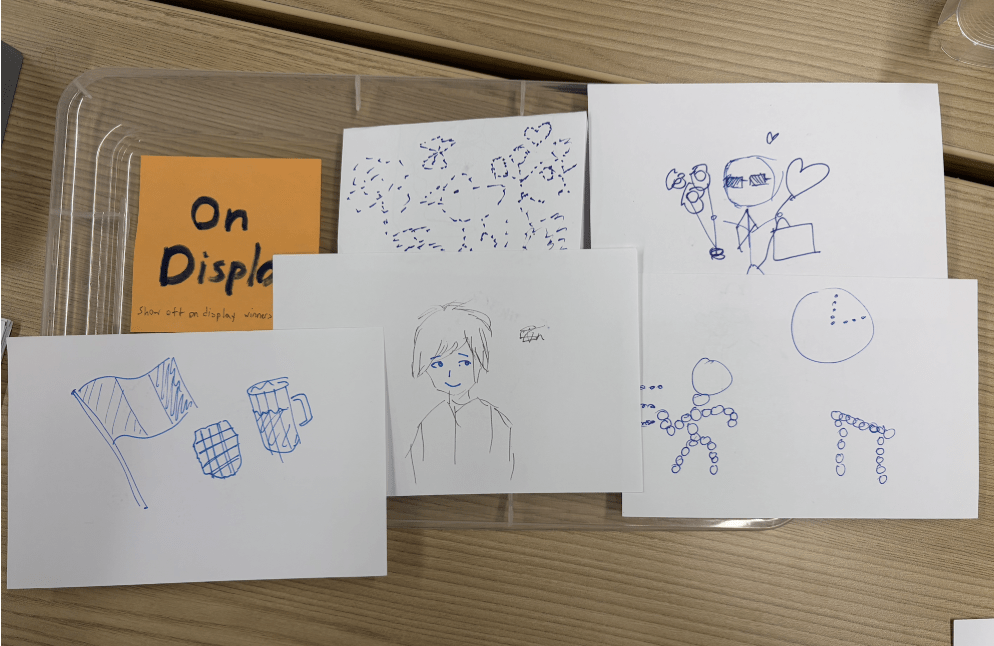
The ‘On Display’ works selected by the curators during our playtest
Further Expansion
Despite the success of our final playtest, we also received additional feedback and suggestions to further improve On Display. Here are some possible changes that may be implemented in future iterations:
- A ‘Sabotage’ system, where artists are able to interrupt and draw on other’s canvases unannounced. This can make the game far more fun and interactive to artists, elevating the weight of the pitching section as artists must be able to work with the canvas they had been handed.
- Adding more physical movement, such as artists standing to pitch or to enact the subject of their drawings to help maintain long-term engagement
- Stricter pitching time limit enforcement
- Even more pair work cards! This includes the possibility of building pair work into the base game mechanics.
- The ability to wear the ribbons that are received (i.e. a pin format)
As well as some final changes that are included in our final prototype:
- ‘Prompt’ and ‘Challenge’ clearly written on the different decks to distinguish them
- Clear outlining in our rulebook regarding what to do with used prompt cards (put them to the side as our playtesters did).
- Further suggestions for playtime duration and ending the game: approximately 15-30 minutes (depending on group size), any longer begins to drag on.
Play On Display!
Find the full printout game here!
Appendix
Ribbon templates (created using Gemini):
Masterpiece drawings for box art (created using ChatGPT):
Graphics for the prompt and challenge cards were created using Canva elements.