

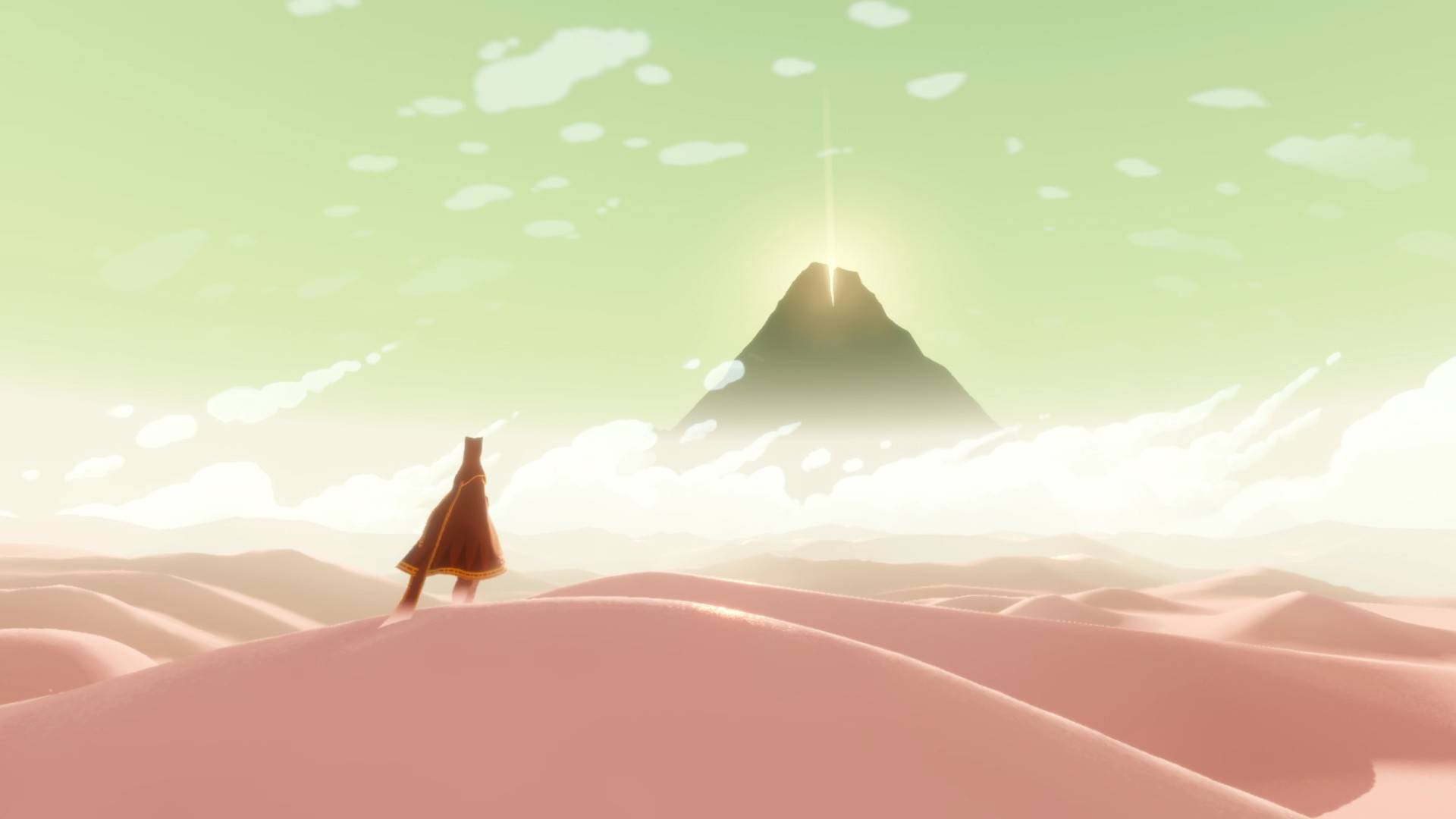
This week I played Journey by Thatgamecompany, originally released on Playstation 3 in 2012, and eventually making it to Mobile and Windows in 2019. The intended audience for this game originally was people interested in indie games, but due to the game’s simplicity, it reached further than I think the creators initially expected.
I would argue that in Journey, walking is representative of struggle. Walking specifically–as opposed to flying or jumping–serves an immersive representation of struggle through it’s contrast with the freedom and speed presented by the jumping and flight mechanics.
Locomotion in Journey serves as the way the player interacts with the world, uncovering the embedded narrative presented by the game. Journey has no text for the player to read, instead Journey leaves it to the player to interpret murals presented at the end of each level in the game, as well as encoding meaning through the mechanics of the game world. Journey starts the player as a cloaked traveler wandering a desert, walking towards a tall mountain with a bright light coming from the summit. As the player slowly walks towards this mountain though, they find mysterious ruins filled with floating pieces of fabric that respond to the player. These pieces of fabric collect around the player, filling the player’s cloak with energy and showing the second and final tutorial prompt of the game, the ability to fly. The designers made sure to make flying in Journey much faster than walking, but at first the players cloak is so small that flight acts more like a jump ability than true flying. It’s only through discovering more of this ruined society that the player is able to fly further and for longer, enabling them to leave the ground for minutes at a time with careful planning.
The mechanic through which the player enhances their ability to fly (and reduces the need for walking) is a big clue to the embedded narrative of the game. As with other embedded narratives, the game never explicitly tells you what the in universe explanation for this is, it’s left to the interpretation of the player. To me, our player is finding the names of fellow travelers who perished on their journeys, and bringing together the ends of their stories allows us to fly. The experience of flight being faster and more “fun” from the sense pleasure perspective compared to the much slower walking experience is the way the designers are communicating the freedom that is coming from finding these names. When I first started playing, I had no idea that Journey was multiplayer, but upon actually seeing a player we quickly realized that by standing next to one another we could charge up our flight abilities anywhere.

Pictured above is me and my anonymous friend. With no real avenues of communication, we backtracked through the entire level together, and were able to fly far higher than would otherwise be possible. In this world, fellowship literally allows you to reach places you could never make it to on your own.
What really drives home the idea of walking as struggle though comes later in the game, after a few very open levels encouraging fun fast flight, the traveler finds themselves in a cramped underground environment. Here, the traveler comes face to face with gigantic robots depicted in murals, and due to confined space and lack of fabric to charge up flight, the traveler is forced to evade the automatons on foot. It’s no accident that the player’s ability to fly is taken when faced with the first real “threat” of the game, it’s another important aspect of the embedded narrative. The player is meant to take away that these giant robots are the antithesis of the coming together that enhanced our flight. If that aspect of the level design wasn’t enough to communicate this idea, the designers also included a much more explicit way of showing this. If one of the robots sees you it will attack, and, if it hits you, it will reduce the size of your cloak permanently.

Despite not being on one of the murals the game presents it’s story through, this mechanic tells a story on it’s own. These robots are the opposite of togetherness, forcing you to walk, and in turn making it more difficult to avoid future robots. It doesn’t stop there though, in one particularly striking moment of the game, the game forces you to be seen by the robots, but just as they are about to strike, a giant wall made from the names of other travelers protects you.
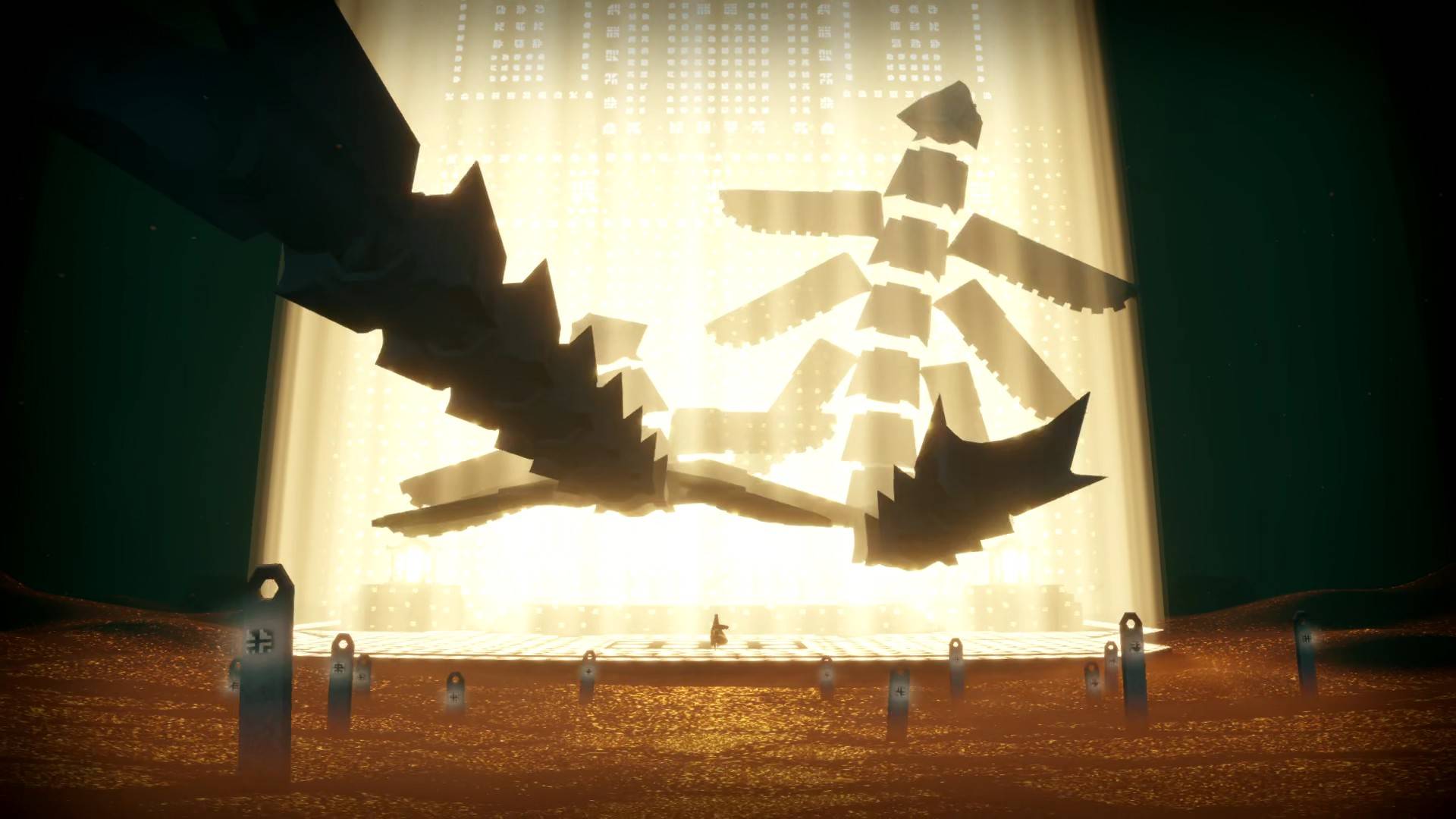
This moment encapsulates the message in a concrete way, highlighting that community and fellowship are vital to freedom and flight, fending off the war and walking that come with suffering.
After this moment, the player reaches the last stretch before the summit, and are faced with cold winds which drain the player’s ability to fly. The player has to struggle to walk against strong headwinds and is stripped of the abilities granted to them through collecting the traces of other travelers.

This final act of the game utilizes the same core mechanic as the start of the game (walking) but it takes on a new meaning. At the start of the game, walking is all the player knows so walking seems normal. Once the player has experienced the wonders that come from flight and fellowship, only to have them stripped away through the twisted legacy of their civilization’s war and the harsh environment, the player understands that even though they didn’t realize it, they were suffering at the beginning too.
Ethics:
In Journey violence exists as a one sided conflict, violence is done to us, not by us. The one sided nature of this violence made me much more sensitive to it than when I play other kinds of violent video games. In most games the violence is a back and forth, in Krunker in class it was a means of competition, and this equality in violence took away some of the emotional impact. In these games, once you die you usually respawn quicky afterwards, making the stakes of the violence much lower as a result. In Journey though, the violence was instead directed at the player and it had lasting consequences to the gameplay experience. In Journey getting hit meant permanently losing part of yourself making the violence feel much more intense. I was genuinely afraid of the robots by the end of the game, and found myself tensing up when just barely evading their sight. I think by including these mechanics around violence, the developers create a dynamic where players become genuinely fearful of violence in the game, allowing the mere presence of a robot in the sky to create real aesthetic affect in the players, increasing the stakes of the story and communicating the brutality of war.