Journey, created by Thatgamecompany and released for PlayStation 3 (I played mobile), is a game designed for up to two players who are open to slower, more atmospheric, and emotionally reflective experiences. Although it is often described as an adventure game rather than a pure walking simulator, it uses many walking-sim values: limited mechanics, environmental storytelling, quiet exploration, and an emphasis on feeling over winning. My argument is that Journey tells its story by making walking meaningful. Movement is not just transportation between story moments. Instead, walking becomes the story’s main language.
Clark explains that “walking sim” originally started as an insult for games that seemed to take out the parts people usually expect from video games, like combat, failure, or difficult puzzles. But the article argues that this misses the point. Walking sims are not interesting because they have “less” gameplay. They are interesting because they make room for different kinds of gameplay, like exploring, noticing details, feeling atmosphere, and experiencing a story at your own pace. Journey is a good example of this. Its mechanics may be simple, but they are not empty. Because there is no constant fighting or complicated objective system, the player pays more attention to the world, the mood, and the feeling of moving through the landscape.
One of Journey’s cleverest design choices is the mountain. From the start, the glowing mountain appears in the distance, partially hidden by haze and light. In my screenshots, the mountain is not marked with a giant arrow or objective text. It simply sits there, glowing, visible enough to guide the player but distant enough to feel unreachable. This is strong visual design because the environment itself performs the role of instruction. The game does not need to say, “Go here.” The landscape teaches the player what matters. The mountain becomes both a destination and a promise.
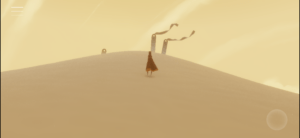
The desert and ruins both tell the story through movement. In the early screenshots, the player is a tiny robed figure surrounded by huge dunes and warm golden light, making them feel more like a small traveler than a powerful hero. Walking through sand feels slow, while sliding down dunes feels graceful and freeing, so the player feels the mood change through the way they move. Later, the ruins add history to that feeling. Broken bridges, tiled platforms, glowing cloth fragments, and massive abandoned buildings suggest that a civilization once existed there, but the game does not explain everything through dialogue. Instead, it asks the player to walk through the evidence. The broken architecture is not just decoration, but it changes where the player looks, how they move, and what they imagine.
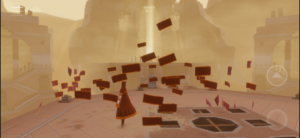
Journey feels different from many violent games because movement is not about controlling or beating the space. In combat-based games, you usually move to hide, attack, collect weapons, or get to the next fight. In Journey, the desert, ruins, and mountain are there for you to move through and respond to. Violence is still present through the machine-like creatures and the ruined world, but the player is not given a weapon or a way to fight back. Instead of focusing on defeating an enemy, the player has to get through the danger. This makes the story less about power and more about survival. The game still has tension, but it does not need combat.
The online multiplayer system strengthens this argument. When another traveler appears, there is no voice chat or text chat. Players can only communicate through movement and small musical chirps. You can choose to wait for the other person, guide them, chirp back, or travel beside them. In violent multiplayer games, another player is often an opponent, target, or strategic teammate. In Journey, another player becomes a temporary companion. The design removes many tools for domination and replaces them with small gestures of care. Walking together becomes the main form of relationship.
A useful comparison is Gone Home, another game often discussed in relation to walking simulators. Gone Home uses walking as investigation. The player moves through a house, examining objects to uncover a specific family story. Journey uses walking differently. It is less about collecting concrete information and more about moving through an emotional and symbolic arc. In Gone Home, walking means searching. In Journey, walking means becoming. This comparison shows that walking can create different kinds of storytelling depending on how the game designs space and movement.
One critique of Journey is that its abstraction can sometimes make the story feel vague. The lack of dialogue and explanation creates beauty and openness, but it can also make the world’s history difficult to understand. Compared to Gone Home, where objects provide specific narrative evidence, Journey sometimes relies so heavily on mood that the player may feel the emotion without fully understanding the stakes. More interactive environmental clues, such as additional murals or ruins that respond to the player, could deepen the world without ruining the quietness that makes the game powerful.
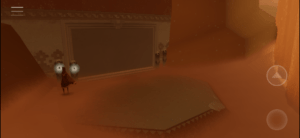
Still, Journey works because its design choices all support the same idea. The walking, silence, visuals, limited violence, and anonymous companion system all push the player to slow down and pay attention. The game shows that walking is not just filler between “real” gameplay moments. It can create tension, loneliness, and wonder on its own. It is how the game builds its story, especially through the slow climb toward the mountain and the quiet experience of traveling with another player.