
Queers in Love at the End of the World is a short hyperlink branching narrative game developed by Anna Anthropy in 2013. It is released for free on itch.io and can be played on the browser. Due to some of its agentic sexual content, it is meant for players 18 and up, and within that subset, I don’t see a particular age range that would be more interested in this (perhaps a younger audience because they can react faster to new hyperlinks?), but I do see a world where queer folk are more invested in the story because of the title of the game and the desperate romance that occurs throughout each click and outcome. I believe that to play Queers in Love at the End of the World as a feminist, the player must consider how their feminist agency affects the love story between the two queer characters in acting against the system of power of the imminent destruction of the world. By intertwining agency into its gameplay, even if the player is not queer, they play through the eyes of a queer character and become invested in their story, accepting an imminent finality that comes specifically with queer love.
According to Chess, “Agency is a tool; it is a concept that reminds those who are marginalized how to act,” and furthermore, “video games can become agentic-training tools” (90). In Queers in Love at the End of the World, the player is given a limited amount of time to read, interact, and choose a path on each screen, ideally aiming for an ending screen indicated by a lack of new hyperlinks
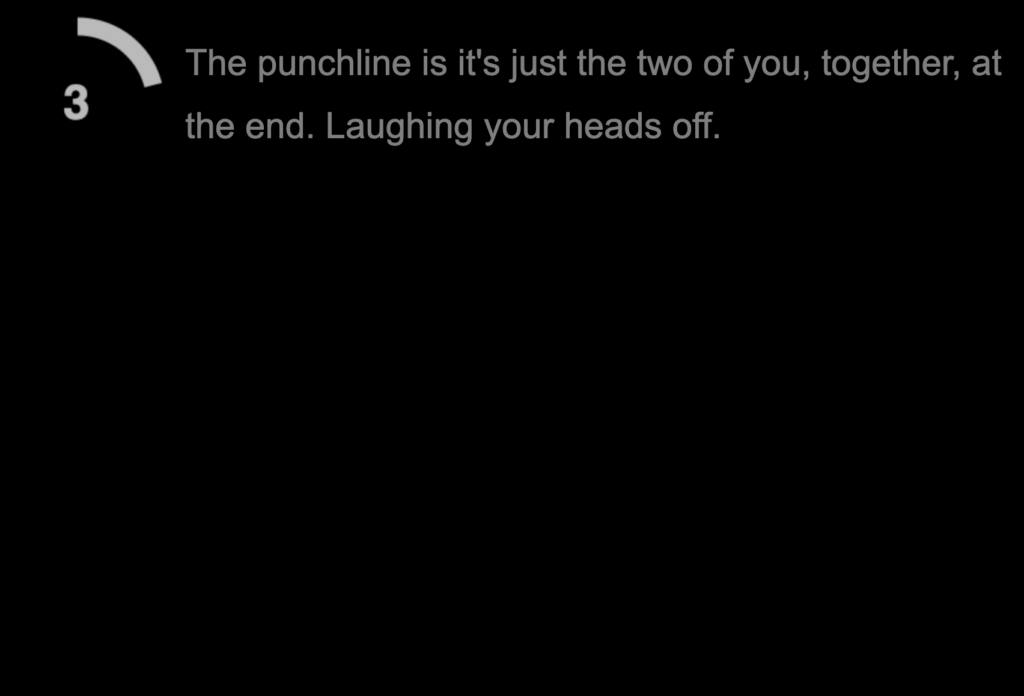
(Fig 1). The game places the player in the perspective of a queer person with their lover, and grants the player complete agency over how they spend their last 10 seconds on Earth. This forces the player to consider a multitude of endings, all having to do with intimate queer love: do they want to spend their last 10 seconds having sex, kissing someone, being held, or talking, or doing nothing? At the end of the 10 seconds, no matter what outcome or path they take, the player is met with the same screen (Fig 2).
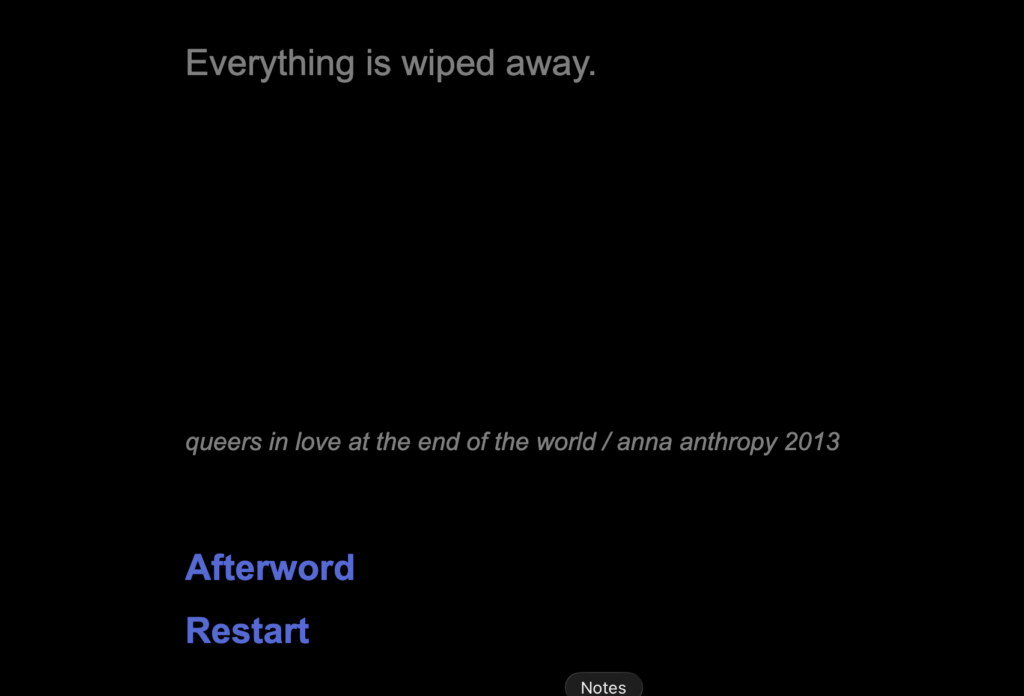
From a formal element perspective, the fact that every path leads to the same objective should give the player less agency; however, this is replenished at the end screen, where they are given an opportunity to “restart,” either to continue the path they were branching down at a faster rate, or to explore another path.
The agency given by the mechanic of restarting allows the player to speak up against a system of power, in this case, the end of the world, which itself may be an allegory to the status quo of queerness in America, where Anthropy is from. Chess notes that “mechanics have power, and that power can exceed the boundaries of the narrative they are representing” (91). The silence ending, which the player achieves by responding to their queer lover with a silence hyperlink, underscores this; they are giving up their agency, and therefore are no longer able to play through the game (Fig 3).

In contrast, every other hyperlink in the game leads to new passages. According to Chess, “by not being climax-centric, the video game narrative is free from the heterosexual masculine perspectives that have guided our storytelling expectations for centuries” (89). By allowing the player to explore multiple passages and endings, all of which a resistance or attempt to experience more in the face of imminent destruction, Queers in Love at the End of the World does not follow the traditional linear, climax-centric storytelling of video games and instead prioritizes the player’s agency, challenging the heterosexual masculine perspective of singular endings and limited understandings. In this sense, the mechanic of restarting empowers the player to resist the linear, masculine scarcity of time and explore a magnanimous amount of queer text. The enacting, branching narrative mechanic subject to the formal element of a rule of time is a powerful representation of scarcity in queer relationships (here represented as the end of the world rather than political and societal backlash), especially in relation to their world, and the agency in exploring this narrative is a powerful tool that allows the player, queer or not, to understand how their actions play into queer love (91).
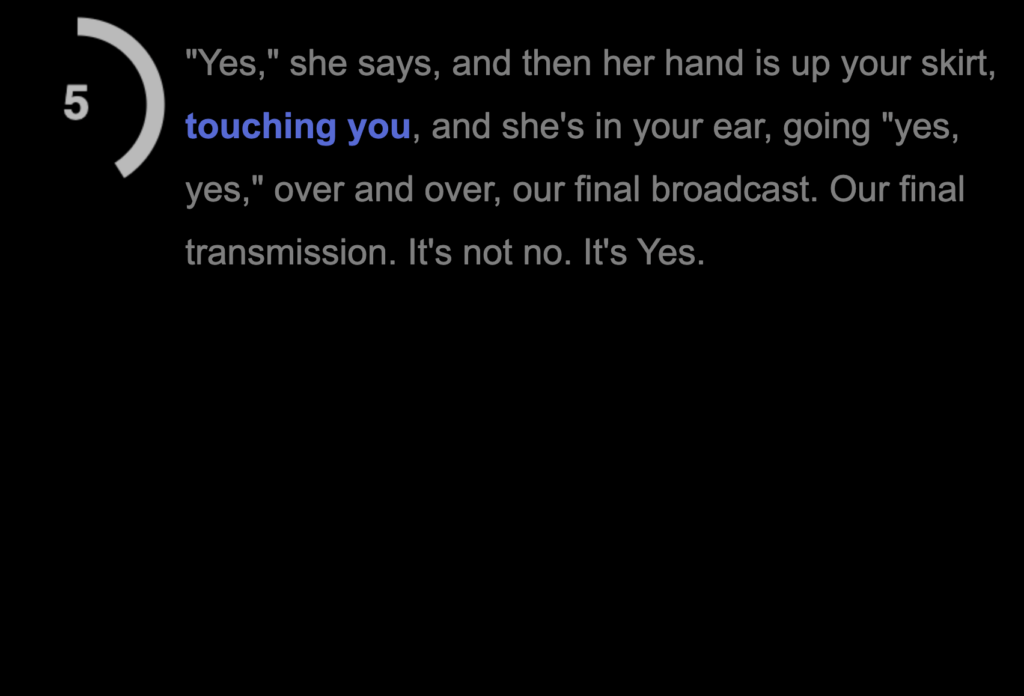
According to Anthropy, there are around 180 passages that the player can explore, and the sheer magnitude of decisions on every screen in the form of hyperlinks almost adds to the physical architecture of the text-based game, presenting both a constraint/obstacle and an understanding of the massiveness of the game and the emotional vertigo which comes with it. Some of these passages are based around the idea of sex, specifically queer sex in relation with a woman (Fig 4).
While these are important to the theme of the game and may be empowering to the creator, they may also prevent this game from reaching a larger audience, especially younger queer players who may want to engage with their agency in video games, where Chess states that “feminist empowerment means playing more video games” (92). To restrict this to an audience of players older than 18 due to its agentic (participatory) sexual content is unfortunate, but as a counterargument, I believe that the discomfort that queer sex may bring in a non-queer player may evoke emotions that one who is typically within the system of power (maleness, heterosexuality) might not experience in their everyday lives.