

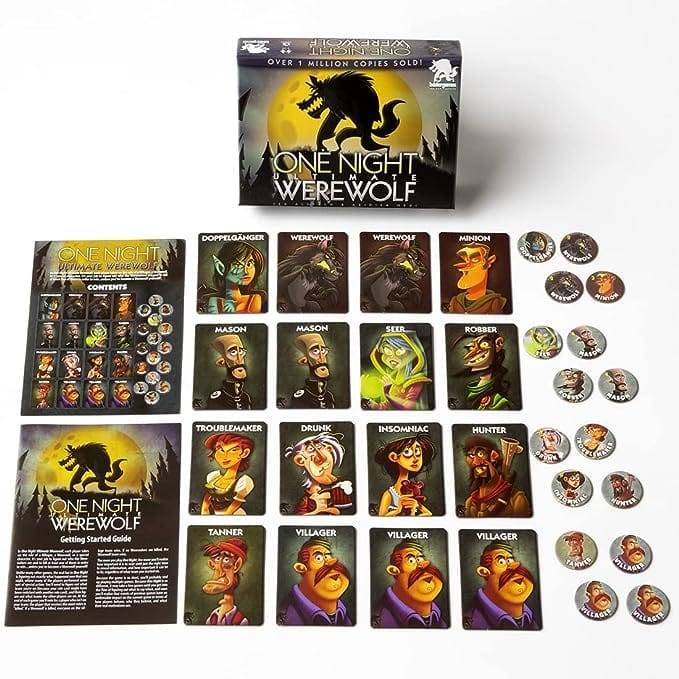
I played One Night Ultimate Werewolf, a modded, fast-paced Mafia-based social deduction game designed by Ted Alspach and Akihisa Okui and published by Bezier Games. It’s designed for 3-10 players, primarily for those ages 8 and up. It’s originally a board game with physical role cards, similar to The Shrimp Game, but I played it online with friends back home (I forgot to take screenshots, so please bear with me). In Bartle’s taxonomy, this game is definitely targeted toward socializers, especially those who enjoy cheeky deception. While both One Night Ultimate Werewolf and The Shrimp Game explore asymmetrical roles in social deduction and bluffing under the comfort of fast games, their difference is in their structure: One Night Ultimate Werewolf is a multilateral teams-based, one-round deduction game, whereas The Shrimp Game is a free-for-all that plays across multiple rounds. These differences change player incentives, game aesthetics, social dynamics, and the role of deception in each game.
One Night Ultimate Werewolf is different from other Mafia-esque games because it only has one round and no deaths, other than the person who is voted out at the end of the only discussion round. In this sense, everyone could participate in the game and didn’t have to worry about dying, and we could play multiple rounds without getting tired. This one-short-round mechanic ensures that, aesthetically, One Night Ultimate Werewolf serves primarily as a fellowship/social game with lower stakes, making it more ideal for parties than more intense social deduction games, blurring the otherwise intimidating line of the magic circle. Similarly, we designed The Shrimp Game to be low-stakes with a fast and replayable 5-10 minute game cycle based on quick turns and whiplashing action cards. The fundamental time mechanics of our games directly correlated with the stakes and the emotional investment of the player, and therefore by shortening it, both One Night Ultimate Werewolf and The Shrimp Game are able to come across as more casual than other social deduction competitors.
Both games rely on asymmetrical roles and bluffing, where players can try to misrepresent their roles to win or avoid certain loss. For example, when I played as the Minion, I intentionally acted suspicious to garner votes, which was an admittedly funny scheme. Furthermore, the “joker” cards in One Night Ultimate Werewolf serve a similar purpose as in The Shrimp Game: mixing up gameplay for overall pleasure. I was really happy to get the Drunk role because I knew that there was a chance I could mess up the game for everyone and completely mix up the flow of the game. From a design point of view, these asymmetrical roles make every game different and thus incentivize multiple rounds in any given session. Where Mafia has a formula, One Night Ultimate Werewolf will always have some chaos baked into it, and that is what gives the game its identity and replayability

In The Shrimp Game, we have 4 random roles distributed from a pool of 6, which similarly change up each game and force players to track each others’ behaviors. To win, you have to hide your win condition (due to our Swordfish/Narwhal role), and this is primarily achieved through intentional bluffing and a hiding of interest or goal. When regarding the low stakes nature of each game, it’s also important to consider that the roles are mostly positive fictional identities, and thus do not imply anything triggering (besides the Drunk, or perhaps all the roles in The Shrimp Game if someone is allergic to shellfish). Both games have ensured that there is safety within the magic circle, which may lend to the comfort of the player overall.
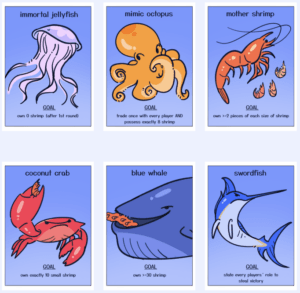
Our games differ wildly when you consider that One Night Ultimate Werewolf is a multilateral game, with two teams vying against each other, whereas The Shrimp Game is a free-for-all where everyone must play toward their own win condition. In the traditional Mafia sense, the Werewolf and the Minion are obviously evil and must band together each round to win, whereas the Village role must discuss effectively and without malicious manipulation to correctly vote someone out. In the Shrimp Game, we gave everyone their own win conditions and roles which perhaps killed the aesthetic of fellowship within the game and inspired challenge within the player to successfully bluff and inch toward their win. One Night Ultimate Werewolf implies a dynamic of collaboration to win, whereas The Shrimp Game incentivizes individuals to win; deception transforms from a collective means of survival into an individual means for victory, showing how one mechanic can serve different roles in different contexts based on the game.


