
Game: Codenames Duet
Creator: Vlaada Chvátil
Platforms: Physical board game, online website
Target audience: Casual or strategic players (roughly teen and up) who enjoy playing in a group
Players: 2+, played with my roommate
Codenames Duet masterfully uses information asymmetry to generate the game’s tension, but it achieves this through high skill ceiling wordplay that risks excluding players entirely. Find the Farm, our team’s concept, shares the same structural concept of information asymmetry, where one side knows something the other does not, and the game is the act of closing that gap. However, it distributes the thinking and deduction through spatial movement, card-based structure, and direct yes or no questioning. Playing Codenames Duet revealed which design decisions we want to emphasize, which we want to avoid, and why our game’s approach to deduction more effectively serves its players. Specifically, we incorporated the mechanics of information asymmetry as the central tension and a constrained space that forces meaningful turns.
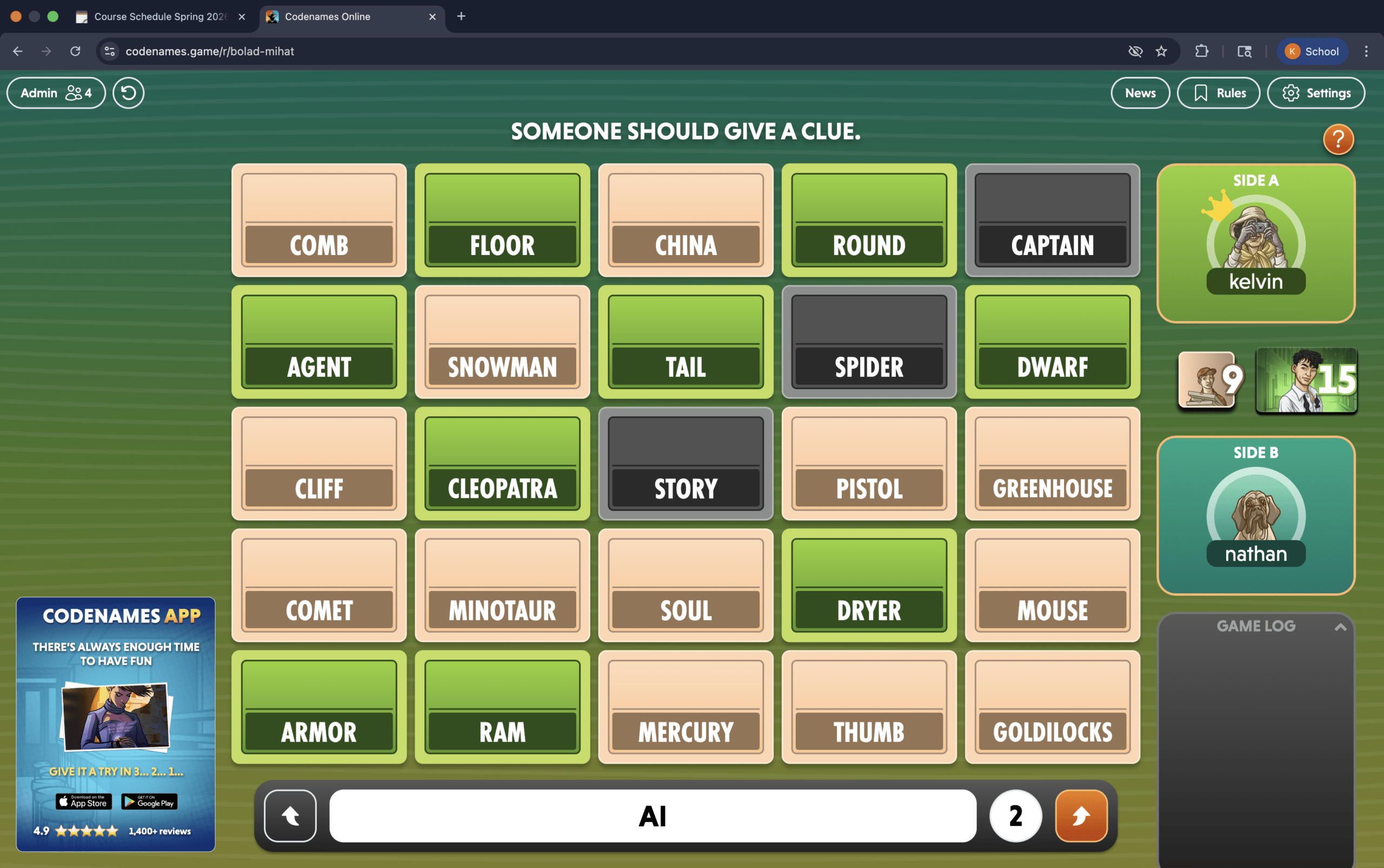
In Codenames Duet, two players cooperate to identify each other’s agent cards, instead of playing on two different teams. Since there are no teams, the objective is to find all 15 of the agent cards within 9 turns. These mechanics can lead to lots of cognitive effort as player’s try to give clues for seemingly unrelated words to get multiple cards. The dominant aesthetics here are fellowship, discovery, and challenge. The challenge is linguistic and cognitive, the discovery is the moment a partner makes the leap and the connection clicks, while the fellowship is trying to understand your partner and how their experiences might impact their hints.
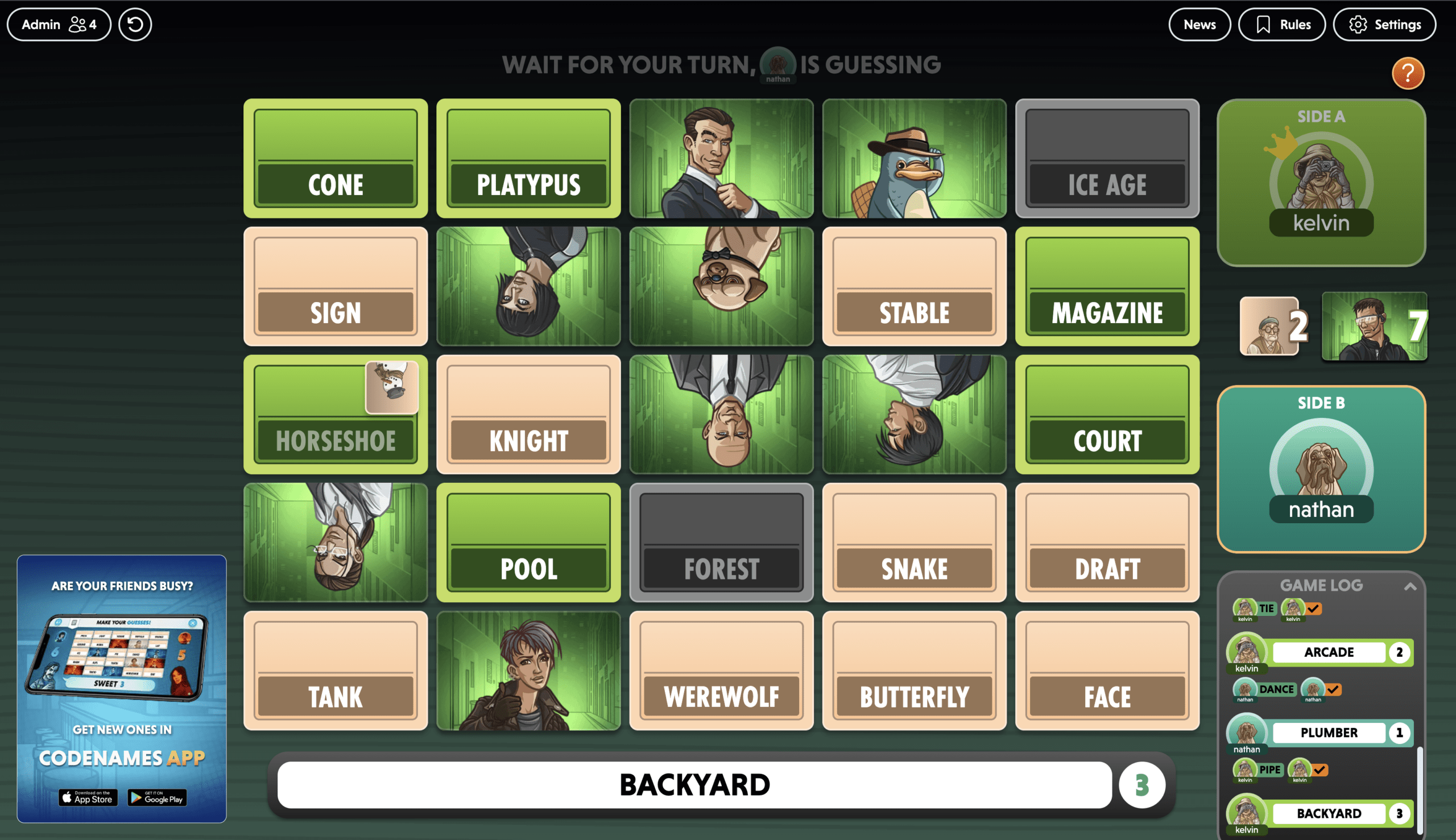
But sometimes, the hint clicking does not happen at all. During our games, my clue of “backyard 3” tried to bridge three words, “horseshoe, pool, court” and landed with visible confusion. My roommate stared at the board and told me “that is such a reach.” In my moment of trying to stitch three words together, I also overlooked that one of the assassin words was “forest,” which is related to backyards. The clue was definitely too ambitious and we lost that game when he chose “forest.” There is a sense of urgency when having to pick clues in a turn limit, that can make choices feel more frustrating than fun when partners’ interpretations and experience do not exactly line up. In the next game, my roommate was trying to come up with clues to connect words and said, “Ugh, I’m not smart enough for this.”
This is one of the cons of Codenames Duet. The game’s difficulty scales with the shared cultural, linguistic, and life experiences of its players. Two people with mismatched vocabularies or thinking styles will find the game consistently frustrating rather than challenging, and there is no other mechanism because the game relies on this kind of wordplay. Compared to other games in the co-op deduction genre, like mafia, this limitation stands out. Codenames Duet is more demanding with few options when players are not in sync. This mismatch of life experience is something that we addressed in our game.
Another frustrating mechanic occurs when players run out of clue giving turns. It turns the game into a free for all where both players have to just guess the remaining cards without any more clues. This can be annoying because the game is essentially over if there aren’t any remaining cards from previous clues. We also addressed this in our game as seekers continue to go until they find the hider.

Find the Farm begins from the same structural premise as Codenames Duet: the hider knows something the seekers do not, and the game is about narrowing that gap. But the mechanics of narrowing work differently. The hider chooses a grid spot on the Stanford map game board to “hide,” and seekers silently ask questions from a card deck and receive binary yes or no responses. This replaces linguistic interpretation with more deductive logic. The cognitive challenge shifts from “what word connects these things?” to “what question gives me the most useful information given where I currently am on the map?” This is a more manageable problem for a wider range of players, and it keeps the skill ceiling high.
The spatial movement layer adds a dimension that is absent from Codenames Duet. Seekers physically move across a grid, meaning their location becomes a variable in their deductive reasoning as they continue to ask questions. Where Codenames Duet is abstract, Find the Farm is physical. Your position matters, the board matters, and the decision of whether to move, ask, or guess on a given turn creates a meaningful action choices outside of giving clues and guessing cards. The hider’s power cards serve a similar function to Codenames’ assassins, introducing uncertainty for the seekers. But, unlike the assassin, the powers disrupt progress without completely ending the game. It also makes the game more engaging for the hider besides answering yes or no questions. Disruptions that complicate the path to victory are more interesting than disruptions that completely cut it short. Assassin tiles are very dramatic in the moment but disappointing, while power cards keep players more engaged.
Overall, what we did not want was a game that might be inaccessible for certain groups of players. This comes from experiential mismatches and linguistic gatekeeping. A game that produces the response “I’m not smart enough for this” sometimes leads to barriers that it intended as a challenge. Find the Farm’s card-based question system ensures deductive tools are available to all players.