
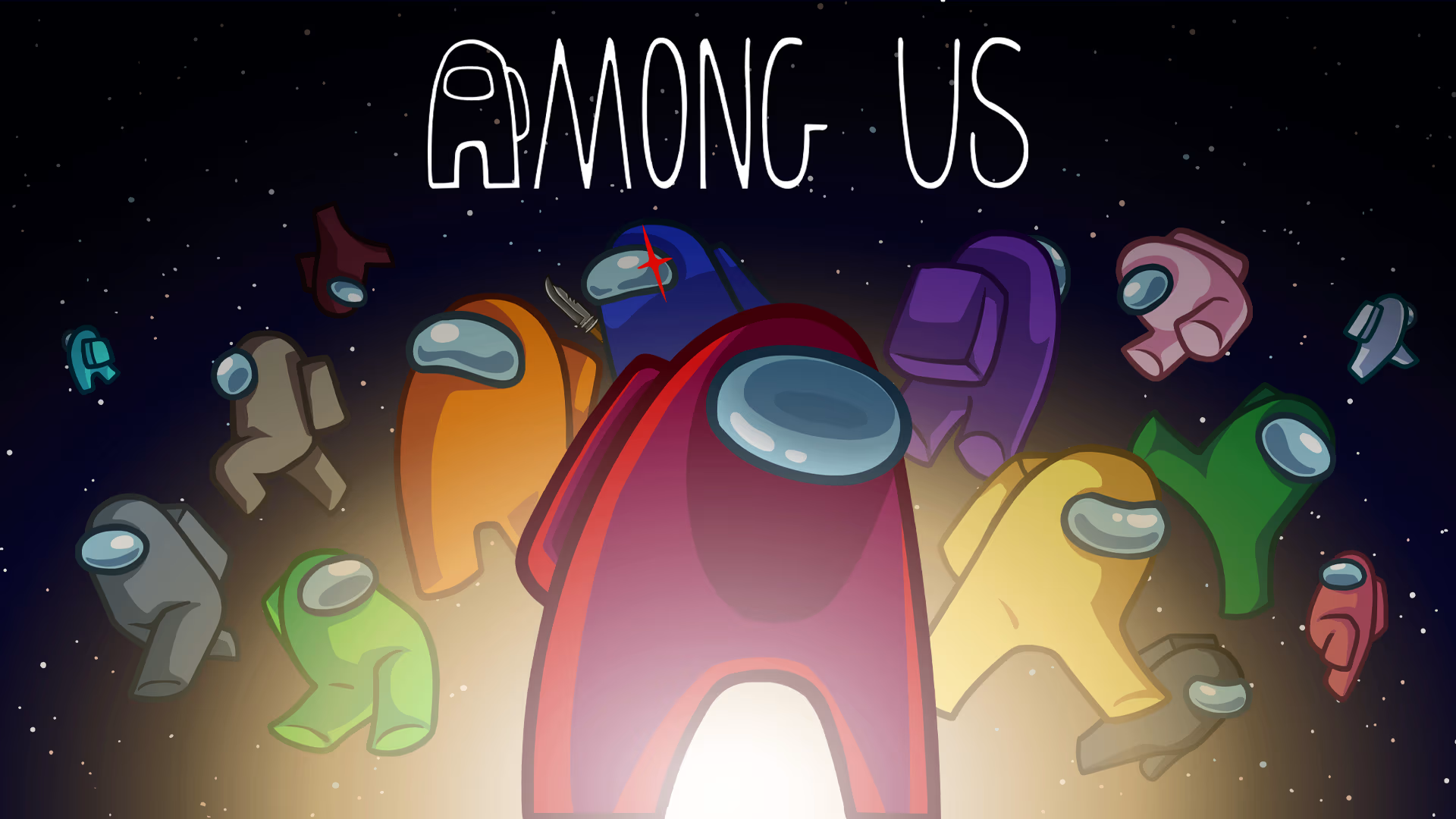
My group is creating a social deduction, murder mystery hybrid game called Accomplices & Alibis (name is TBD, but it is a Samaritans [good] vs Spoliators [bad] game). Moreover, I chose to focus my critical play on Among Us, a popular social deduction / “friendslop” game with the goal of finding the imposter(s). Among Us was released by Innersloth, an indie game studio, in 2018. It was originally released on iOS and Android, but later made available on Windows, PlayStation, Xbox, the Nintendo Switch, and more. It does not have a universally suggested age range, but it likely targets those around 14-30 years of age. It can be played with 4-15 players and is intended for people who like social deduction. Among Us contains a largely customizable ruleset (i.e. anonymous votes, kill cooldown, visual tasks) and togglable role system. This overall flexibility really separates Among Us from other games of the social deduction genre like Werewolf, Coup, and Avalon; it can be played in both a more casual / “friendslop” style or more competitive one.
My central argument is that Among Us and Accomplices & Alibis have similarities, specifically regarding the games’ psychogenic domains of achievement and information; however, they also have clear differences regarding player engagement and player profiles, specifically involving intensity and play styles.
Among Us’ first similarity is that it contains the same group of psychogenic domains as our game; as both games are hybrids of information and achievement.

Anonymous Voting (greyed out icons).
As shown in the above example, these greyed out icons in Among Us encourage greater autonomy in voting, as this design choice discourages groupthink. If this design choice was omitted, players would likely be scared to vote against consensus, creating a less compelling voting stage. Our game also utilizes autonomy, as if a single person decides to fail an expedition in a given room, the clue the game moderator gives is tampered rather than a true clue. This gives each individual player significant power in the final decision, as one vote from any member can change the outcome of the clue.
In Among Us, as both crewmate and imposter, it is critical to explore and seek knowledge in order to give one’s team the best chance to win. Innersloth employs tools to address this via the information psychogenic domain. One notable mechanic that Among Us incorporates is the admin table, which can be seen in the below image.
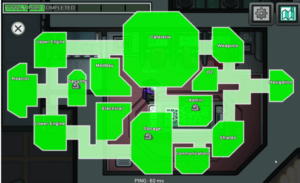
Admin table from our first game
The admin table illustrates MDA: it is a mechanic creating a dynamic of asymmetric information, which leads to a more complex discussion stage. Both crewmates and imposters can use the admin table, so it is also encouraged to discuss admin information in meetings. The admin table, along with another similar mechanic in the camera system, create an aesthetic of uneasiness among players– a feeling that you could be being watched at any point. Without these designed mechanics, the game would feel more random and task-oriented, resulting in less dynamic interactions between players. Accomplices & Alibis attempts to utilize asymmetric information as well, specifically with the sheriff role, which knows who one of the spoliators (specifically, the information tamperer) is. The spoliator; however, does not know who the sheriff is, but has a secondary win condition of finding out who the sheriff is, which creates a dynamic of the sheriff wanting to assist the Samaritans– while not being too obvious.
Our game was originally Mafia inspired, but one flaw of Mafia is that there is nothing to do while dead. Among Us addresses this: when one dies as a crewmate ghost, they can still do their tasks, and when one dies as an imposter ghost, they can still access sabotages and doors.
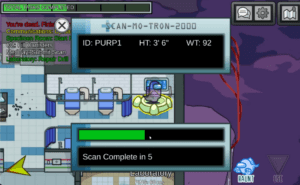
Doing the “Medbay” task as a ghost
For instance, I died first in one of our later rounds, but these little minigames (in this case, Medbay) exercise players’ brains and keep an early death from leading to boredom.
When designing Accomplices & Alibis, we wanted to keep player engagement high at all phases in the game, but did so in a different way. We framed it in a way where the Game Manager was the one killed by the Suspect, and that no one actually dies during the game until the final round’s final vote. While a key difference from Among Us, it ensures that all players at all points are actively participating in the game, even if suspicion builds naturally for certain players in this fellowship-styled game.
Lastly, the player profile when comparing Among Us to Accomplices & Alibis differs. Among Us does not necessarily require high intensity. With multi-platform integration, a group of friends on their phones just aiming to pass time can have a vastly different experience than Windows players playing in a ranked tournament. Our game differs, as we aim to have the intensity relatively high throughout all stages, while increasing incrementally throughout the game. Currently, all players have to pay significant attention throughout our game to figure out the solution, specifically keeping track of all relevant quests, rooms, and weapons on a provided notesheet.
Among Us also does an excellent job of encouraging different play styles, as a more passive, alibi-heavy style, or a more aggressive, trigger-happy style can work depending on one’s group, which is a design choice making Among Us quite replayable. This is not currently the case for our game, as based on Thursday’s playtesting session, aggressive styles are more optimal for Samaritans, and passive styles are more optimal for spoliators. This is a key, unintentional difference. Before our final prototype, we aim to test this balance via more playtesting.