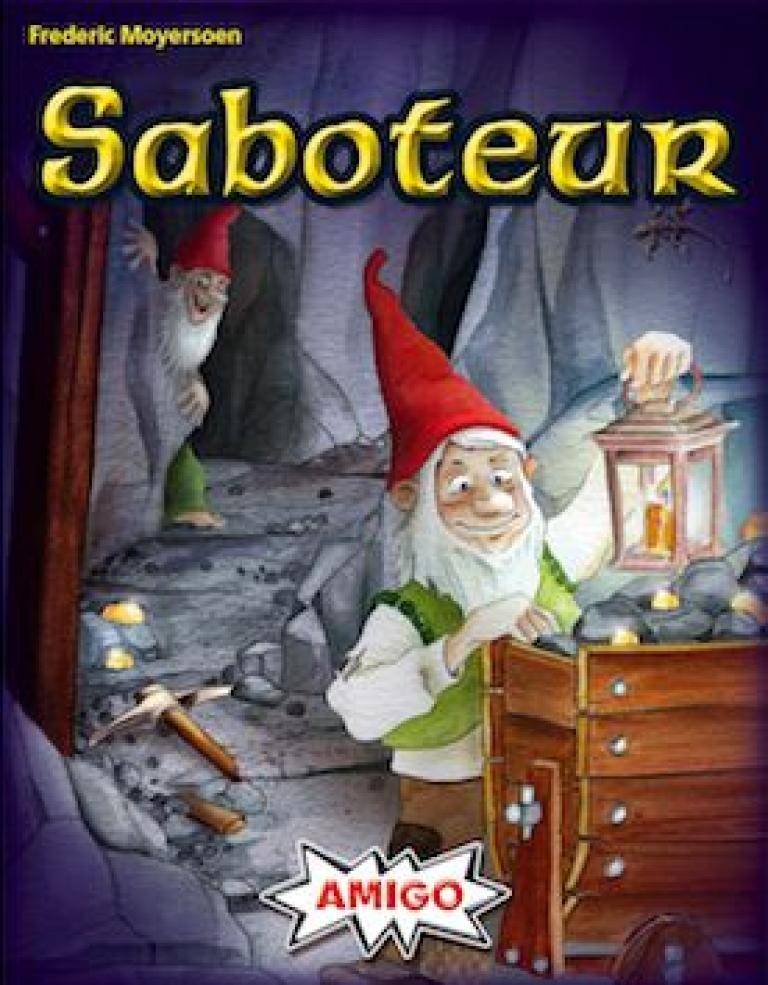
My group’s game, Rock-it, centers on resource distribution, roles, and bluffing. For that reason, I chose to play Saboteur. Created by designer Frederic Moyersoen and artist Andrea Boekhoff, Saboteur is a mining game where one miner (or two) is trying to sabotage the rest of the players in their search for gold. This game is simple enough to play, and there isn’t a particular target audience. I would say that it’s fit for anyone over 12. I played it online at Board Game Arena, so I will analyze the game as an online game.
To start with some key differences between the two games, the dynamics of roles and resource distribution feel much more salient in Rock-it than in Saboteur due to the large variety of roles that we include and the fact that each move that players make is directly related to attaining more resources. In Saboteur, there are only two roles: Miner and Saboteur. One design critique with regards to roles is that it is very difficult to tell which role you have. The first round of the game, I played as a miner since I was frantically searching the screen for my role and couldn’t locate it. Look for the red oval in Figure 1 to see how tiny the words “Saboteur” are. This felt pretty inaccessible, but I will note that the game included a pretty thorough tutorial which helps counteract some of the design flaws.
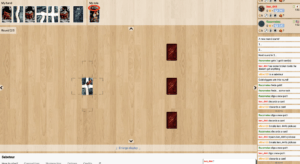
Figure 1
Once I began playing the game correctly, it quickly became apparent who the saboteur was, resulting in a fairly straightforward game with no bluffing. This was surprising as the game was listed as a bluffing game in the Board Game Arena genres, but it seemed very different from Coup or Secret Hitler where you are incentivized to bluff the whole game. The mechanic of everyone playing their cards in a way that is visible to all other players results in very little ability to lie about your actions or motivations, which resulted in a fairly bland dynamic. On the contrary, we deliberately chose to implement the mechanic of multiple roles in Rock-it (Politician, Activist, Space Cowboy, etc.), all with their own motivations. The abundance of possible characters and motivations gives players more uncertainty and creates a more engaging dynamic. We also give players a lot of privacy with their moves, which allows them to keep up a charade for much longer than I was able to in Saboteur. Overall, Saboteur gave me a sense of Discovery fun since it was a novel game and I had to figure out the best strategies. This made it especially satisfying when I improved over the rounds. Rock-it, on the other hand, seems to have more Fellowship fun baked into it as the bluffing and bartering are much more central dynamics to the game.
Despite these differences, the two games had many structural similarities that resulted in similar aesthetics. The most impactful similarities were the social element, the three round nature, and the potential for large switch ups in who is in the lead. With regards to the social element, I wasn’t expecting Saboteur to be very strong since I was playing online. However, the chat element of the game led me to enjoy the game because of the people I was playing with which led to an aesthetic that was more focused on socializing than I would have expected (See Figure 2). We kept some light conversation going throughout the rounds and it made the experience more enjoyable. I do feel that I would have felt more of this had the game been in person, which is why I think I characterize Rock-it as being more centered on Fellowship fun. The moments I remember most from playtesting our game are the lighthearted laughs and big reveals that hit a lot harder when playing face to face.
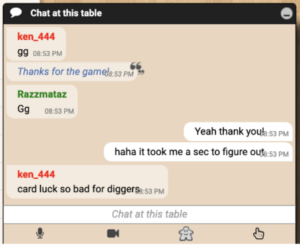
Figure 2
I thought it was an interesting coincidence that both these games had three rounds, but not too surprising. Having rounds as a mechanic gives players a chance to rest and reset throughout the game. It also allows players to bounce back if they feel they were doing poorly earlier. Building the ability to recover and reframe your standing in the game is a dynamic that should be prioritized when designing a game as you want to create an environment where players can mess up and not feel that all hope of winning is lost. Including this in the game leads to a more forgiving and gentle aesthetic, which I tend to prefer when playing games.
The last dynamic I noticed in common was the ability to quickly change the leaderboard of the game. For example, I totally failed at Saboteur the first two rounds. However, I was able to win a fair amount of gold in the last round, leading to me unexpectedly taking 2nd rather than last (See Figure 3 for the final ranking). Similarly, in Rock-it there are many roles that take specific actions at the end of the game. For example, our Robin Hood role can pick a character to steal rocks from and redistribute them to the masses. If they picked the wealthiest player to steal from, Robin Hood wins the game. This mechanic of having large changes towards the end may be too extreme and we might have to adjust it, since it may create an unfair dynamic that favors certain players.
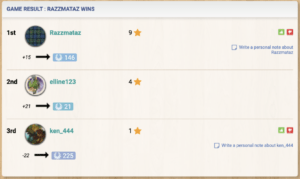
Figure 3