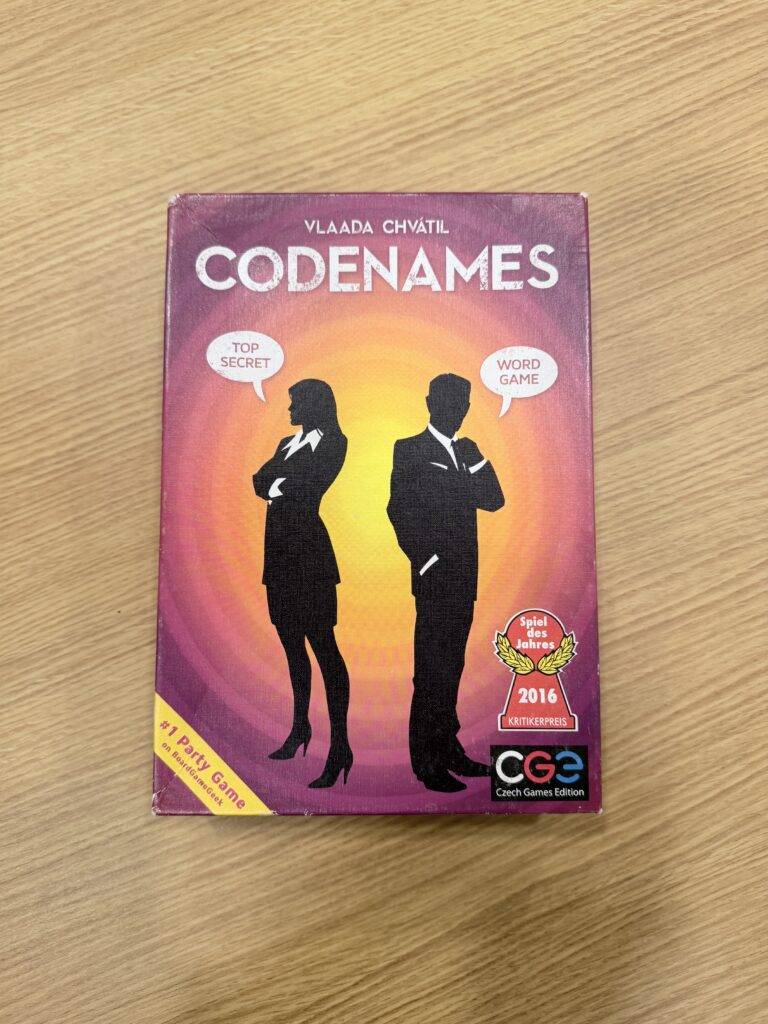

Codenames is already one of my favorite games. It is a team-based word association game designed by Vlaada Chvátil. The way people perceive associations and make deductions between words differently is the most important part to pay attention to in this game. It clearly covers a wide range of players, from casual to strategic, serving a variety of target audiences. I played it with people who share the same cultural background, and although we used the English card deck, we played in Korean. This was a very new experience because, as I wrote in my previous critical play, people who share a similar cultural context and social background tend to have overlapping interpretations. This made the game feel smoother and more collaborative, compared to my earlier experience with culturally unfamiliar humor-based games.
Codenames is similar to our game, Emergency Response, in that both rely heavily on communication as their core mechanic, but they structure that communication very differently. One interesting similarity is that both games use a 5×5 grid-based system. In Codenames, words are laid out in a grid and players interact with them through clues and guesses. On the other hand, in Emergency Response, each tile has a specific function such as danger, survivor, cat/dog, or empty space. While Codenames treats the grid as a semantic space, Emergency Response treats it as a physical and functional space. This creates a similar visual structure but leads to very different player interactions. However, the grid organizes information and creates a shared reference point for communication in both cases. Comparing our game to an existing game helped me understand how the same game mechanic, like a grid system, can change players’ dynamics and aesthetics.
The difference becomes clearer when looking at how communication is constrained. In Codenames, communication is centralized and highly restricted. The spymaster can only give a single word and a number, which forces teammates to interpret the meaning. This creates a dynamic where players negotiate meaning together, and the aesthetic outcome is a mix of tension and triumph when guesses align. In contrast, Emergency Response distributes communication across roles. Each player has different abilities—such as the Engineer removing danger or the Medic rescuing survivors—and this creates a system where communication is not just about interpretation but about coordination. The dynamic here is shaped more by time pressure and dependency. We focused a lot on fellowship and expression in our game. Players must rely on each other’s roles, and miscommunication has more direct consequences, such as triggering danger tiles or failing to meet the rescue goal.
This also affects how players experience failure. In Codenames, failure is relatively low-stakes. A wrong guess may benefit the opposing team or end the game. In Emergency Response, players share responsibility for failure. A player who reveals a danger tile becomes unable to act until someone, usually the Medic, revives that player.
From a design perspective, this comparison highlights different types of player experience. Codenames emphasizes interpretation, shared understanding, and creativity, while Emergency Response emphasizes coordination, efficiency, and risk management. However, this also reveals a trade-off. Codenames allows more flexibility and expression because players can interpret clues in multiple ways. Emergency Response may limit that flexibility by assigning strict roles and actions. We received feedback that the rules are too complicated, but this is typical for co-op games that go against the game system. This could reduce engagement for some players, even though it increases structure and clarity.
In my previous critical play, I discussed how games can unintentionally exclude players based on cultural or social context. Codenames depends on shared knowledge, which can disadvantage players from different backgrounds. Emergency Response reduces that dependency by focusing on mechanics rather than cultural interpretation, and our team agreed to design a more inclusive game for all players. We try to avoid making certain roles more active or influential. This suggests that designers need to think carefully about mechanics and how participation is distributed among players, so that every player feels they are in the magic circle together.