I played the Jackbox Party Pack, specifically Drawful and Fibbage, with my friends back home, and it was nice to catch up with them amongst our banter-filled rounds. It’s a collection of games from Jackbox Studios that are centered around playful deception and socialization. The game is made for literally anyone, but if I were to try to categorize it, it would be party attendees and casual gamers between the ages of 16-40, and especially, as I’ll argue later on in this blog post, millennials. We played it off of Steam, but it’s also available on many other platforms and consoles. I believe that Drawful and Fibbage, as party games, highlighted my and my friends’ abilities of camouflage and deceit, by incentivizing deceitful behavior with points.
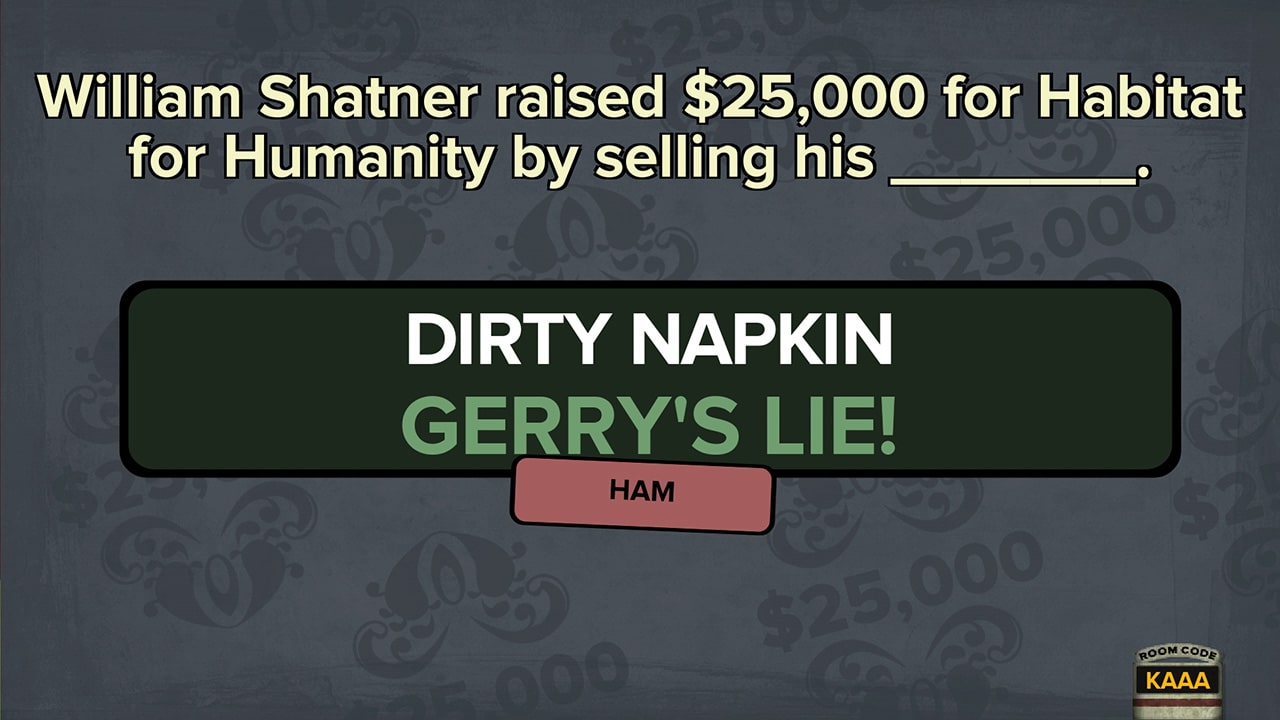
For context, Drawful is a player versus player multilateral video game that plays like Pictionary with guided (and intentionally misleading, I should add) answers provided by the players, and Fibbage is a very similar game of providing fake answers to random trivia facts. In Drawful, each player draws their own rendition of a unique prompt, and each player can submit a fake, anonymous answer. In the next phase, players are given each image accompanied by the actual answer surrounded by impostor answers, and must guess correctly to receive points for the round. If the player follows the forbidden action of guessing an impostor answer, the impostor gains points, which gives them an edge in the final scoring. That is to say, in the sixty seconds the player is given to create their fake answer, they should create something that describes the picture well but is believable as an answer. In the interest of word count, Fibbage is the exact same, but instead of writing impostor prompts for pictures, the player writes impostor fill-in-the-blanks for trivia questions. Both Drawful and Fibbage ask the player to create something convincing so they can gain a competitive advantage through points, and therefore they are built on the very nature of deceit.
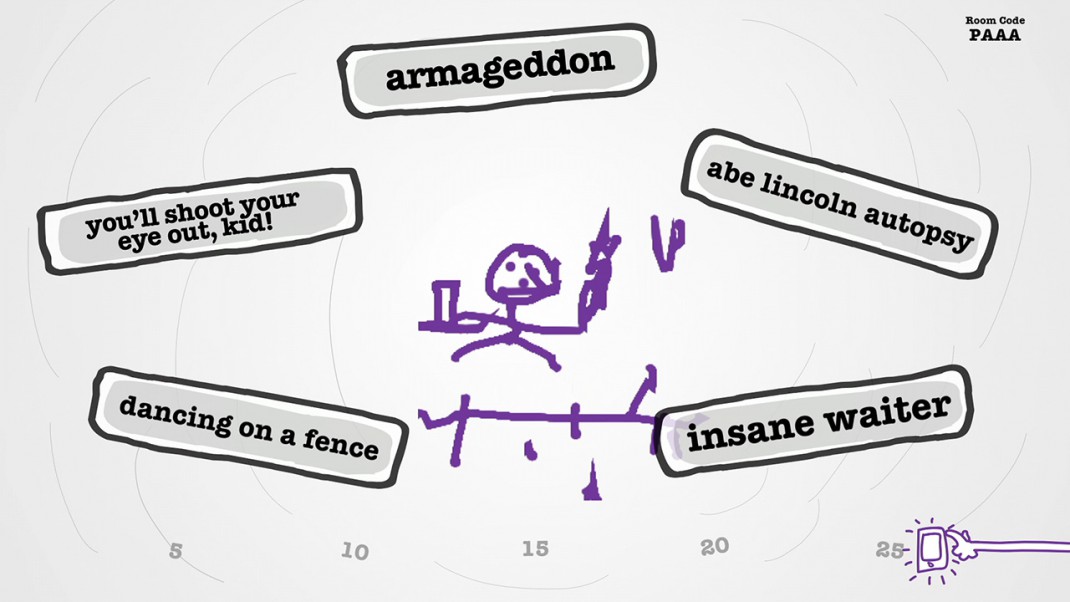
When we were playing the games, we noticed that there was a clear pattern with how the real prompts were named; they often used bizarre modes of punctuation that no one would take the time to spell out, niche millennial references related to Disney and films from the 80s which we’d never watched, and other clear giveaways as to what a real answer would be. For example, one of our prompts was “The Disney Vault,” which puzzled us, and another was “Oh no! A bee!”, which was just… not a typical phrase in our cadence (Jackbox Studios). (Another example is the image in this paragraph, which shows a ridiculously punctuated answer.) As a result, my friends and I would try to imitate these archaic-sounding answers when we created our fake answers. Where we were originally in the magic circle of the game, this flaw yanked us out and gave us a new objective: make our answers sound as millennial as possible to overcome the obviousness of the game’s provided prompt, which inundated the challenge aesthetic of the game and leaned into a deep sense of fellowship in dealing with the flaw, while also limiting the true expression of our impostor prompts and answers. In this sense, the incentivization of camouflage and deceit in Drawful and Fibbage actually take away from the game, as they force the player out of immersion and pull from an unfamiliar vocabulary.
For a judging game, I believe that there is no way around the feeling of implicit social rejection of not having one’s response picked. Very often, the soul and core mechanics of judging games such as Cards Against Humanity is to make the funniest combination of Black Cards and White Cards, and the scoring is based on judging. This is no different from Drawful and Fibbage, where you must create an impostor prompt or answer that is practically begging to get picked; to win the game, in any judging game, you literally must be picked. Therefore, I believe the player who intentionally engages in a judging game must shed their ego at the edge of the magic circle and embrace the challenge aesthetic of creating something that will bring entertainment and joy to the circle. That is not to say that the players within the magic circle should not be supportive and kind to each other, as I believe that that is implied in sportsmanship within a magic circle. However, I also believe that if a player knows empirically that they will not enjoy a judging game for the very reason that a judging game exists, then they should not participate in it and suggest another social game, such as Mafia. If sportsmanship exists within the circle, it should exist outside of it, as well, and therefore the group should accommodate to the needs of their members.