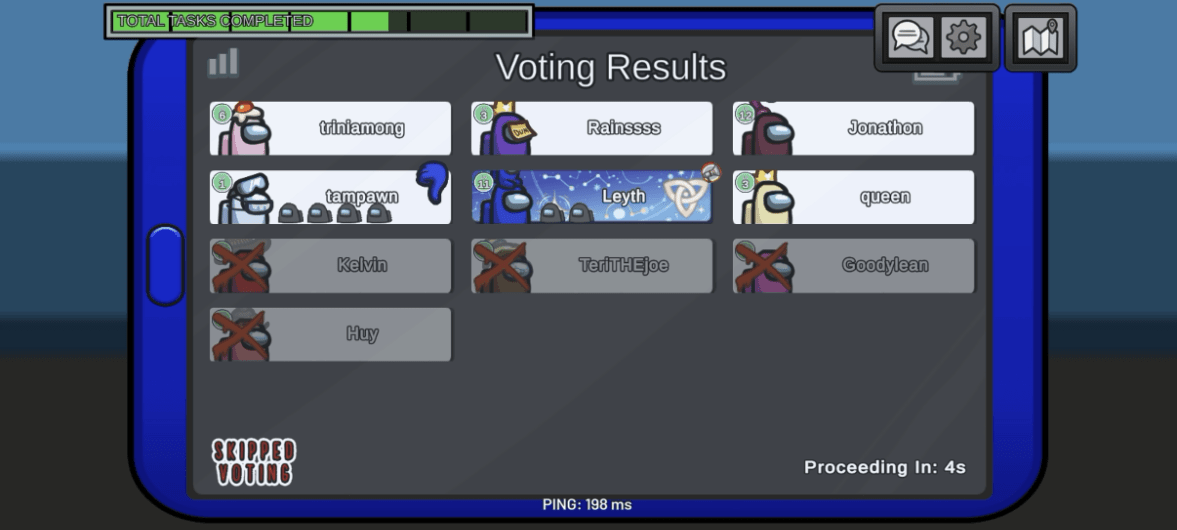
For my critical play, some of my friends in the class convinced me to hop onto Among Us. Now, I have played Among Us before, but outside of maybe one or two games, I haven’t played the game in something like 4 or 5 years. We also decided that to get a more representative experience, that we would play in an open lobby with strangers online. I think one of the biggest changes to the mechanics of Among Us since I last played was the addition of roles beyond just the crewmate and the imposter. When we booted up the game I honestly thought my knowledge from years ago was going to save me, but in truth I think that having that knowledge served to my detriment for a while.
I think this lack of knowledge highlighted how much I tend to present myself as knowledgeable in these kinds of social situations. I usually use very logical arguments, often predicated around deep knowledge on a game or system. In one of our first rounds I got assigned the role engineer, who is able to use the vents usually reserved for the imposters as a crewmate. Despite the fact I had never played a game of among us with the engineer role included as a mechanic, I fell back on the patterns I used when playing among us during COVID lockdown. I spoke very confidently about how the game worked, so when someone else was caught using the vents and claimed to be the engineer, I said “Um actually I’m the engineer so you’re definitely the imposter.” Since just before this I had correctly identified the imposter, everyone trusted me immediately, and this poor innocent engineer was thrown out of the airlock.


After this misstep I started to be much quieter, and definitely sort of left the “discussion leader” role I often take on in games that I think I know well. Having increased randomness in the form of these new roles curbs a lot of what you can say definitively in a game like Among Us. I remember when the game blew up during the pandemic, game knowledge was often enough to make huge claims based purely off of process of elimination. In the earlier days of the game there was this dynamic where you could catch one piece of objective evidence and by process of elimination you could effectively solve the entire game. Since the mechanics were relatively deterministic it was easy to draw cause and effect correlations. Now though with these extra roles, the game becomes much more of a guessing game where you don’t quite know what’s going on. It makes the game feel less structured in a lot of ways, and really opens up discussion more. Since the mechanics have been expanded so far, there’s more than one reason to be in a vent for example, and so the social, discussion portions of the game have become much more important since there’s always more than one way to explain something.
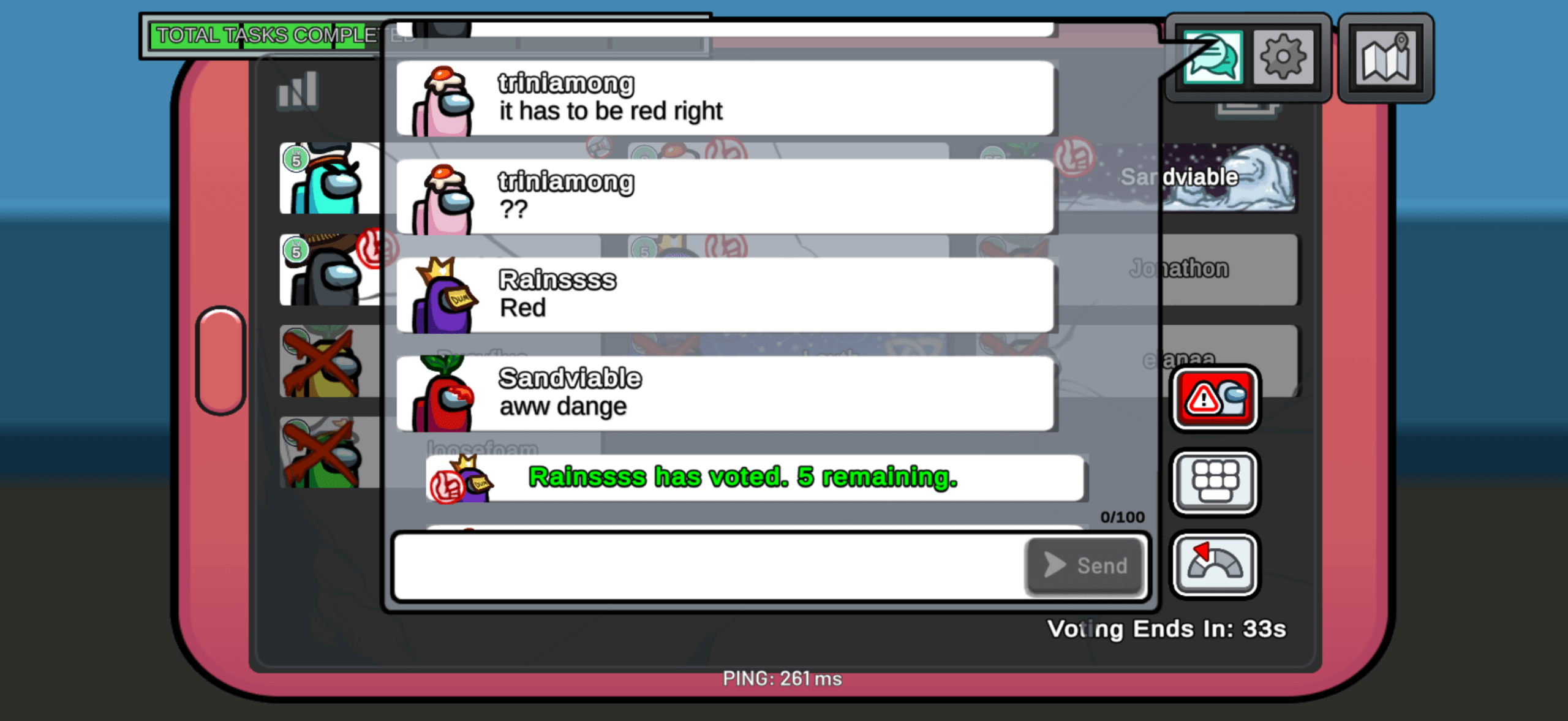
Over the course of playing we ended up actually have some strangers stay and play with us for multiple rounds. I have almost exclusively played among us with people I already knew, and I hadn’t used the game as a medium to build new connections. Even though the vast majority of the game is spent in silence and with no communication, the mechanics of the game still allow for people to express some innate characteristics of their personality. In one the pink player got killed early in the game, and we all immediately suspected cyan since they had been tending to walk around the map with pink. We didn’t act on this evidence because it felt flimsy, but then 3 dead bodies later we finally voted for them and it turns out our intuition was correct. I find it really interesting how giving player an embodied avatar can do so much to express our social tendencies. Even though the only communication we had between us and the random strangers was short periods of text chat, that sort of neutral time walking around the spaceship was enough to make us feel like friends to an extent. Despite never even hearing each others voices, we were able to form social connections with people just by perceiving ourselves to be in the same virtual space as them. I think Among Us fundamental traversal and map mechanic make the game much more compelling than if it was some kind of turn based game with the same actions, because it creates social dynamics merely by putting players in a shared world. Here’s a silly reaction from one of our new friends in one of our later games.
Ethical Question Response:
As far as the ethical question posed about the game, whether or not lying constitutes a wrong action is very dependent on the game being player, or more accurately, on the norms of the players playing it. This ties into the magic circle a bit too in the sense that lying is morally allowed in a space, only if those in the space agree that it is. To unpack this, let’s think about why lying is even frowned upon in society in the first place. Lying and storytelling are fundamentally similar in a lot of ways, but they differ because by definition a lie is made without the consent of the other party. The “deception” in a story on the other hand is something the recipient is aware of, when we see actors playing roles we know that they’re acting, and so when they say their name is something else we don’t feel hurt or confused. In a deception game though, the players are on the same page, we all go into it expecting deception and have the knowledge that the lies are in service to a game. This is also why lying isn’t just okay across the board when playing games, it’s not the fact that we are lying in the context of a game that makes it okay, it’s that we’ve all agreed to lie and be lied to. When I backstabbed my mom in Risk after promising to be allies, that was not part of the social contract of Risk (and it’s why she still brings it up almost 8 years later). When I coup her in the game Coup though, she laughs it off because it’s something we both agreed to going in.