Target Audience: Young adults and older. Better if you have a smartphone.
Name of the Game: We’re Not Really Strangers
Game’s Creator: Koreen Odiney
Platform of the Game: In person card game
I played We’re Not Really Strangers with a group of players that I hardly knew. This was such a fun game to play with a new group of people, and I learned a lot about the players and myself. Overall, I realized that I’m not too nervous about being open with groups. I also felt that the game was purposefully designed to ease people into social interactions by starting with fun and relaxing questions and then moving on to more personal questions. Most get-to-know-you games do not ease into deeper topics as smoothly.
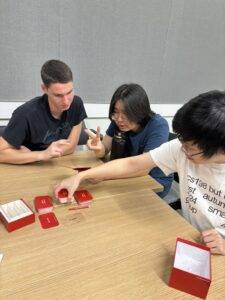
I learned that I am not always perceived the way I think I am. The most surprising assumption someone made about me was that I was popular in high school and had a clique that was not the nicest. OUCH! In truth, I was friends with a bunch of band kids. The game starting off with these lighthearted assumptions immediately got us joking with one another and poking fun at each other.
With regards to how this game affected our roles within a group, I found that while we didn’t feel like a group at all before this game, we came away with a sense of camaraderie that I wasn’t expecting. Upon reflecting, the game was about an hour and a half long. We joked, were uncomfortable, and opened up to one another for an hour and a half straight, and the time passed so quickly. I think the mechanic that most led to the time passing quickly was the three round nature of the game. Every half hour, something novel was introduced and the energy in the room changed with each new round. This avoided any awkward lags and it felt like everyone was engaged throughout.
Ethics
This game is constantly in conversation with the social norms surrounding what conversation topics are acceptable. In our round, we were playing largely with strangers. Normally, conversations with strangers would consist of small talk about classes, the weather, and weekend plans. However, there is nothing stopping us from having meaningful conversations with strangers. This game creates a magic circle where those social norms are softened, giving us the “permission” to break those norms without as many consequences.
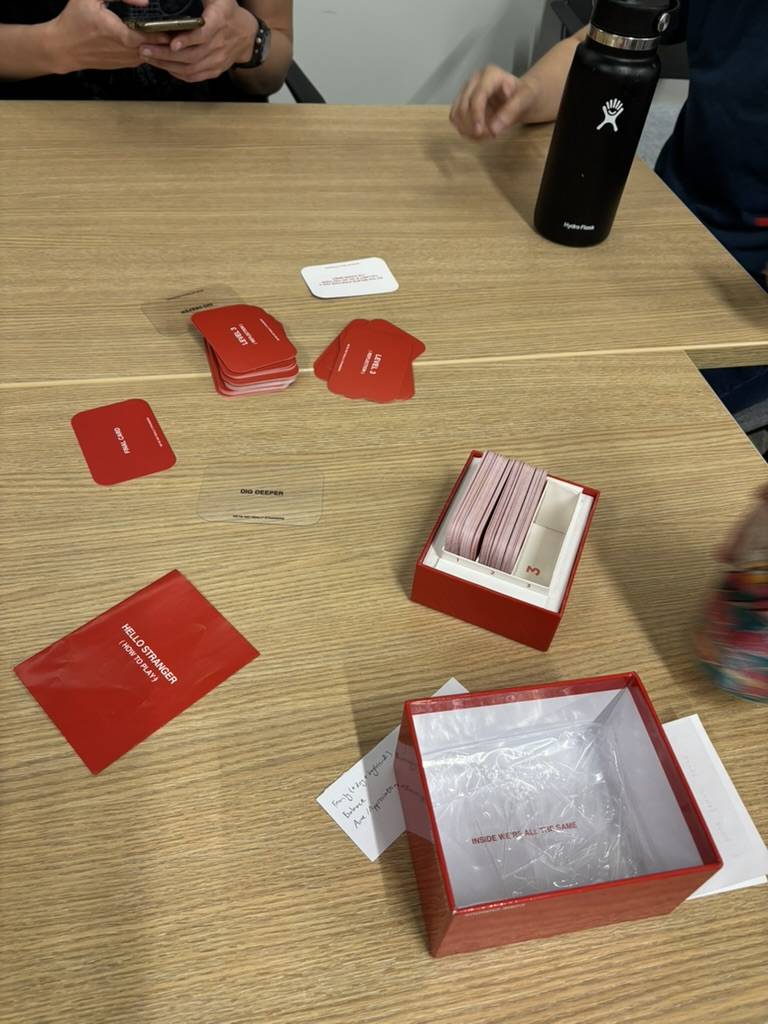
The presence of the “Dig Deeper” cards felt unnecessary. These cards sit on the table and can be tapped by any player once to claim that the person answering is not being quite open enough and should share more. This mechanic never came up in our round, and I think that reflects the fact that this game is purely as fun as you make it. If the players are not comfortable opening up, they shouldn’t be pressured to do so. I think this is summed up pretty well by the note from the creator included in the game:
“I have found there are 2 ways to play this game:
- Play safe.
- Play to grow.
The second is how you win.”
Everyone in our round took this to heart, and it led to a really great time. This game already includes some amount of social pressure to open up and be honest, and I think too much of that can put people in difficult situations. One question that drew my attention to this was “What is the most pain you have been in that wasn’t physical?” I could think of a lot of potential answers here that someone might not feel comfortable sharing, and give a vague answer as a result. I think if someone had pressed the dig deeper cards with a more vulnerable question, it would have changed the dynamic and likely been awkward enough to push us apart rather than bring us together as players. So, I think the game would be better off without these cards and leave it up to the players to open up themselves.
Design & Accessibility
One design issue I noticed was the instruction manual being hard to read. It took me a while to stumble through the sentences. The font size is tiny, and the margins are large enough that they could have made the text larger. Also, the thin white text on a red background was hard on the eyes, and maybe inverting it to be red text on a white background would have been more legible. Despite this issue appearing in the manual, I felt that the cards themselves were well designed and easy to read. Another design choice was that it was easy for people to join and leave this game. Some party games are not as flexible as this, so I appreciated that.