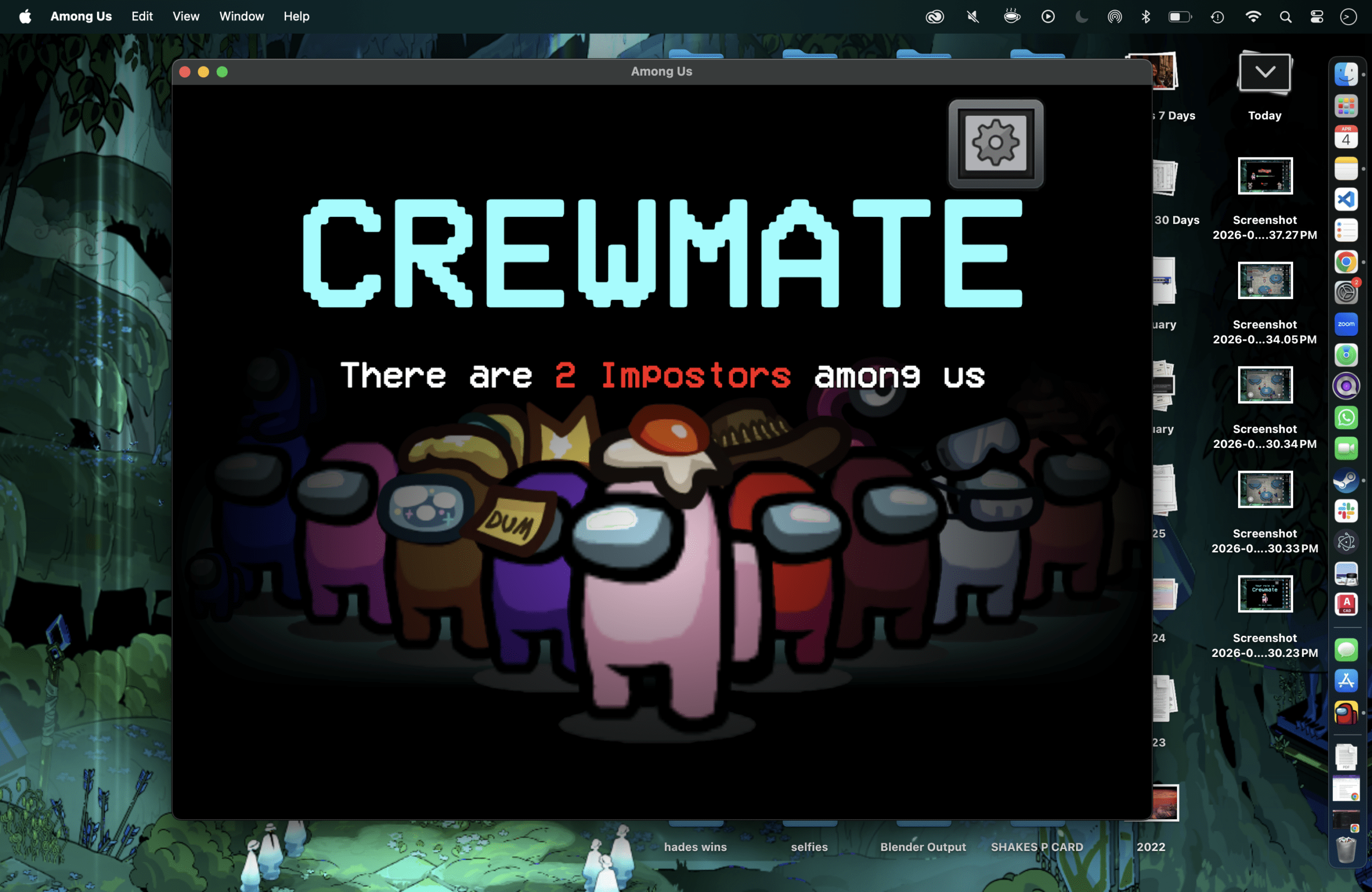
At a late-night time in Spilker, with the rest of the building largely empty, four friends and I took over a glass-walled conference room to play Among Us. It’s been years since I heard too much about the game and how it’d changed since its COVID heyday, but we were excited to play – and after a few minutes of figuring out logistics (who talks when, what medium are we playing on), we began by creating a lobby.

The first game, we played with just the five of us, and one imposter. This was the only time I was the imposter in the play session. Among Us’s game mechanics – that anyone can call a vote at a given point, or simply say what they saw out loud – lead to a stressful game for me, since I wasn’t really able to lie effectively in an in-person space and with so few people. I found that the game structure (that you can only see what’s happening in a room you’re in, that you must rely on visual and sound cues to identify information, that you must remember accurately and explain your ideas verbally) facilitated particular lines of questioning whenever a dead body was found. These lines of questioning are quick and hard to avoid – “I saw xx kill them” or “I heard them vent” or so on, that are built on claims, to be either disputed or not. I am not an extremely confrontational person, but it is due to the specific mechanics of the game causing a reliance on memory and verbal self-explanation that I struggled with.
This highlighted, for me, how my communication style is stronger in a written format, rather than oral or audial. I believe that Among Us’s game dynamics significantly changed when we switched later to talking in chat versus talking out loud, as the 5 of us were curious about playing in a lobby with many other players.
The mechanics of the game shifted immensely when the game became more centered around the digital realm. With a newfound “us versus them” mentality, as we could see each other react and laugh in real time as opposed to the random players in the lobby, the game became much more relaxed and fun. The game mechanic of anonymous voting and talking slowly in chat lead to social disinhibition – I noticed how sometimes we would get into a new game and within 5 seconds one of the online players would engineer a vote on no information. This is not the intended way to play the game, but the mechanics of the game make it possible. I realized then that my role was less to preserve the sanctity of the game and voting only when it made full logical sense, but more to simply make jokes about the behavior and continue making the experience fun for the group, through simply engaging with our lobby in that way without being too critical. After all, it is just a game.
Lastly, I do feel that I tried to provide useful information as a Crewmate when I could, also facilitated by the game mechanic – that up to 10 players can stay in the same lobby game after game and build social relationships with each other lasting between games. After a few games in the same lobby, I began to pick up on an interesting dynamic between us and the other recurring players. Because us in person were very comfortable with each other, I was able to banter in chat alongside my friends, and this encouraged the other players to as well. We built quasi-social relationships with them and their habits in game, how they lied and their strategies, which made the game even more engaging. For example, the light blue followed me in multiple games, a talked-about strategy in the voting room, and creating a pack bond. The social disinhibition through virtual mediation then seemed to make it easier to joke and play the game – with little consequence or verbal discussion through the chat mechanic.
In terms of the ethical question tied to the game’s theme, I would say that the morals of lying depend highly from game-to-game. I think if it is a game that requires or normalizes lying through directly building it into its structure or rules, then the players are almost given a moral free pass to continue, since it isn’t them personally deciding to lie for any malicious reason – they simply want to win a game and those are the parameters set for them. If it is a game that requires truth as a core mechanic, however, and a player chooses to bluff or lie, then that would indicate that the player has violated the bounds of truth and honesty outside the expected parameters of a game, moving it into a moral judgment of character external to the inner rule-set agreed upon. So, I would say that this question depends on the game itself. The games that rely on bluffing create a “magic circle” inner world where it is socially acceptable to be a “bad” person. Though, this then makes me think of other social games with more real-life consequence, such as the reality TV show Survivor (which is a similar bluffing game, but for monetary gain, and players use their own identities and are judged on their trustworthiness, and so on), or competitive bluffing games with monetary incentive, where perhaps the consequences of bluffing or lying are still considered in the context of a game and therefore are not significant moral transgressions, but may lead to more hurt feelings after.