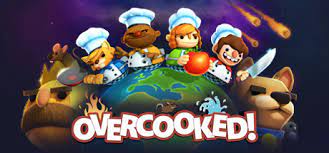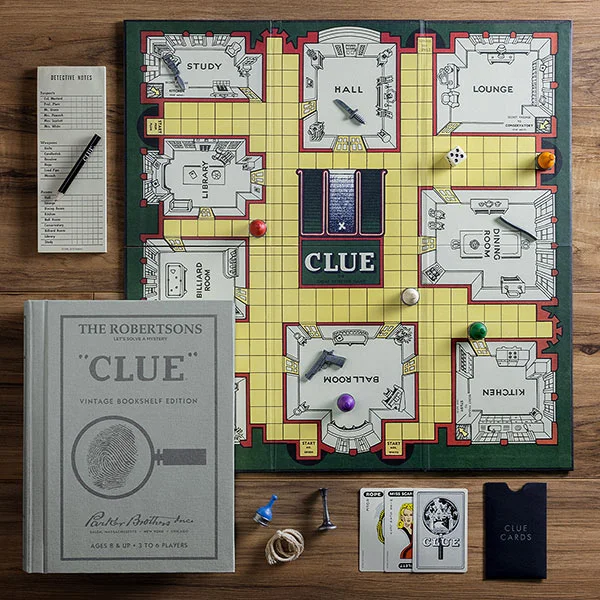
Our team is currently split between two directions: Mafia with (currently) undefined minigames, or a Clue-style game meets social deduction framework. My four exercise questions assume we go the Clue hybrid route only because I’m most familiar with and have created a loose concept to retcon and play around with. Nothing is set in stone. But honestly, the most important prototype might be the one that answers: Which direction is actually more fun? That’s a question we can’t answer on paper, especially not right now. We may have to build both. Quickly. And let the playtests decide.
Q1: Does the “room investigation” voting mechanic create meaningful social tension, or does it just feel like a slower version of Avalon?
Why this matters: Our current hybrid could lean heavily on Avalon-style team voting to investigate rooms. But if players just feel like they’re playing a worse version of Avalon with a Clue re-skin, we’ve failed. We need to know whether the room investigation phase generates its own kind of fun, suspense, paranoia, tactical lying, or whether it’s just procedural filler before the “real” game starts.
Prototype: Paper prototype. We’ll build 3-4 room cards, role cards (Suspect, Spoliator, Good Samaritan, Sheriff), and a simple voting mechanism. No shared notebook yet, no tampered clues, no Trust/Doubt phase. Just the investigation voting loop. We’ll run 2-3 quick games with 5-6 players and observe: are people arguing? Are they second-guessing their votes? Or are they bored?
My prediction: The first round will feel tense. By round three, without additional layers (tainted clues, the Sheriff as a target), players will start to feel the mechanic is thin. I think we need the “Tainted Success” option and the shared notebook to make this really sell. But I want to be wrong.
Q2: Does asymmetric information among the bad team (Suspect knows Spoliator(s), but Spoliator(s) don’t know Suspect) produce interesting confusion or just frustrating chaos?
Why this matters: This is our most distinctive design choice. Most social deduction games give the evil team perfect information about each other. We’re breaking that on purpose. The Suspect knows who their Spoliator(s) is (are), but they only know each other—not the Suspect. This could create amazing tension where Spoliator(s) accidentally sabotage their own killer ooorr it could just feel random and unfair. We need to know which.
Prototype: Paper prototype with a simplified ruleset. Only three roles: Suspect (1), Spoliator (2?), Good Samaritans (rest). No Sheriff, no tampered clues, no room investigations yet. Just a single night phase where the Suspect chooses a “frame” target, and the group votes on who the Suspect is. We’ll run 3-4 rounds and debrief: Did the Spoliator(s) feel empowered or confused? Did the Suspect feel clever or isolated?
My prediction: This may work better with experienced social deduction players and fail with new players. New players will feel lost. Experienced players will love the paranoia, and the challenge, of not knowing who their own leader is. That means we need an “easy mode” variant for first-time players, maybe the Spoliator(s) knows the Suspect in the basic version, and asymmetric info is an advanced variant?
Q3: Does replacing night kills with room investigation “failures” keep players engaged, or does it remove the urgency that makes Mafia exciting?
Why this matters: Everyone agrees player elimination (sitting out after death) is bad. But Mafia’s night kills create real stakes, someone dies, information is lost, the clock is ticking. Our room investigation failures don’t kill anyone; they just deny clues or reveal tampered information. That might feel less urgent. Players might not care enough about who gets sent on missions because the penalty for failure is seemingly abstract. We need to test whether “no one dies” is a feature or a bug.
Prototype type: Paper prototype comparing two versions. Version A: Our current room investigation system (failure = no clue or tampered clue). Version B: A modified system where failure also eliminates one player from the next investigation (not death, just temporary exclusion). We’ll run both with the same group and ask: which felt more tense? Which made you care more about who was on the team?
My prediction: Version A will feel safer and more inclusive, which is good for casual play. But Version B will create more genuine social pressure. I think our target audience (classmates, game nights) might actually prefer Version A because no one likes sitting out. But I’m worried Version A won’t feel like enough of a game – it might feel like a conversation with extra steps. We may need a different penalty altogether, like the bad team learning a secret about the Sheriff on a failed mission (which I drafted something similar in an individual concept draft but the draft is susceptible to HEAVY retcon.
Q4: Can the shared notebook with tampering be understood and used by players without slowing the game to a crawl?
*When I was coming up with this questions and answering it I was already retconning how the tampering system could theoretically work without a narrator. I still don’t want a narrator for the game and this system below would theoretically eliminate the need for one but comes at the cost of just being too much. So this is subject to change some more, a lot more.*
Why this matters: The shared notebook would be one of our most Clue-like mechanics. But physical tracking + social deduction + hidden tampering is a lot of cognitive load… If players spend more time staring at the notebook than arguing with each other, we’ve lost the social mediation soul of the game.
Prototype type: Again paper prototype with a literal shared notebook and three different colored pens (one for each player type). We’ll run one full game (4 rooms, final accusation) and time how long players spend writing vs. talking. We’ll also ask: did anyone notice tampering? Did anyone successfully plant false information? Did anyone feel overwhelmed?
My prediction: This will be the hardest mechanic to get right. First-time players will forget they can tamper. Second-time players will tamper too obviously. Third-time players will get it. I think we need a “tamper token” system, each bad player gets two tamper tokens per game, spend one to alter a clue. That limits the chaos and makes tampering a deliberate choice, not a constant burden.