

https://canvas.stanford.edu/courses/231736/assignments/825181
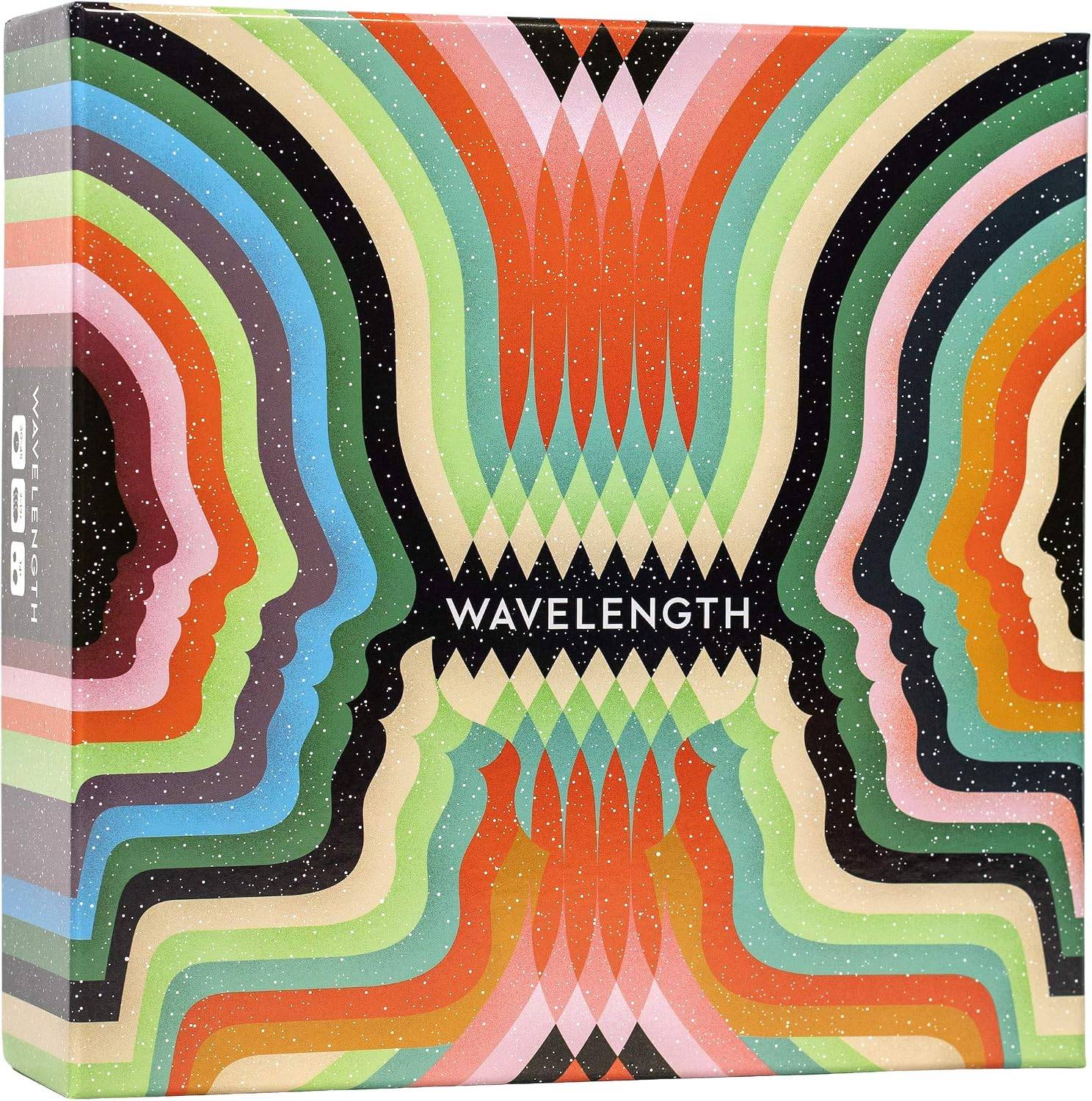
Wavelength is a game designed by Alex Hague, Justin Vickers, and Wolfgang Warsch and published by CMYK Games where one person knows where the point markings are located and says a phrase to the other person. The game’s objective is to collaborate together in a shared space, where both players are trying to adjust to each other’s vibes throughout the game.
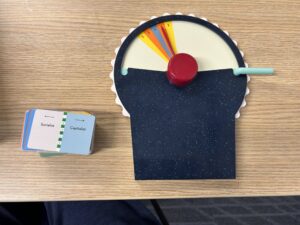
The photo above shows what the psychic sees. The information asymmetry between the psychic and guesser creates the guesser’s curiosity. If the guesser guesses on the yellow, orange, and blue section, they get 2, 3, and 4 points respectively.
The other person has to guess where the point markings are located based on the spectrum card (socialist vs. capitalist) and the psychic’s clue without looking past the cover shown below.
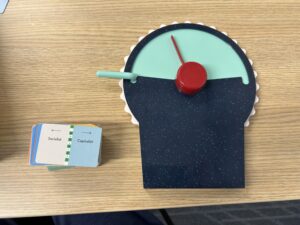
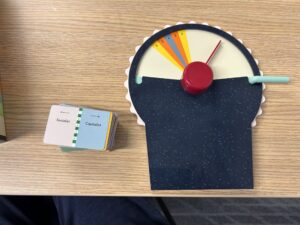
The first photo shows what the guesser sees, and the second photo shows the reveal of the answer after the guesser locks in their answer. The reveal of how close the guesser was creates a sense of achievement if the guesser is close to the points.
The wheel and knob have a satisfying click sound when you move the wheel around, which appeals to the player’s tactile fun. There is a challenge of communicating the exact words to best explain where the points are and trying to guess by understanding the other person’s perspective and the shared wavelength that both of you are trying to create. The game has fellowship fun, where both players are trying to collaborate on trying to get the most amount of points possible. It’s very repeatable because there are many different cards you could pick from the selection. The game promotes open-ended exploration of expression by prompting the thinker to form exact words to describe where the points are.
The mechanics of the game are the psychic providing a clue to the guesser, while knowing where exactly the points are located. The guesser turns the dial to guess where the points are. This creates dynamics where both players try to collaborate together. The guesser is curious where the points are, and there is a sense of achievement when you successfully guess near the points. The outcome of the game is understanding another person’s perspective. The whole point of the game is to collaborate and have some shared space, where you are trying to adjust to each other’s wavelengths as you play the game.
AI Tool Usage: I used Claude (Anthropic) to review drafts of this post. With my permission, Claude read my Google Doc and gave feedback on whether the draft met the assignment’s requirements, including photo captions, rule explanations for new readers, the MDAO framing, and formatting issues like typos and image size. Claude did not write any of the analysis; all of the text is my own. The full transcript of my conversation with Claude is linked here: https://claude.ai/chat/6eec110a-4c8b-4f8a-8195-46133d11fb37.
