

Secret Hitler is a social deduction board game created by Goat, Wolf & Cabbage, designed for 5–10 players and available as a free browser-based version at secrethitler.io. The target audience is players aged 17 and up who are comfortable with themes of political manipulation and deception.
Players are secretly assigned roles as either Liberals or Fascists, with one player secretly assigned as Hitler. Fascists win by enacting enough Fascist policies or getting Hitler elected Chancellor. Liberals win by enacting enough Liberal policies or assassinating Hitler. Since most players are Liberals, the Fascists must lie, misdirect, and manipulate to survive.
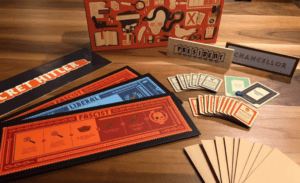
Cards and pieces for Secret Hitler
My Experience
The game I want to focus on is a round I played with a group of my friends this week (this was the second time that I played). I was assigned the role of Hitler. What followed was one of the more revealing social experiences I have had in a game setting. Playing the game exposed a side of my communication style I rarely get to observe: how I perform trust, how I read other people’s hesitation, and how I behave under sustained social pressure. My central argument is that the game’s social mechanics don’t just simulate deception. They actively surface real behavioral tendencies in players that would otherwise stay invisible in everyday interaction.
The defining moment came mid-game. As Hitler, I initially had no knowledge of who my Fascist teammates were, which is intentional by design. This forced the Fascists to gradually reveal themselves through subtle hints without alerting the Liberal players. Once I pieced together who my allies were, we started coordinating without appearing to coordinate: accusing each other publicly to create confusion, vouching for Liberals at strategic moments to build false credibility, and timing our moves carefully. When our team won, one teammate laughed and said:
“I can’t believe you were able to fool the other team for so long!”
That moment made something clear to me. The sustained deception had not felt uncomfortable. It felt like a puzzle we were solving together. This revealed something real about how I operate in groups. I tend to read the room carefully before acting. Secret Hitler gave that tendency a sharper, more calculated application, and the game’s structure made that behavior not just acceptable but necessary.
Analysis Through MDA and Formal Elements
Using the MDA framework from Hunicke, LeBlanc, and Zubek, the mechanics of hidden roles and policy drafting produce a dynamic of sustained uncertainty where nobody can fully trust anyone. The resulting aesthetic is a mix of Fellowship and Challenge: internal fellowship among the Fascist team, and the challenge of maintaining a false identity under social scrutiny. The Liberal team experiences a different aesthetic entirely, closer to Discovery, as they try to piece together the truth.
Compared to other social deduction games like Mafia or Among Us, Secret Hitler introduces a meaningful structural difference. The Fascists do not automatically know each other, and Hitler begins the game without knowing his allies. This asymmetric information is a formal element that produces a richer and less predictable dynamic than simpler hidden-role games where all team members start with full information. In Mafia, deception and deduction are separated into distinct phases. In Secret Hitler, they run simultaneously throughout every interaction, making the deception continuous rather than episodic.
Koster’s Theory of Fun adds another useful lens. He argues that fun comes from mastering patterns, and Secret Hitler is designed to resist easy pattern recognition. Because human psychology is one of the game’s core variables, no two games play the same way. This supports Koster’s point that games incorporating unpredictable human behavior tend to stay engaging longer than rigid formal systems.
One area I had thought about for improvement is onboarding. New Liberal players often struggle to understand what meaningful deduction looks like versus random guessing. A clearer set of starting guidelines would help new players engage with the game’s depth more quickly.
Ethical Reflection
The ethics question for bluffing games asks whether lying within a game is morally wrong. My view is that it is not, and Secret Hitler illustrates why. The game operates within what Huizinga called a “magic circle,” a shared agreement among players that normal social rules are temporarily replaced by the game’s rules. Everyone at the table consents to being deceived before the game begins. That consent is what separates in-game lying from real-world dishonesty.
Having said that, the game pushed on this boundary in ways I did not expect. The deception felt genuinely satisfying to execute, and the social skills it drew on were real ones. Koster notes that games teach patterns that carry over into real life, which raises a fair question about whether practicing strategic deception in a game sharpens those tendencies more broadly. I don’t think the game makes players more dishonest outside of it, but it did make me more aware of how much social persuasion relies on timing and performance, an awareness that extends well beyond the game table.