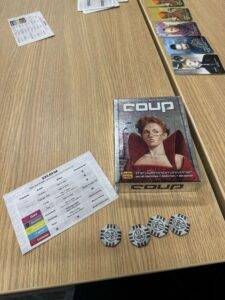
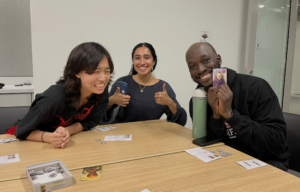
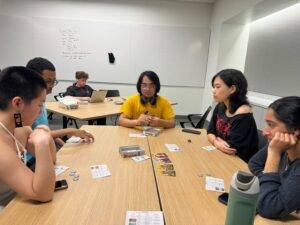
For this Critical Play, I played Coup with a group of 5 others from class during game night. Coup was designed by Rikki Tahta and published in 2012 by Indie Boards & Cards and La Mame Games. This is a bluffing game where each person has up to two character cards that each have different abilities related to politics. The objective of the game is to amass wealth and eliminate other players by lying and calling other’s bluffs on their abilities they have based on the cards they claim to have. The round took about 25 minutes to play, longer than the advertised 15 minutes mainly because we were all learning the game for the first time and would frequently pause to discuss rules and strategy.
Coup’s fun draws primarily from the fellowship of engaging with other players and capturing moments of well crafted deception. There was also an element of fantasy as the characters (Duke, Assassin, Contessa, etc) all came with unique abilities and we started to make up backstories and connections between them as we played. At the beginning of the game, I realized that this was an element I leaned into heavily. I wanted to have a connection between the Duke and Assassin as siblings, and the Captain and Contessa as spurned lovers in a feud. This desire for narrative overlay is unsurprising given my love for both tabletop and virtual RPG’s; there are few things I love more than getting completely lost in a world.
This love of escape also expressed itself in my comfort with the deception elements of the game. As an example, I showed up to the session just after the Noe (our TA) had explained the rules the first time, and the group generously offered to start over when I arrived. I got a quick crash course and we started playing. On my first turn, I used the fact that things could appear confusing to give an impression of having made a bad play, which cost another player a life when they incorrectly called a bluff. This led to a fun moment with lots of laughter, and it felt good to have contributed to a moment like that. That did place a bit of a target on my back as I quickly amassed wealth, and other players realized I had caught on quickly. I ended up being the second or third person to die, but the fun of the interaction was well worth it. This was a key insight on social games for me: the fun moments trump winning for me. This is surprising because I am generally quite competitive and like to win, but in these kind of games, I would much rather make “bad plays” that generate exciting moments than play to win.
The bluffing mechanic in Coup was a unique take that I hadn’t seen before and had a very high risk/high reward effect on the game that allowed it to move more quickly. Because players could only have up to two lives, a wrong call could get you to elimination quickly. Despite this, people were quick to call bluffs mainly because of the “coup” mechanic where a player who amassed 7 coins could automatically eliminate another player’s card. Fear of others gaining this advantage encouraged risky behaviour because it was better to take a chance on being eliminated on a wrong call than to have a guarantee of elimination if another player was left unchecked. Eliminated cards were also placed face up for everyone to see, which meant all players had the same information about how many of a certain character were still available in active play or the draw pile. I was impressed by how these different mechanics balanced each other out for fair gameplay. The only character that is potentially over-tuned is the assassin, especially in the late game, where the ability to eliminate other players by paying only 2 coins, as opposed to the 7 for a coup, proved to be very strong.
In terms of the ethics tied to the game’s theme, this game used global politics as a backdrop for intrigue and deception. The “blocks foreign aid” mechanic felt close to home, as I am from Ghana and have seen the effects of having foreign aid cut by the current US administration. Stockpiles of food aid rotting at borders and health centers shutting down are just two examples of the devastating effects that international war games can play. Overall, this was a poignant and fun experience that I would play again and recommend to others.