- Identify the basic elements in a game of your choice (actions, goals, rules, objects, playspace, players).
I’ll pick Hollow Knight: Silksong since I’ve been playing it recently. The primary actions in Silksong consist of: Moving Hornet around, Attacking Enemies, Jumping/Pogo-ing, Using a variety of skills (no spoilers!), equipping various tools/skills, interacting/speaking to NPCs/Mechanisms (Like benches!), buying things from shops.
The goals of Silksong include: defeating bosses, collecting tools, unlocking abilities, completing achievements, filling out the map of Pharloom, , fulfilling wishes made to NPCs (which in turn have a variety of goals often related to exploration or the defeating of enemies), and increasing the completion percentage by doing all of the previously listed goals.
Some of the rules of Silksong are defined by the physics system in the game, the terrain which dictates where a player can and cannot move based on the movement abilities they have unlocked. It also is defined by the enemies and the ways they are vulnerable to the player character, is x or y technique more effective against them (an enemy immune to taking “pogo” damage would have this as a sort of mini rule associated with it). The limits on what kinds of items can be equipped at the same time also function as a sort of rule. Shops and other ways to spend currency in the game also sort of serve as kinds of rules for the player.
There’s a ton of objects in silksong, tools (both passive and active) that the player can have, the enemies in the world, things like benches and ways to obtain maps, progress on the map itself is a kind of object, currency dropped by enemies is an object, terrain elements that can be “pogo”-ed off of are sorts of objects, destructible walls, traps and the like also fit under this kind of umbrella, health (masks), silk (energy), bosses (It’s a huge game so I could go on!).
The playspace of silksong is the 2D land of Pharloom, with its many areas.
The player in Silksong controls the character Hornet and can interact with the gameworld by platforming and using menus.
- As a thought experiment, swap one element between two games: a single rule, one action, the goal, or the playspace. For example, what if you applied the playspace of chess to basketball? Imagine how the play experience would change based on this swap.
I’ll apply the action of hitting the ball with a racket from tennis into American football. The quarterback would have the option to hit the ball with a racket instead of throwing it. The defense would have to be much more careful when trying to tackle the quarterback since they could potentially get smacked with the racket as they’re swinging. I imagine a football wouldn’t go very far if hit with a tennis racket though, so throwing would probably be a better option if the quarterback wants to get the ball far. I would predict that there be plays where the quarterback fakes a swing to scare the defense but then actually throws it.
- Pick a simple game you played as a child. Try to map out its space of possibility, taking into account the goals, actions, objects, rules, and playspace as the parameters inside of which you played the game. The map might be a visual flowchart or a drawing trying to show the space of possibility on a single screen or a moment in the game.
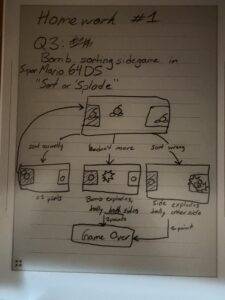
- Pick a real-time game and a turn-based game. Observe people playing each. Make a log of all the game states for each game. After you have created the game state logs, review them to see how they show the game’s space of possibility and how the basic elements interact.
Persona 5 Phantom X – Nightmare’s Getaway Battle
Game States:
To Start: All Characters at full health and boss at full health – SP is full, Highlight Starting at 25% (due to their character team composition). Boss has infinite health, goal is to deal as much damage as possible within turn limit
Choose skill, applying debuff to boss increasing the likelihood for allies to get a critical attack, dealing damage.
Did a turn on each character, dealing damage and buffing teammates.
The boss attacked, killed a character, so the player decided to restart the challenge to get more favorable luck.
On the next attempt, the player followed a similar pattern, applying debuffs to the boss in order to deal more damage with each character’s turn, but then, the boss again did a move which killed one of the squishier characters on the team, so they once again decided to restart.
This cycle repeats, with characters losing health and healing one another while doing damage. The player said “Time to roll the dice again” before starting the third attempt.
The game’s space of possibility is determined in two ways, one is through the team the player chooses to bring to the battle, in this case my friend brought the main character, Morgana, Mona, Motoha, and Yui. Once the battle is started, the second dimension of the probability space appears. Instead the possibility space is determined by the moves used by the player characters, and the boss’s random behavior. By using abilities strategically, the player can increase their chances of success and take advantage of beneficial interactions, or fall victim to the boss’s random behavior.
ZZZ Battle
Game start: Team consisting of Yuzuha (Support + Off field attacks), Burnice (Burn effect and debuffs), Alice (Main damage dealer), full health, boss has full health. Each character has a special gauge, burnice and alice start at full, Yuzuha starts at half.
On battle start switch from Yuzuha to burnice to apply her debuff, switch back to Yuzuha to build up her energy, to build up her extra special attack, then switch to burnice again to refresh her debuff, then switch to alice to deal big damage. This was the basic rotation the player used.
While they played, they occasionally timed their character swaps in order to deflect enemy attacks, the timing on this rotation was flexible, due to the lack of turns, the player;s mechanical skill in avoiding attacks was much more relevant. It seemed as though it would be possible to complete these kinds of battles without taking any damage if the player was skilled enough.
Zenless Zone Zero has a similar possibility before the battle as Persona 5 Phantom X in that the team brought to the battle determines the abilities the player will have at their disposal. Unlike that game, the possibility space once the battle has started seems to be larger. In P5X the player could only do the very specific actions defined in each character’s moveset in the fixed turn order. In ZZZ the player can use actions at any time, and can use them to completely avoid boss attacks without relying on favorable luck. In ZZZ the player is not required to even swap characters, there were occasionally long stretches where the player did not swap their character at all, whereas in P5X the structure of how actions were selected were much firmer.