


Game of Stanford🌲
Daphne Liu, Emma Wang, Abbie Maemoto, Hannah Yu — Team 1
Slice: Senior Year
Artist’s Statement
The Game of Stanford is a collaborative, part-digital, part-analog experience that invites players to explore the chaos, camaraderie, and choices that define life at Stanford. Drawing inspiration from the rhythms of campus culture—late-night trivia at the Arbor, the whirlwind quarter system, and the quiet pressure to “have it all”—this game uses episodic storytelling, interactive mini-games, and point-based strategy to simulate the balancing act of personal growth, academic ambition, and well-being.
In true Stanford fashion, players accumulate and juggle Aura, Prodigy, and Health points as they bounce between hard choices, campus events, and chaotic fun. The game is not about winning in the traditional sense—it’s about discovering how each choice, interaction, and challenge shapes your path forward. The final outcome isn’t fixed; it reflects a mosaic of the priorities and trade-offs players embraced throughout the game.
By blending humor, strategy, and narrative, The Game of Stanford transforms familiar experiences into a shared reflection. It’s an homage to the strange, yet beautiful mess of trying to navigate Stanford and stand out in an environment designed to push limits—together.
Model of System

Initial Decisions
From the beginning, we aimed to have our game design deliver an emotionally resonant experience tailored to our target audience, Stanford students—especially seniors. Our goal was to capture the bittersweet mix of nostalgia, chaos, and reflection that characterizes our time in university. To stay true to this vision, we made an early and intentional decision to scope the project as a vertical slice focusing solely on Senior Year, rather than attempting to represent all four undergraduate years. In order to fully capture the sentimentality that seniors feel at the end of four years of Stanford experiences, we felt that trying to narrate and fit in all four years into this project could potentially disrupt our storytelling flow.
From this, our choice allowed us to prioritize narrative cohesion and emotional depth over breadth. We wanted each moment in the game to feel grounded in the lived experiences of Stanford students, from row signature events and senior nights to off-campus travels and final moments with friends. By narrowing the timeframe, we began to plan crafting specific mechanics – trivia, memory challenges, choose-your-own-narrative cards – that could generate dynamics of friendly competition, shared storytelling, and collective memory-building. From the start, we wanted all of these components to come together to produce an aesthetic of belonging, amusement, and nostalgia for our target audience of Stanford students, whether they were seniors reflecting on their time and preparing to leave or freshmen curious about what their next few years could look like.

Further, in seeking inspiration for the tone and overall aesthetic of our game, we initially found this map of Stanford as key visual inspiration – it was whimsical and cartoon-style while capturing familiar campus landmarks with charm and personality. We ended up using the map itself for the digital part of the game, which we had not initially planned, as it helped express the lighthearted energy we had wanted to convey.
The type of fun we focused on delivering was primarily narrative and reflective, supported by light strategy and social interaction. The senior year theme offered a rich setting for moments of both individual agency and shared reminiscence. Each mini-game was intentionally designed to evoke personal Stanford memories, and our point system encouraged players to travel together, as they would just like real groups of friends do through Stanford, to each shape their own versions of their “Stanford story”.
We also aimed to make our game accessible and inclusive. Though the narrative would naturally be more meaningful for players who can refer to their own personal experiences at Stanford, our aim to have players “choose their own adventure” rather than play based off of personal experiences would allow them to explore and learn about the world of Stanford regardless of their level of familiarity with it. Our challenges also required minimal prior knowledge and varied across different mediums, allowing players from different backgrounds, class years, and experience levels to meaningfully engage.
Additionally, we initially decided to have a hybrid medium for the game rather than completely digital. In trying to curate emotional depth, we believed it was important to have an in-person, analog component to ensure that there would be human connection. For the digital component, we were initially inspired by the playfulness of Super Mario Party and how Mario’s team travels together to overcome challenges both competitively and working all together to relay the story of saving Princess Peach. For the analog component, we were inspired by the board of Game of Life, its similar playfulness, and how it simulates an individual’s travels through life – we considered how to adopt a similar structure as a foundation for the more emotional narrative of a real Stanford journey, which would be tailored for a more specific audience and time in their lives.
Iteration History
Playtest 1 (May 6) — Narrative & Theme Interview
Objectives: The objective of our first playtest was to gauge our target players’ interest in our game’s general Stanford theme and mini-grame structure. We presented our initial idea for the layout and structure of our game, captured by the design sketch below.

We guided our playtesters through this sketch, highlighting how players as a team would progress through the narrative, action, and trivia squares. The movement as a group reflected how students move through the school year together and everyone graduates as a class. This iteration was before we decided to narrow down our game to just the senior year slice, so the sketch also shows milestone activities that marked the end of each school year. During our interview, we presented mini-game ideas we had that were each tied to a specific location. For example, trivia questions at Treehouse and a run around the room activity at the Gym. We also asked our playtesters about defining moments from each year (freshman, sophomore, junior, senior) to help with our min-game and narrative brainstorming.
What went well: Our playtesters expressed interest and enthusiasm for a Stanford-themed game and liked the mini-game structure because it added in a competitive layer while maintaining the movement as a group on the board itself.
What we learned: From asking people to think about the most defining moments of each year, we quickly realized that we would not have enough material or the bandwidth (within 5 weeks) to fully flesh out mini games and narratives for all four years of Stanford. At this point, we decided to narrow down the scope of our project to a slice of a single year. We found that people had the strongest memories of freshman and senior year, and decided to pursue building our narrative solely around senior year of Stanford because it aligned the best with our objective to capture the nostalgia of looking back on your time at Stanford.
Ideas for next iteration: For our next iteration, we needed to flesh out our mini-game, trivia, and narrative activities and create a digital prototype that players could navigate through.
Playtest 2 (May 15) — Activities, Point System, Superlatives
This playtest was conducted in section on 5/15 with three seniors and one graduate student.

Objectives: For this playtest, we tested out a Figma prototype version of our game that showed movement of a bike on a board and also all of our activities (narrative, mini-games, trivia) that were all linked to properly simulate the digital experience. In this prototype we also implemented a point system (game points, aura points, health points, and GPA points) that culminated in superlative awards. We playtested with 3 seniors and 1 graduate student.
 Narrative game example that rewards points

Figma prototype showing movement of bike on board
During the playtest, we used two computer screens: one that showed movement of a bike on a board (which we intended to have physical for our final iteration) and one that displayed our various activities.
The objectives for our first run-through of the game were to gauge the level of fun and player engagement with our activities and see if the superlatives were a satisfying end to the game that gave meaning to the point system we developed.
What went well: Overall, playtesters liked each of the 6 mini-games we had and expressed that they felt the physical, reaction-based mini-games were especially fun. During and after each of these physical mini-games, players had more energy and were more engaged in anticipation that another reaction mini-game would appear. Players also felt that the narrative options were representative of the senior year experience and helped the game feel more immersive. With regard to the point system and superlative ending, players were excited and happy with the superlatives we handed out to them.

What we learned: We observed that players tended not to read the story results of their narrative choices, but instead only focused on the points that they earned or lost. Playtesters were also disproportionately obsessed with aura points over the rest of the categories, which made us think about how to make the other categories equally as appealing (especially GPA points). Additionally, the superlatives were really fun, but became a little complicated when one person had the most points in multiple categories when we had wanted everyone to end with an award.
Ideas for next iteration:
For our next iteration, we changed the name of GPA points to Prodigy Points to boost the appeal and also added several more mini-games, since playtesters found this type of activity the most engaging.
Playtest 3 (May 20) — Activities, Point System, Superlatives
We conducted this playtest in class on 5/20 with mostly seniors.

Objectives: This playtest was more of an extension from the previous playtest. We added some more mini games and refined some of the narrative and trivia activities from the previous iteration, but overall just needed more feedback on how players engaged with our activities and point system. The set up of our playtest was identical to Playtest 2 in that we had two screens opened, one that showed a bike moving on the screen and one that displayed the activities, and we also had physical score sheets for players to keep track of their points.
What went well: Again we found that the narrative options and overall progression of the activities was relatable and engaging to our senior playtesters. Of the mini-games, the Guess the Song game for Frost Fest was popular and playtesters also really enjoyed the physical activities (like running to the door) which boosted players’ energy levels.
What we learned: We noticed that there was a logistic issue with the Fizz mini game being the last one, since we had to wait a few minutes for the posts to get upvotes before players could collect their points. Additionally, it imposed a barrier in some ways for two of the players since they did not have the Fizz app. Consistent with our previous playtest, we found that there was a lot of silence while people were reading the narrative options on the screen.

Fizz Mini Game
Throughout the various activities, we noticed player confusion with the “tree” points that they got for winning mini-games and how they were different from the aura, prodigy, and health points that had a clearer function. With regard to the superlatives that we handed out at the end of the game, we noticed another logistical issue in that one player had the highest value for two categories and some players had low points overall. But because each player could only receive one superlative, some people were given superlatives by default that didn’t end up matching their final point totals (e.g. player with least “tree” points got the GOAT award just by default because other players received other superlatives).
Additionally, the player score sheets worked well for tracking points, but having to manually add and subtract points from different categories seemed a bit awkward, so we began to think of ways to make points tracking more seamless.

Further, we found that players overall wanted some sort of final milestone game that would be more fulfilling and satisfying than just receiving a superlative.
Ideas for next iteration: We decided to move the Fizz mini-game to one of the first games and then also decided to get rid of the “tree” points altogether, and instead just assign health, prodigy, and aura points to the mini-games. Lastly, we knew we needed to prioritize brainstorming and creating a final milestone challenge for our next iteration to make the ending of our game more rewarding, satisfying, and aligned with the overall narrative of graduating from Stanford.
Playtest 4 (May 22) — New Physical Board, Point Cards, and Puzzle Milestone Challenge
Playtest 4 was conducted with 2 juniors and 2 seniors during section.

Objectives: This playtest was the first time that we used a physical board. All of our previous playtests were fully digital (on Figma), but we knew we wanted our game to be part digital and part analog. Our path looks a bit different from the Figma path, but for no particular reason. However, we did want to ensure we incorporated some need for the physical component. Our first attempt at that was adding “parking lots” for our narrative and trivia activities. These are intended for the players to place their character tokens to signify which answer choice they want to choose.

In this playtest we also introduced the paper point cards rather than the score sheet. This way there is another physical component and it’s easy to just draw and count how many points you have based on how many cards you have in each category.

We also tried out a location related end-of-quarter milestone challenge. We knew we wanted a big wrap-up activity, so we came up with an idea that corresponds with the 7 locations on the board to spell out DIPLOMA at the end. Each location has a little riddle and you have to unscramble letters from the answers to those riddles. We wanted to see how this would work as a milestone challenge.
Because previously we found out that players wouldn’t read the narrative they would just skip over to the activity, we tried something where we ask a player to read the prompts out loud. Something like telling the tallest player or player with the longest hair to read aloud:

What went well: The players felt the parking lots were intuitive and helped to justify a need for a physical component. The milestone challenge also went pretty well. It was just the right amount of difficulty.
What we learned: Many of the activities in this playtest did not sit well with our playtesters. We had a photo caption contest and they just couldn’t come up with anything to drag the game on for no reason. We also had a game for players to post on Fizz. They said they didn’t have Fizz so we ended up just skipping the activity altogether. Even the shareouts just took too long and all the players’ focus started drifting away from the game. A part of this might have also been influenced by the fact that we introduced the voiceover mechanic. They had to discuss who was the tallest or who had the longest hair before they could start the activity, which often was distracting.
The players also couldn’t remember to move the bike on the physical part. They said they liked the physical part but admitted it’s not the most necessary. They do some randomization or dice roll to make it necessary. They also wished that the accumulation of points meant something more. Though the milestone challenge was fun and challenging, it didn’t wrap together the whole experience.
Ideas for next iteration: Moving forward we knew we needed to do something about the physical path and the points, but we were looking for feedback on how to actually implement that.
Playtest 5 (May 27) – Refining activities and testing the need for physical component
This playtest was conducted in class on 5/27 with mostly seniors.
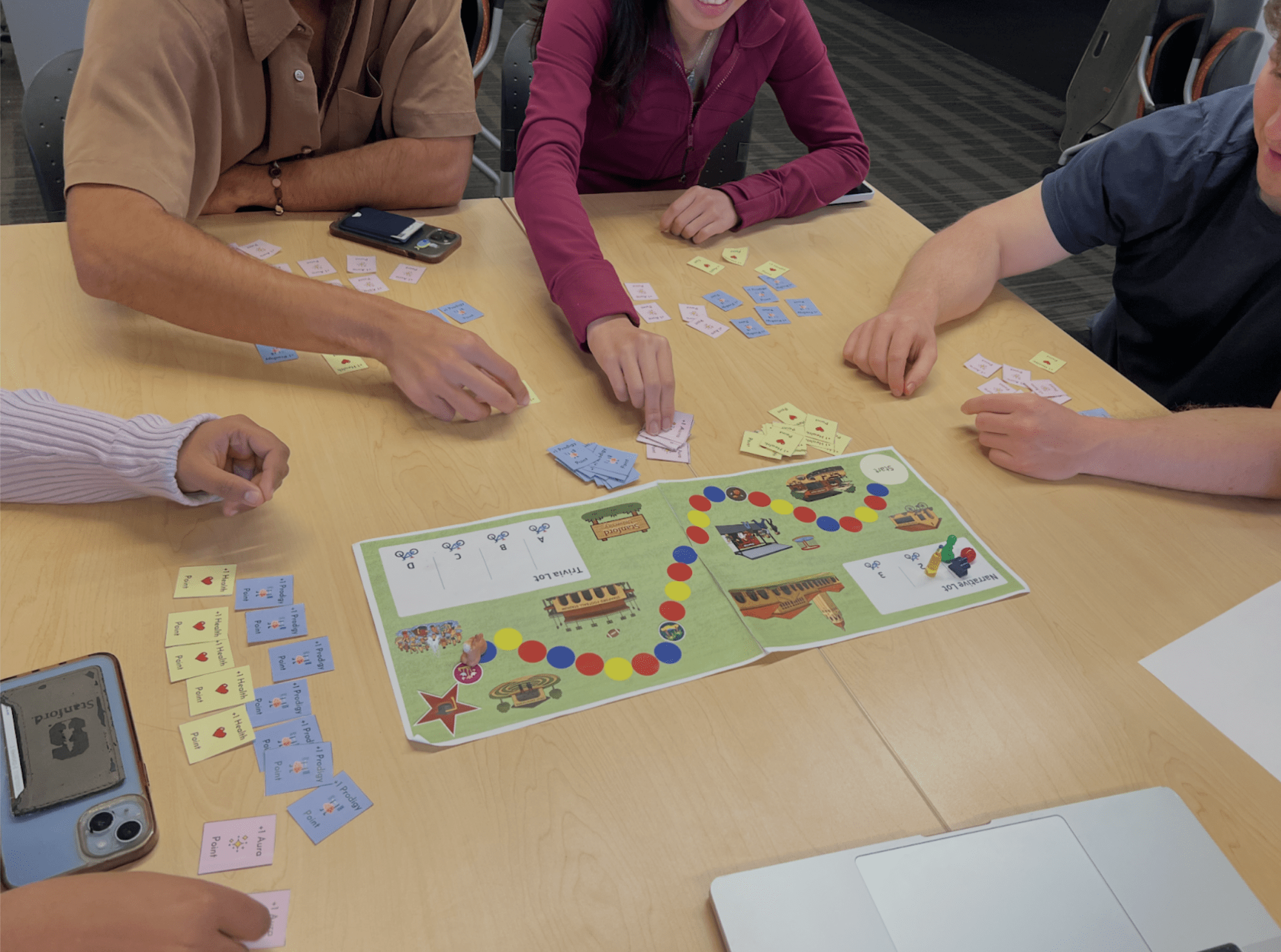
Objectives: At this point, we knew we were generally looking for feedback on 1) making the map path more necessary (or even potentially pivoting to a fully digital game) and 2) how to make the points build up to something.
During the actual play of the game, we were just testing more of our minigames/trivia/narrative squares that we hadn’t covered previously playtested.
We also took away their voiceover prompting and restructured our narratives to be split between screens to see if they would help players read the narrative without having to waste time/get distracted by assigning someone to read out loud. We also added a reminder to move the tandem bike along the physical path, in efforts to kind of make the physical path more necessary.
What went well: We felt reassured that we didn’t actually need to assign someone to read out loud if we just structured our pages with less text. We noticed they naturally read out loud anyways! We also got to see the point cards really do their job. The players were getting really excited about how many points they had. The physical cards really helped to make it ~look~ like you have a lot of points because you can lay them out. Our playtesters really liked the reaction games! We thought it would be good to incorporate more of those. This playtest went quite well and solidified many of the winter quarter activities for us.
What we learned: The point of the physical board was still a bit unclear. The parking lots are necessary, but the path isn’t. They also were a bit confused between switching between the two lots, so we knew we needed to add more guiding instructions throughout the game. They had a couple suggestions like introducing randomness with a dice roll or even backwards moving. We didn’t get to test the milestone challenge again so we kept brainstorming on our own.
Ideas for next iteration: We knew we needed to adjust the layout and function of the physical board so that it would be integral to the playability of the game. We wanted to find some way to ensure the physical board gave meaning to the digital component and vice versa, and that players also had incentive to move the tandem bike along the board. We liked the idea that a player suggested adding designs to each square to link up the two components, so we decided to pursue that.
Playtest 6 (May 29) — Same Figma Prototype, but New Physical Board with Icon Mapping
We conducted this playtest in class on May 29th with mostly seniors.

Objectives: We switched to a completely new board! The physical board is designed to look more Stanford themed, with the Oval and bike lots and Tresidder’s umbrellas! The board is covered in icons that map to a digital map, just like suggested in the previous playtest. This digital map allowed us to separate location from timeline, but still link it together to show the importance of both. We wanted to see how intuitive this was for the players, and whether this solved our issue of wondering if the physical component was necessary.
 Digital map shown on computer

Physical game board
The digital portion was still on Figma and we linked up each emoji to the corresponding activity so players could properly test the flow. We also added an onboarding flow to see if the players could play on their own without us moderating.
What went well: During the playtest we found that the icon mapping was quite successful in linking together the physical and digital components. It definitely made it so that the physical component was integral to the game. In general, the new board in general was nice! It was much more on theme and the narrative and trivia lots were still clear!
What we learned: The players were a little confused with our onboarding instructions. For example, the players put their character tokens on the START alongside the tandem bike, when they didn’t need to. They also didn’t move the bike to the next square when we asked.
They also pointed out that the icons were kind of hard to see on the digital map, and one player was unsure how they were supposed to know to click the icon. For the next playtest, we lowered the opacity of the map so that the emoji’s stood out more, and made sure the onboarding instructions were more clear about clicking on the map.
Ideas for next iteration: Moving forward, we knew we needed to start coding and really refine our onboarding instructions. We continued to get questions about the reason for the point cards so we knew we needed to come up with a milestone challenge that used the points, rather than our old idea that was rather unrelated.
Playtest 7 (6/3) — Coded Up Digital Component and Final Milestone Activity
Our final playtest was conducted in class on 6/3 with three seniors and one graduate student.

Objectives: This was our first complete play through of the game with our new coded-up digital component and our new final milestone activity. We kept moderation to a minimum, allowing users to be fully onboarded into the game with just the instructions we included on the digital component.


Figma minigame (Top) –> Final coded-up digital component (Bottom)
For this iteration, we also implemented a new final milestone activity that we had brainstormed with feedback from peers during Game Night. To solidify the create-your-narrative and life after Stanford themes of our game, we designed the milestone activity to allow players to design their characters’ future post-graduation. It was also crucial to us that we made the point system an integral part of this milestone activity to ensure that players felt the points they were accumulating throughout the entire game were meaningful and culminated to something by the end of the game. For this activity, we designed Aura, Prodigy, and Health “Future Cards.” Each of these cards had three tiers, Common, Rare, and Legendary, with unique options within each of these tiers that players could choose from. The tier in which players could choose from was dictated by how many points they ended up with in that category.

What went well: The feedback from this playtest solidified that the integration of the digital component and physical board was very intuitive, as players knew to move their piece and then find the corresponding icon on the screen. Reducing moderation and including instructions on the digital component also went well – in the final video, you can see players remembered rules from the beginning, even reminding each other of the rules from time to time. It was also interesting to see how players gave thought to the amount of points in each category they were accumulating. At the beginning of the game, some players really wanted aura points, but towards the end once they had accumulated many aura points, they turned their attention to the other categories, even mentioning during the game that they were making a specific choice because they “need health points.” Overall, this showed us that each of the point categories was equally attractive to players, unlike in previous iterations where players only wanted aura points. The milestone activity was also a hit! Players enjoyed being able to “cash in” their points to choose options and create their future narrative. Players put more thought into their selections than we anticipated. For instance, a player chose “Olympic gymnast” on their health card, and then had the option between “Ted Talk Speaker” and “Accepted into Y Combinator” for their prodigy. He decided to go with Ted Talk Speaker, which was a surprising choice to another player who asked him why he chose that option. He explained that if he was an Olmypic gymnast and a YC start up founder, he wouldn’t have any time to do anything else! It was great to see how immersed players were in this create-your-narrative finale to our game. We also received positive feedback for our visuals.
What we learned: There were definitely some minor issues/inconsistencies within our game that we needed to fix. For example, there was a small bug in one of our digital component links and also the QR code we had on the board that led to the web app was not intuitive since players should be accessing the web app on a desktop and not a phone. We also needed to add clarification during our onboarding process for the set up of the physical component/digital component and explain the function of the different tokens (tandem bike token vs individual player tokens). Another thing we noticed was that the player that was navigating the screen had an advantage for the physical reaction-based mini games since they were closer to the screen and could read it easier. Lastly, we also took note of players’ final point distributions. Overall, players accumulated much more aura and prodigy points than we had anticipated, which meant that almost everyone got to choose from the Legendary tier on the Future Card. However, the distribution of points was slightly unbalanced, as health points were accumulated much less frequently.

Ideas for final iteration: Given some confusion with the onboarding process, we decided to make a physical rule sheet that clearly outlined how to set up the board and the digital component. This rule sheet included a link to the web app instead of a QR code. To address the issue with unequal point distribution, we adjusted the ranges for each tier on the Future Card to be on the higher side (eg: 13+ points needed for Legendary instead of just 7 points) and we also added more opportunities throughout the game to earn Health points. To fix the issue with advantages for the reaction-based mini-games, we included a countdown timer before each one. We also wanted to make some refinements to our physical pieces to make them more on theme and match the art style of the physical board: we needed to create print-and-play tokens and refine the art of the point card. Lastly, to make the game experience more immersive and to address issues with silence from previous playtests, we knew we needed to add background music and sound effects throughout the game.
Final IterationAfter our final playtest we felt our game mechanics proved to be very effective and fun! For our final iteration, our goal was mainly to refine what we already had. Specifically, we knew we needed to add details for the starting rules, as well as refine the physical and digital components to be more on theme. In terms of game mechanics, we also knew we needed to add some details to make some activities more clear (for example, clarifying that one of our minigames expects the player to find Nina on the board, not in the class), as well as play around with the point cutoffs for our Future Cards. Another big point here was making the options on future cards more diverse and inclusive! For the physical component we created a physical rule sheet, foldable print and play player tokens, as well as refined physical board and cards. We paid attention to keeping the design match the cartoonish aesthetic of the rest of our game, and made sure everything looked refined and polished.
We paid attention to details like rounding the corners on the point cards and matching the banner on the rule sheet to the physical board to the digital intro screen. In polishing the final design, we wanted to ensure our game had a personal touch and tactile feel to align with our initial vision while remaining true to the Stanford experience. From this, we ended up leaning into an artsy, sketch-like aesthetic to keep the tone lighthearted and approachable, mirroring how memories often feel: colorful, imperfect, and full of character. Our physical game board and supporting assets were therefore hand-drawn, adding the personal touch that aligned with our goal of evoking sentimental reflection.
One thing we needed to make clear is that the vision for the game is that anyone can access it and print it and then play it (i.e. it’s not something that is packaged and sold in stores). Our game is a digital game with a physical component, rather than a physical game with a digital component. This is why we chose to have a print-n-play and have tokens that people make themselves and the instructions on the rulebook. We initially had a QR code on our board, but since we were framing this as a digital game with a physical component, and it’s intended to be played on a laptop, not a phone, we changed it to be a just a rule book with a link on it. We also hand-picked playful sound effects and background music for each activity, carefully matching the audio to the vibe of the moment to make the players’ experience feel fuller and more immersive. This visual and auditory direction supported the overall game’s tone and helped ground the player experience in a Stanford that felt both real and lovingly exaggerated. For example, we added jeopardy music to the trivia questions and other sound effects when different answers + point totals were revealed. We also added some extra mechanics to make the game more fair/intuitive. For example, countdowns for some of our reaction games so that all players have a better chance at winning. In the coding portion we also employed some Plants vs Zombies onboarding techniques. We introduced roles at the beginning of activities and made sure to highlight instructions for putting character avatars in the lots, or picking up physical point cards. After doing it once, the players caught on and knew how to do it again. We also realized our biggest limitation from our final playtest was the digital onboarding, so we added extra detail to make it more clear. In particular, we added instructions for when to put the tandem bike down and to keep the character avatar tokens to themselves. |


Accessibility Considerations
Our development team would like to acknowledge some of the accessibility limitations associated with our game. We created this game for the enjoyment of all Stanford students; however, in this initial version of the game, we understand that our game may marginalize students with disabilities. Below we will outline various areas for improvement in terms of accessibility that will be addressed in future iterations of our game.
- Our game is highly visual as it requires identification of objects on the board; visual matching between the board and digital map; and significant amounts of reading. We do not have a screen reader implemented which means that students with visual impairments may not be able to enjoy the full experience of our game.
- Some of our visuals rely heavily on color to distinguish between different states or categories (e.g., points, cards, game tiles). Players with color vision deficiencies may find it difficult to differentiate between elements. Future versions will improve contrast, incorporate texture-based cues, and provide colorblind-friendly modes.
- While our game includes sound effects and music, we do not currently provide captions or visual indicators for these audio cues. This creates barriers for deaf or hard-of-hearing players. We plan to implement captioning and sound alternative features in the next version.
- Certain parts of the game require fine motor skills (e.g., moving game pieces, using small interface buttons) which may not be accessible to players with limited hand mobility or those using alternative input devices (such as switch controls or adaptive controllers). Future versions will incorporate alternative input methods and customizable controls.
- Our game includes many Stanford-specific references. We tried to include references that all students would understand; however, we would like to recognize our bias in the design process. We are an all-female team of 3 seniors and 1 freshman, all of whom come from a technical CS background and are involved in Greek life. Our shared identities shaped how we designed the game, especially with the narrative squares and the final milestone activity. We know that our Stanford experience may be very different from other students’ experiences, and we want to acknowledge our bias in the gameplay experience.
- Our game requires both an analog and a digital component. The digital component is optimized for laptop and desktop use which may exclude users who do not have access to these devices. We hope to optimize our game for other devices (mobile, android, etc) to increase the accessibility of our digital component.
- Currently, our game is only offered in English. Future iterations of the game will offer the game in multiple languages.
Final Implementation and Playtest
Print & Play: Print and Play File
Digital Component: https://game-stanford.vercel.app/
Final Playtest Video: https://youtu.be/iVFuXhrgywk
GitHub: https://github.com/abbiemaemoto/game_stanford
Welcome to Senior Year, hope you enjoy playing!


