The Stanley Parable isn’t a game in the traditional sense. There are no puzzles, no enemies, no real goals. You walk. You listen. You choose. But quickly, you start to realize that your choices don’t really take you anywhere new; they just lead to another part of a system that was already waiting for you.
At first, I followed the narrator. He told me to take the left door, so I did. Everything felt oddly controlled but smooth. Then, I decided to disobey. I took the right door. I walked into the broom closet and just… stood there. I jumped off the lift. The narrator reacted every time, sometimes annoyed, sometimes amused, always aware. That awareness is what made the experience stand out.
When the Game Knows You’re Playing It
What I didn’t expect was how much the game would anticipate my resistance. It doesn’t punish you for going off-script, but it folds your defiance into the experience. Even when you’re trying to break the story, it keeps going, and that’s kind of the point.
The assigned article talks about how games like The Stanley Parable blur the boundary between story and system. Most games treat narrative and mechanics as separate layers. Here, they’re the same thing. The narration is the gameplay. The choices you make, whether to obey or not, don’t just move the story forward. They are the story.

Left Door or Right Door?
No Real Freedom, Just Structured Rebellion
Eventually, I stopped feeling like I was making real decisions. Every “choice” was already accounted for. That’s what makes this game so strange and brilliant; it gives you the illusion of freedom, but constantly reminds you that you’re still inside a machine. Even rebellion is part of the design. That raises the question: if every path is predetermined, what does it even mean to play? Are you exploring a story or just cycling through scripted reactions? The game doesn’t answer that, but it definitely wants you to think about it.
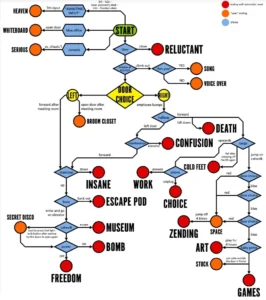
The Endings of The Stanley Parable! (Reddit)
The Story Isn’t About Stanley
There’s also something meta going on with how the game pokes fun at storytelling itself. It doesn’t just mock the player; it mocks the structure of video game narratives: the tidy hero’s journey, the “true” ending, the need for meaning. It’s not trying to deliver a satisfying arc. It’s trying to show you how artificial those arcs often are. And somehow, even when it feels like nothing matters, it still feels worth exploring. That tension, between control and chaos, meaning and meaninglessness, is what gives the game its edge.
Overall, The Stanley Parable is less about Stanley and more about you. It forces you to question the role of the player, the purpose of choice, and the architecture behind games themselves. It’s funny, self-aware, and occasionally unsettling. And it leaves you with the sense that you’ve been part of something clever, not because it told you a great story, but because it let you test the limits of one.