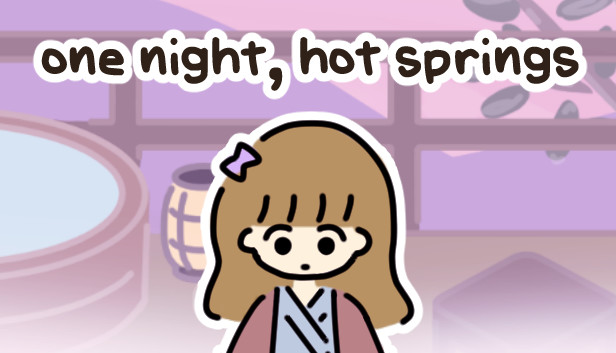
For this week’s critical play, I decided to playtest the game one night, hot springs, which is a short visual story developed by indie creator npckc (this is just what is on Steam, I cannot find the real name or more details) for the 2018 Trans Gal Jam. It was released Aug 30, 2018. Throughout the game, players walk through the story of Haru, who is a 19-year-old transgender woman who is invited by her childhood friend Manami to spend a night at a traditional hot spring in Japan. This game is available for download on Steam for Windows, Mac, Linux, and Android. The game is built with the Ren’Py engine and features a minimalist interface and many accessibility perks which I will mention at the bottom of this response. The game is free to play and has seven different endings based on player’s choices through the game. Its target audience is likely people interested in LGBTQ+ narratives, especially on the transgender experience, because the game explores the challenges Haru faces navigating a gendered space. The game does not note the age range that is most appropriate to play the game, but I would suggest ages 10+ not due to the difficulty of the game but due to the difficult topics that are taught behind the game that I believe those who are 10+ would have started to understand.

I believe that to play one night, hot springs in a feminist lens means having an open mind towards learning about the transgender experience through Haru’s exploration of a gendered world, like through a Hot Springs trip. The game’s core mechanics (its dialogue, imagery, and decision-making about which facilities to use) makes us as a player battle through internal decisions on whether to see gender as a personal identity vs a social identity and both. Playing as a feminist means recognizing how the game makes visible the invisible labor and anxiety that trans women face in spaces designed for cisgendered people. The game begins with Haru receiving a call from her friend Manami inviting her to the Hot Springs. As a player, we connect to the story and experience through Haru’s internal dialogue, like Figure 3 below.

My Experience and Lessons

At the first choice, I wanted to see what would happen if I chose to not go to the bath house, so I clicked “Sorry,… I just..” and it ended the game just promptly after Haru has some internal dialogue that is regretful but also respecting of her decision to stay back and not put herself in an uncomfortable situation.
This immediate ending felt both validating (win for self worth) and heartbreaking (missing out on fun because of gender) respecting Haru’s self-protection but also showing how a non trans-friendly society prevented Haru from being able to have fun. When I restarted and chose “If they have reserved baths”, Manami’s single line “Yay! We will have so much fun!” and then immediately handing up highlighted the two’s privilege gap. It would have been helpful if the game allowed players to ask more questions or type in the specific worries and questions they have. Another critique is that when I restarted, the game brought me right to the very beginning of the narrative, and I had to click through around two dozen quotations before getting to the point of decision making again.

Playing one night, hot springs as a feminist aligns well with Shira Chess’s idea of feminist gaming as a playful form of protest and disruption. Chess talks about how feminist games intentionally challenge traditional storytelling norms by amplifying voices and experiences that usually don’t get much space in mainstream gaming. I think this game accomplishes this well. By placing us in Haru’s shoes, the game builds empathy and makes us aware of the hidden emotional labor and anxieties transgender people experience in everyday settings. This approach is powerful and it disrupts typical gaming narratives (which usually cater to cisgender perspectives) and encourages us to reconsider gendered expectations and social norms through a relatable story.

However, one critique I have of one night, hot springs is that its short length and limited interactive elements prevent a deeper exploration of intersectional feminism. Chess encourages games to creatively break boundaries, but the limited choices (usually two per decision) provided here feel restrictive and the game can end really fast even in deep parts of the story and then the player has to start all the way from the beginning (which they might not). For example, look at Figure 6, where we only have two options: to join the family bath or not. But it could be better if we could “sit to the side,” “inquire about clothing requirements,” or some other options. Additionally, the game don’t offer much space to explore intersectionality, such as how race, class, or other identities might complicate Haru’s experiences even more.
I believe that the new technologies we have today can be integrated to really improve the game. For example, we can use AI to dynamically expand the range of dialogue options, or even allow players to input their own concerns and questions as Haru. This would create a more complex and more personalized storytelling experience. Additionally, integrating AI-generated narratives could introduce intersectional elements (like race, class, disability, or cultural backgrounds) that would make the game more complex and challenging society even more. I understand tho that at the time the game was made, there were no capable-enough AI tools to generate narrative and images on the go, but now that we do have them, integrating them would solve many of the limitations I saw.
Accessibility


One aspect that the game does well is on the accessibility front. No critiques on the that side! This game does all that is possible to make the game accessible to as wide of an audience as possible. Regarding language, the game is accessible in 14 languages. Regarding age, experience, and mental capacity, the game offers a “On” and “Off” mode for hints. It also offers players to skip “Unseen text,” “After choices,” and “Transitions” to match the pace and difficulty of the game to their liking. Regarding reading speed, the game has a sliding bar in which players can adjust the text speed (to accommodate slow and fast readers)and auto-forward time (to accommodate experience and capabilities). Even after all this, we can even adjust the volume of music and the volume of sound separately.