

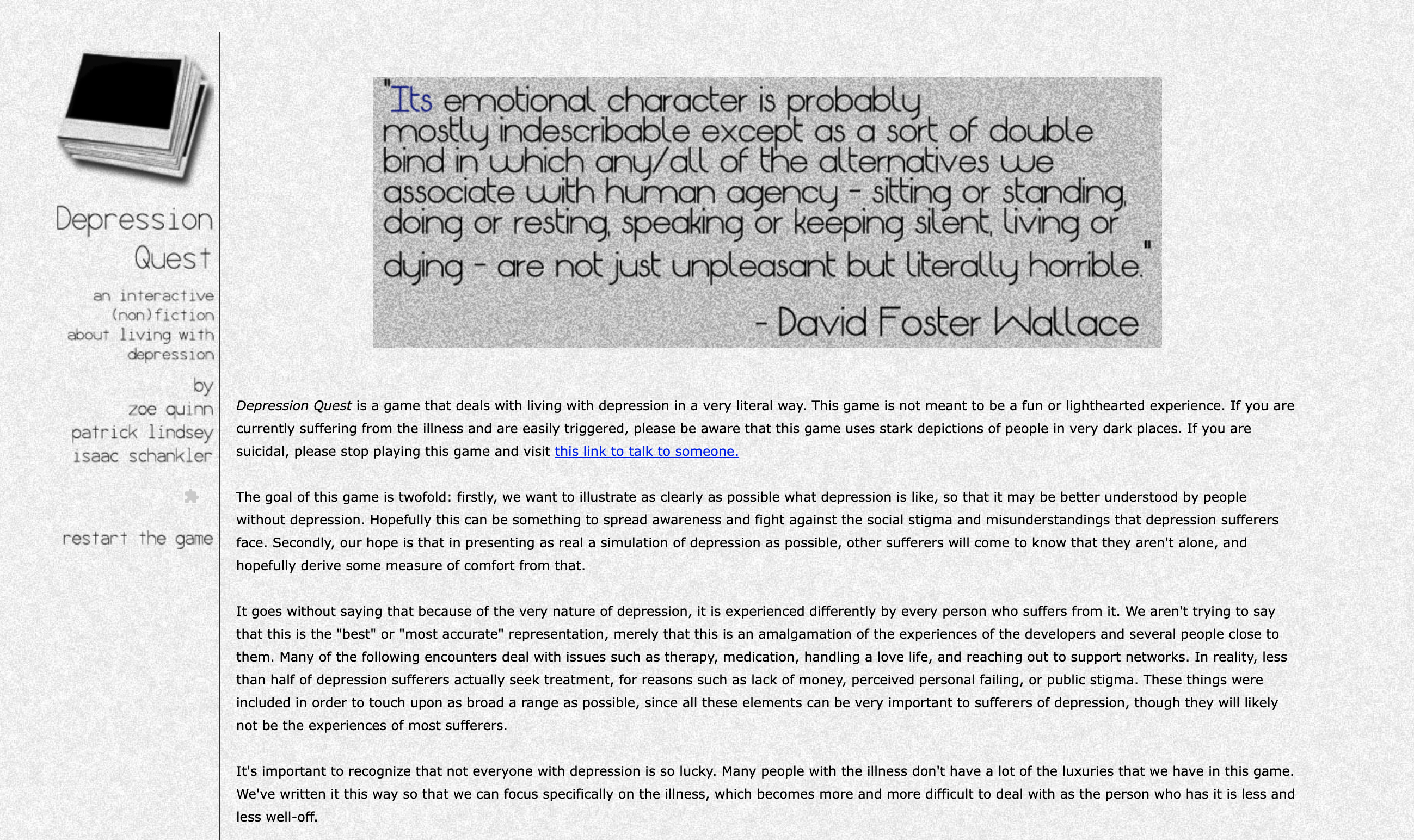
About this Game
Depression Quest is an interactive fiction game where players experience the daily challenges of living with depression, making choices that reflect the limitations imposed by depression. Depression Quest was created by Zoë Quinn, along with contributions from Patrick Lindsey and Isaac Schankler. The game is available on PC, Mac, and browser platforms. The game’s target audience includes people seeking to understand mental illness, and players interested in emotionally immersive, empathy-driven storytelling and perhaps even unintentionally people with depression.
In this blog, I will look at what it means to play Depression Quest as a feminist and how it intertwines feminist theories. After, I will critique this game’s portrayal of depression and offer suggestions through an ethical lens.
What does it mean to play Depression Quest as a feminist? How does Depression Quest intertwine feminist theories or fail to do so?
To play Depression Quest as a feminist is to think about agency and female narrative in the game. In this game, agency is restricted and it lacks a female narrative, making Depression Quest ultimately fall short as a strong feminist game.
For example, in Depression Quest, the player is presented with options to advance the narrative, but their agency is restricted (see image below). In Chess’s article, she mentions that “Agency is a necessary part of feminist definition of equality.” Leveraging this idea to analyze Depression Quest, the game perhaps reflects what a player might experience in our restrictive society. Contextualizing her idea within the game, agency in Depression Quest gives the player a sense that depression affects any gender. But to play this game as a feminist, I think Depression Quest would be stronger if agency were not so restricted, because it has the potential to push the narrative that anyone can get treated for depression. The game would benefit from encouraging players to seek help, because as it stands, it affirms the idea that depression may not get better. Although I understand the narrative’s intention, bringing in feminist thought on agency reveals that the game could also tell players (especially women) that while depression is difficult and recovery can be long and slow, there are actions they can take to seek the help they need. Additionally, Depression Quest should offer players the agency to seek help when the story becomes really dark and sad. In my opinion, agency is important for recovery. If I could change the game while applying the feminist idea of agency but still retaining its powerful message, I would restrict agency early in the game, showing the lulls of depression, but gradually allow the player to make more choices and seek help. In a world where depression has such a strong grip, we should encourage people to believe that recovery is possible, and that seeking help should be normalized. But also doing so with compassion, empathy, and love.
Likewise, Chess mentions, “Video games have a history that might tend to misogyny.” According to her, a female narrative should resonate with diverse and unrepresentative audiences. As it stands, this game has one female character named Alex (see image below). Although Chess adds, that games do not need to have everything centered around female narrative it should appeal to marginalized communities. That being said, this game lacks diverse perspective because it provides a one dimensional depression narrative that feels curated for a white audience. The game is suffused with platitudes and generalizations about depression, which hinder’s Depression Quest ability to be a strong feminist game. In my ethics section, I will expand on this idea and how to improve it.

Restricted Agency

Alex’s Story
Ethics: Critiquing Depression Quest
Depression Quest offers a traditional portrayal of depression, which I found one-dimensional because it lacked diversity. For example, the narrative pushes a depiction of depression that aligns closely with how modern media tends to represent depression (see image below). While depression can take many forms, the game focuses heavily on the paralyzing “can’t get out of bed” trope. I challenge this depiction because it reflects the same version of depression often assigned to women: emotional, passive, and internalized. In media, women are often portrayed this way, and I question whether such representations truly expand our understanding of depression. Additionally, does depression look the same for people of color? The narrative in Depression Quest feels tailored to white experiences. It overlooks the realities of growing up in households where mental health is not acknowledged or is actively dismissed, which is common in many communities of color. I’m not saying the game needs to encompass all experiences, but it would benefit from critically examining whether reinforcing this narrow narrative of depression is helpful to society.
That being said, some ways Depression Quest could improve and expand its narrative is by including diverse characters and storylines. Adding cultural sentiments in the narrative can also be helpful in creating a more inclusive and diverse story. Another way to improve this narrative is expand the depiction of depression. For example, the game can include more high functioning depression, different coping mechanisms, and physical symptoms. This would elucidate the notion that depression is a spectrum. As Chess mentions, the game should appeal to diverse audiences.

Example of Traditional Depression