I played Blackjack for my critical play analysis. Blackjack is a card game commonly found in casinos where players aim to get a hand total of 21 or as close to it as possible without going over. It is also available on mobile devices, which is what I played on for this analysis. For casinos, the target audience is adults age 21 or over, however, the game could be played with no real money bet by anybody with a basic grasp of probability and addition. The origins of Blackjack are unknown and there is no credited inventor of the game, though it has been tracked back to as early as the 17th century.
Central Argument
Blackjack puts people at risk for addiction by giving players the illusion of control over randomness and fostering emotional attachment. Players are presented with choices which make them feel in charge of the outcome. However, the House edge ensures that players are statistically at a disadvantage over time, and the randomness of card draws supports the belief that strategy can influence results. This illusion encourages players to stay in the game, as they hold on to the hope of beating the odds. Moreover, the possibility of quick profits and the emotional drive to recover losses create a cycle of hope and loss. Since it is difficult to quit while at a loss, players often keep playing in search of recuperating their losses.
Analysis, Learning, Evidence
One of the most critical aspects of Blackjack that contributes to its addictive nature is the illusion of control. The game’s mechanics are primarily responsible for creating this illusion. Players are given basic decisions on each hand, such as “hit”, “stand”, or “surrender”, giving the false impression of control. In reality, nobody knows the card they may receive or the dealer’s down card. There are even other mechanics such as splitting pairs and doubling down to further offer players opportunities to increase their chances in certain situations. In this moment, I decided to “double down” on a 9 in hopes that I would get a 10, because there are more 10s in a deck than any other card. I ended up losing overall, because despite my intuition, I did not truly know what the next card will be or what the dealer’s sum will be.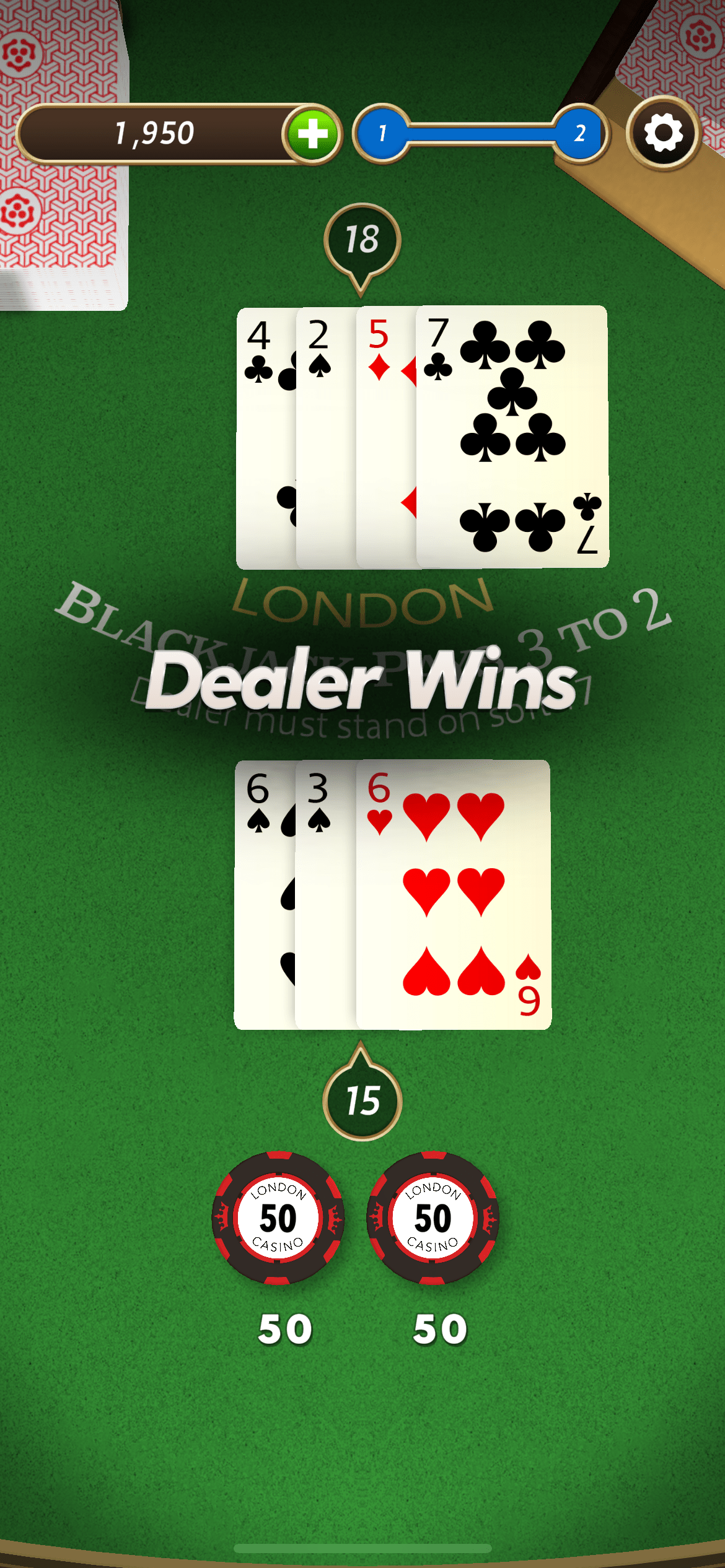
From these mechanics, a basic strategy is derived from probability given the assumption that the dealer’s down card is a 10. Below is an image illustrating basic strategy.

While basic strategy can help reduce the house edge, it cannot overcome the fundamental randomness of the game, and players are still at a statistical disadvantage. The illusion of control creates a false sense of empowerment, when outcomes are ultimately determined by chance.
The emotional attachment to Blackjack is another significant factor contributing to addiction. Periods of winning and losing create a psychological loop that keeps players emotionally invested. During my time playing Blackjack at a casino two months ago, I felt a rush of excitement when I won, and I kept playing hoping for more quick profits. When I lost, I felt the desire to try to recover from my losses. The unpredictability combined with the emotional investment into the game creates a high risk for addiction.
Comparative Analysis
Another game I played extensively that incorporated chance is Overwatch, specifically its loot box system. Overwatch introduces a different dynamic from Blackjack with its loot box system. In Blackjack, probability directly influences the game’s outcome, with each card drawn affecting the player’s chances of winning or losing. In other words, the player’s success is heavily tied to the outcome of the shuffled cards. In contrast, Overwatch’s loot boxes do not directly affect player’s wins or losses—they contain cosmetic items like skins, voice lines, and stickers, which do not affect performance in the game. However, the aesthetic rewards feed into the player’s desire for personalization and social recognition within the gaming community. Players may become invested in acquiring skins or rare items to express themselves or fit in, but it is different from Blackjack because the aspect of randomness does not impact game outcomes.
Ethics: When is it morally permissible or impermissible to use chance in your games
I believe it is morally permissible to use chance in games when players are fully aware of the risks and odds involved. Games that use chance should ensure transparency and provide players with the tools to set limits on their time and spending. I believe it becomes morally impermissible when games manipulate emotions to encourage continued play. It is also morally impermissible when games can cause players to suffer financial or psychological harm. When chance is used to exploit players’ hopes or encourage risky behavior, it crosses into ethically problematic territory.