To be honest, I’m not someone who ever found myself interested in Monument Valley. Even when it first came out and friends and classmates were all over the game because of its aesthetics and vibes, I just didn’t really see the appeal. Sure, its target audience (10+, probably geared towards younger students) definitely fit my understanding. But, when asked to play a puzzle game for this critical play, I found myself drawn to the game because of its broad appeal. Is there really something that makes it that good? It’s just solving puzzles, right?
After playing the game on iOS for about an hour, I can say that Monument Valley is so much more than solving puzzles. First of all, it’s so visually appealing to move the objects around – the sounds and the smooth animation is just really well done, In some sense, then, it reminds me of the first reading we had this week, where the author said, “To build a good puzzle, you must first build a good toy.” This is a really cool toy, and it makes you want to fiddle around to figure it out.
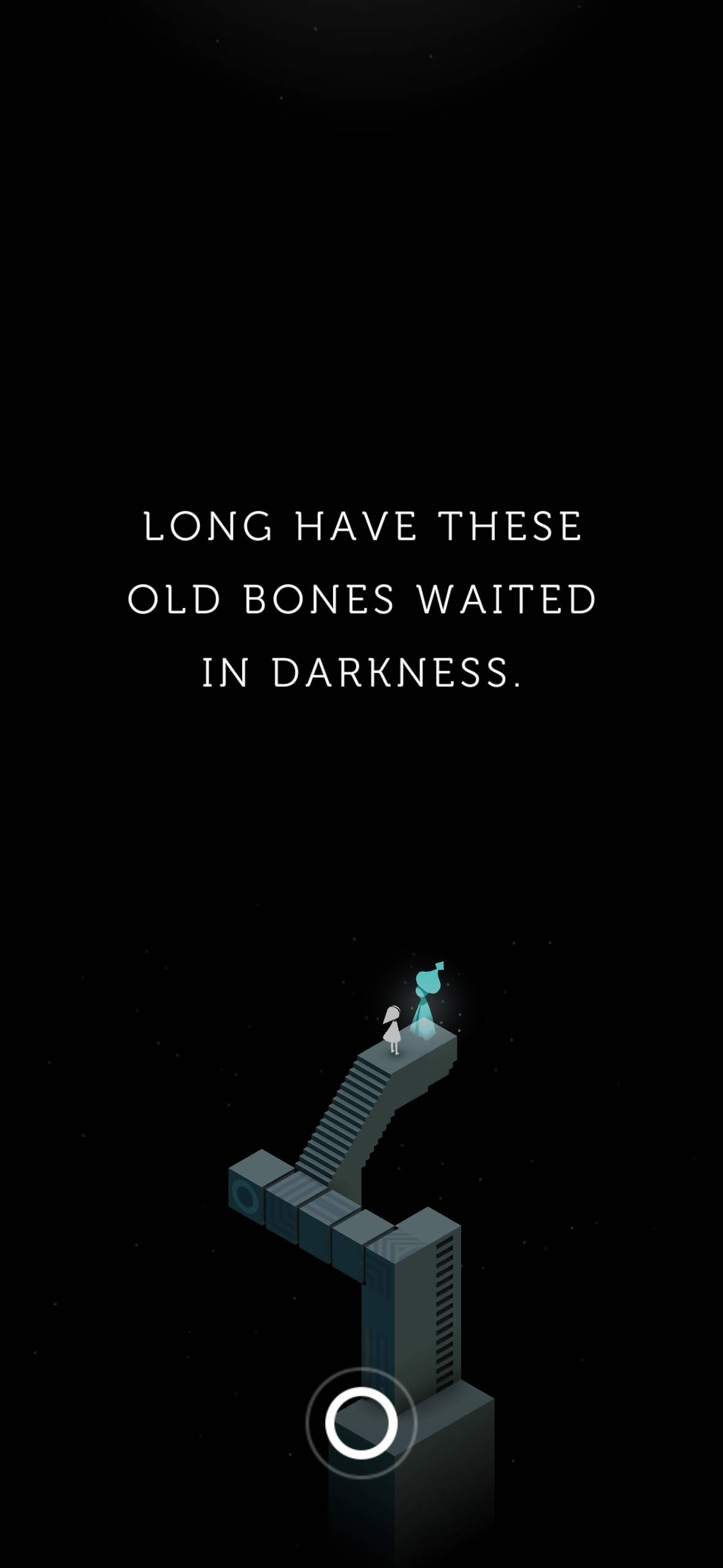
The coolest thing to me is how Ustwo Games, the developers, use optical illusions and impossible structures to make the puzzles more interesting and, in the best way possible, puzzling. As someone who’s always been interested in these sorts of illusions, wondering how they could be possible, I’ve never seen anything like it. Most puzzle games try to adhere to the laws of physics, since as I can understand it, a general rule of thumb, echoed in the reading about architecture in games that we had last week, is to be predictable in the things that people expect to be predictable.
Monument Valley turns this around on its head in that it is predictable in its unpredictability. Nothing makes sense in a purely physical understanding of the 2D world – starting with the very first world where you turn a level piece of ground and it progresses you vertically towards your goal. It only makes sense if you suspend your disbelief and simply play the game for what it is. You can walk sideways on a level? Okay. You can walk into a door and walk out immediately after on the other side of the map simultaneously? That’s fine. It’s all about taking everything at face value, because nothing is as it seems.
What’s interesting about this is that the fact that the world is so warped and crazy makes all of the story almost more believable in a sense. You’re a mystical princess trying to figure out a futuristic universe? Sure. Anything’s possible in a world where physics doesn’t make sense to start with. Even if the story is secondary, it makes complete sense in the context of this world where mechanics are only obvious in a world where nothing makes sense to the naked eye. It’s a really cool concept that is so unlike other games that I’ve played before.
If there’s anything I’m curious about the game, it’s about how well the game works for people who have some sort of disability, especially BLV users. A lot of the game’s aesthetic appeal / coolness is in the use of impossible structures, and being able to move them around, and so it feels like a common assumption of the creators is that people need to be able to see to enjoy it. But that is an unfair assumption to put on BLV users who simply might want to play the game for its puzzles and its aesthetics. However, it’s not necessarily the most clear to a BLV user about how to move such structures, let alone to what configuration that makes the most sense. Some of this is kind of related to the fact that it’s a purely visual game, but one immediate problem I can see is that there is very little difference in sound between when a processable input is registered (i.e. the character can move to that spot), and a non-processable input is registered. If you listen in closely, you can hear the character moving, which I guess is something, but it feels like more should be done here.
ScreenRecording_05-08-2025 11-21-16_1
An example here of optical illusions and impossible stairs in action!