The game I chose for our competitive analysis is Quiplash. Quiplash is a game developed/created by Jackbox Games. The game has a rating of T for Teen, meaning ages 13 and over, but I found that some prompts were adult in discussing sexual themes so I would probably categorize the target audience as adults 18 and over. The target audience is also restricted to those residing in the United States, United Kingdom, European Union, Canada, and Brazil. I think its target audience also includes lighthearted players who enjoy humor and have access to digital devices required to play this game. The platform of the game includes computer systems like Linux, Windows, and Macs but they also support consoles such as Xbox, PlayStation, and Nintendo Switch. Players can join from their mobile devices, only the host needs to run on the above systems.

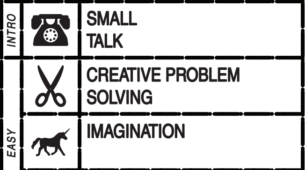
(example of adult-age appropriate prompts)
While Quiplash and our game, The Game of Truth, share an appeal to humor as expression, which follows MDA’s 8 kinds of fun, and responding to prompts the game creators crafted. However, the mechanics of executing this kind of fun contrasts our two games: a democratic voting process of selecting a winner in Quiplash while the players take turns being the judge in ours, which also in turn influences the pacing of the game.
This game compares with our team’s concept by using the theme of humor and competition as the basis for fun, as well as providing prompts for users to fill in or respond to. We chose to use this technique as well so we can reduce the cognitive load of the players, since being intentionally “funny” can sometimes create stress rather than fun. The mechanics of voting between answers creates a competitive type of fun, creating a dynamic of crafting a creative response that will engage the majority of the audience. I think an observation that we learned from playtesting was that although our game did not implement an explicit voting system like Quiplash, a similar dynamic took place where the judge would choose the game that garnered the most laughter from other players. I think there isn’t a strong need for a voting mechanic in our game because it will be played in person, so the players can inexplicitly “vote” through their reactions. We also chose to use turn-taking of being the judge to appeal to Henry Murray’s theories around human beings’ psychogenic needs, specifically power, which is fun to exercise in choosing the best response. I also wonder if appealing to a group of people can be stressful rather than fun to some people, and I noticed that receiving no votes could cause a player to lose motivation to play. This was the case in response to “A rejected title in the Magic School Bus series: The Magic School Bus Goes to” when “The USSR” got one vote against “North Korea” getting 5 votes. While democracy is generally positively viewed, in this case, it could make certain players feel targeted since their answer is individually pitted against another player’s. I think as a designer, a way to mitigate this is by creating a pool of answers to choose from, rather than just 1 vs. 1, which we did in our game.
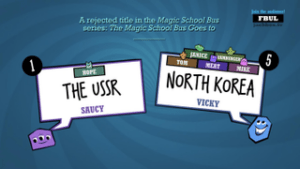
I think something that Quiplash did well is designing the visual elements of the game to match the types of responses they hoped to get. The handwritten font and goofy character design fit the humorous tone of the game. Furthermore, the animation is unique to the digital space where the game exists. I think this contrasts from our game which is analog, but I believe our game can take inspiration from the graphical elements to shape the aesthetic of the game and set expectations from the players.