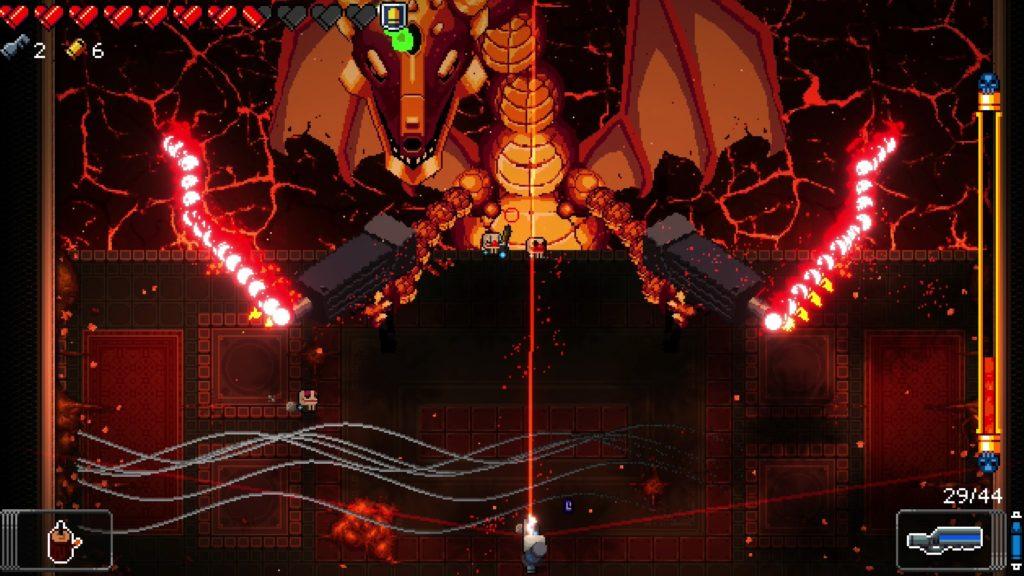
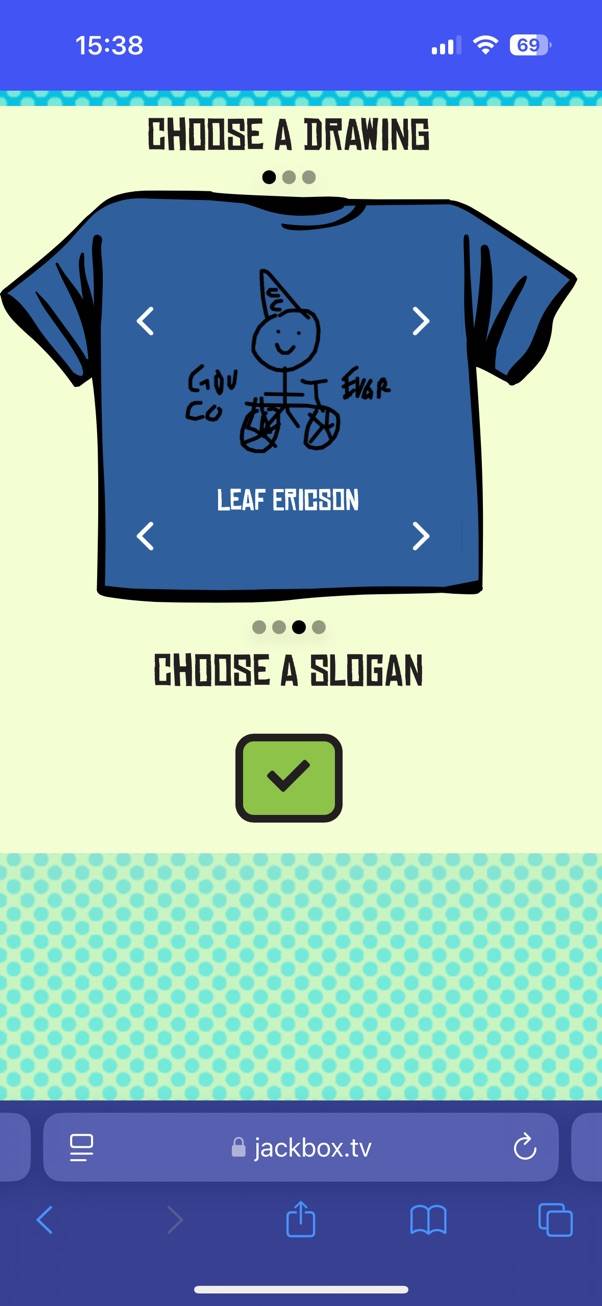
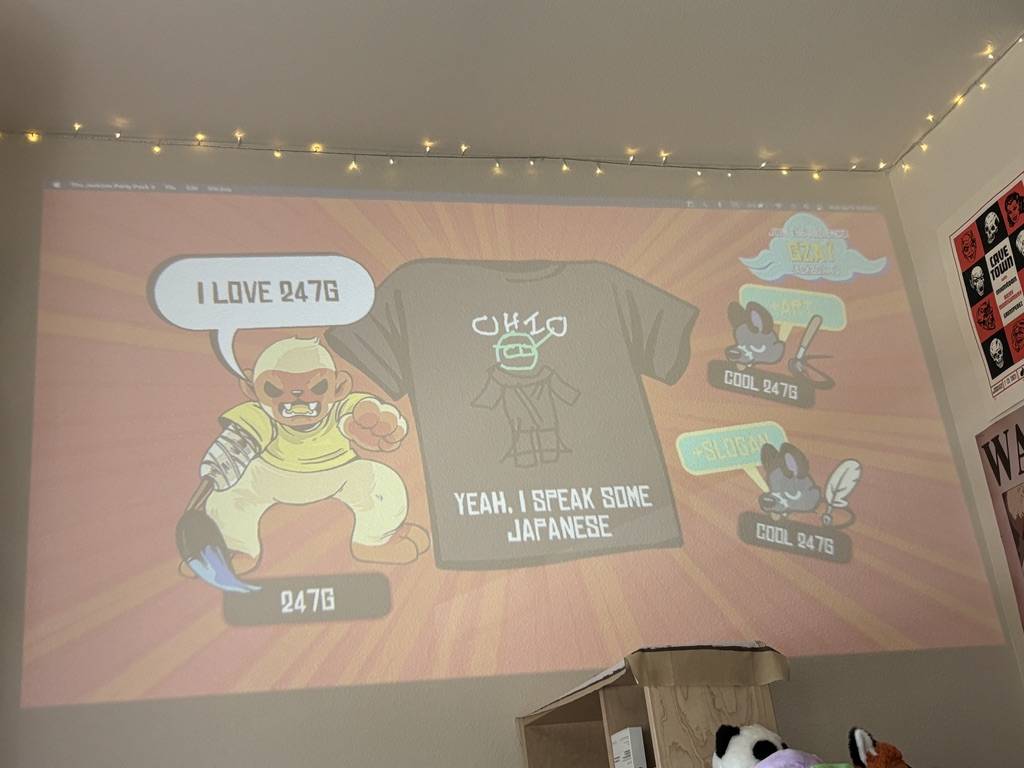
For my critical play, I joined fellow classmates Lour Drick and Amaru, as well as some other friends, to explore some Jackbox Games. Jackbox Games are a set of party games created by publisher Jackbox Games. The target audience seems to mostly be groups of friends, family, or people who are already familiar with each other. This suggestion comes from the presence of several games that either directly require or benefit greatly from knowing the other players well, which I will explore more thoroughly later in this post. Within the themes of this week’s assignment, we chose two in particular to focus on: TEE K.O. and Quiplash 2. TEE K.O. involves drawing pictures and writing slogans, before someone else chooses a pair of two to put on a shirt that is then pitted against others’ creations. Quiplash 2 is your traditional prompt/response game, with two players being tasked with free-writing responses to given prompts, and the rest being allowed to vote between them.
Playing these games did a lot to highlight my individual decision-making process. To start with Quiplash 2, a very important distinction is that in reality, your goal is to get the most votes. While this could mean best meeting the prompt, it often boils down to how well you know your audience. Because of this social contract, I think that the game really brings out my observant nature. By being able to listen and understand the little moments that make for great callbacks is an essential skill for these types of games, and in-jokes and pop culture references often make for good content.

However, these methods don’t always guarantee success. One thing that Amaru mentioned is that the game struggles to be played in the middle of the day as opposed to its usual evening time slot. This is due in part to the fact that players are not necessarily as relaxed and easy to entertain but similar issues exist within groups unfamiliar with one another. A large part of judging games is understanding what the judge is looking for, which is made far more difficult with the barrier of unfamiliarity. Our friend Paw Mar pointed out that most of our responses would be nothing but nonsense to your casual observer, and I’d be inclined to agree.
TEE K.O. suffers even more severely from this issue. While Quiplash 2 has some structure due to its pre-generated prompts, TKO tasks you with creating to your heart’s content. Draw and write whatever you’d like, and it is up to your friends to make the most of your musings. This freedom is one of the game’s greatest strengths, as well as one of its greatest weaknesses. Many a friend group has had a laugh-out-loud moment at a ridiculous combination or deep callback to lore between the members. A more structured game would not be able to have these moments, but similarly, would also not have as many non-starters. One common pitfall with TKO is that sometimes, a player will just flood the drawing and response pools with nonsense, and in these cases, it matters not how much effort all the others put in. The judging is an exercise in choosing between trash and garbage, and ultimately, leaving all parties unsatisfied.
Lour Drick pointed out that perhaps, this is simply the price of admission. All games that involve others contain social contracts about the type of fun that each player wants to have. By building rapport and familiarity with other players, we similarly lower the barriers of entry and allow everyone to have the experience that they signed up for rather than to be found wanting. Despite their flaws, the judging games remain some of Jackbox’s most popular, and this is no accident. Though the risk is great, the reward is equally so, and the wonderful moments will be far more memorable than the mediocre.

Ethical Reflection:
In my opinion, the onus for preventing hurt feelings in judging games lies primarily with the players. Amaru brought up the point that when you win in Jackbox, the animations often make it a point to show how thoroughly you destroyed your opponent, which can lead to a sort of zero-sum feels-good and feels-bad scenario. While it would be possible to remove these animations and provide less emphasis on the victor, this would not necessarily result in more fun. Instead, the breadth of experience would be far narrower, and the game would simply be less stimulating.
Communication is at the heart of gaming. One of my favorite games, Magic: The Gathering, will often involve a conversation before and after the match to see what everyone is looking to get out of it and what everyone is ok with. While these conversations don’t always prevent hurt feelings or saltiness, they go a long way in setting expectations. Judging games are no different; communicating your reservations and also exploring the group’s expectations will improve everyone’s experiences. Whether playing with friends or strangers, taking the feelings of your fellow players into consideration is essential. It is with this empathy that we build more inclusive play spaces, and in turn bring more players into the fold.