I played EteRNA, a browser-based game created by Dr. Adrien Treuille, Jeehyung Lee, Dr. Rhiju Das and their labs at CMU and Stanford. EteRNA is a puzzle game that teaches how RNA folds, primarily through using the aesthetic of challenge and discovery.
Under the MDAO framework, EteRNA has clear outcomes: transferring the explicit skill of understanding how RNA works, such as which base pairs are strongest, and teaching the implicit skill of reasoning about how RNA folds. To achieve these outcomes, EteRNA implements several mechanics that mimic how RNA works in real life, with the way to pass a level being successfully folding an RNA into the desired shape.
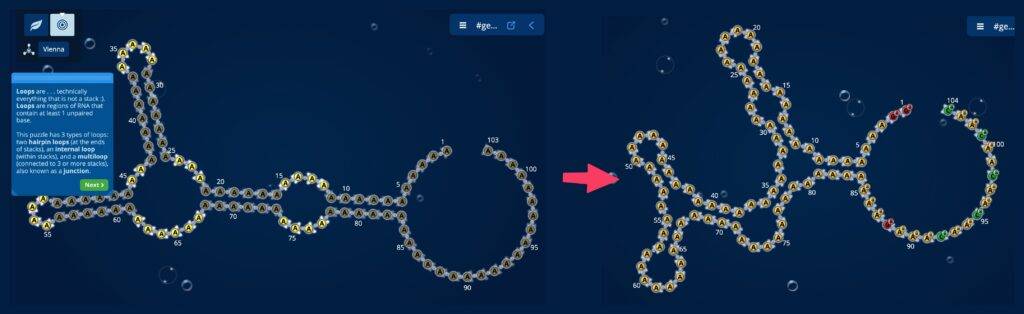
For example, the game begins by introducing the different RNA base pairs and the mechanic that only those pairs will connect in the simulated RNA. Since the required structures often feature parts that must be connected, this creates the dynamic of players using the introduced base pairs to create the straight sections (“stacks”) of the RNA. This helps support both desired outcomes as players reinforce the explicit skill of understanding which bases pair to each other as well as the implicit skill of reasoning that base pairs can be used to determine the structure of RNA.
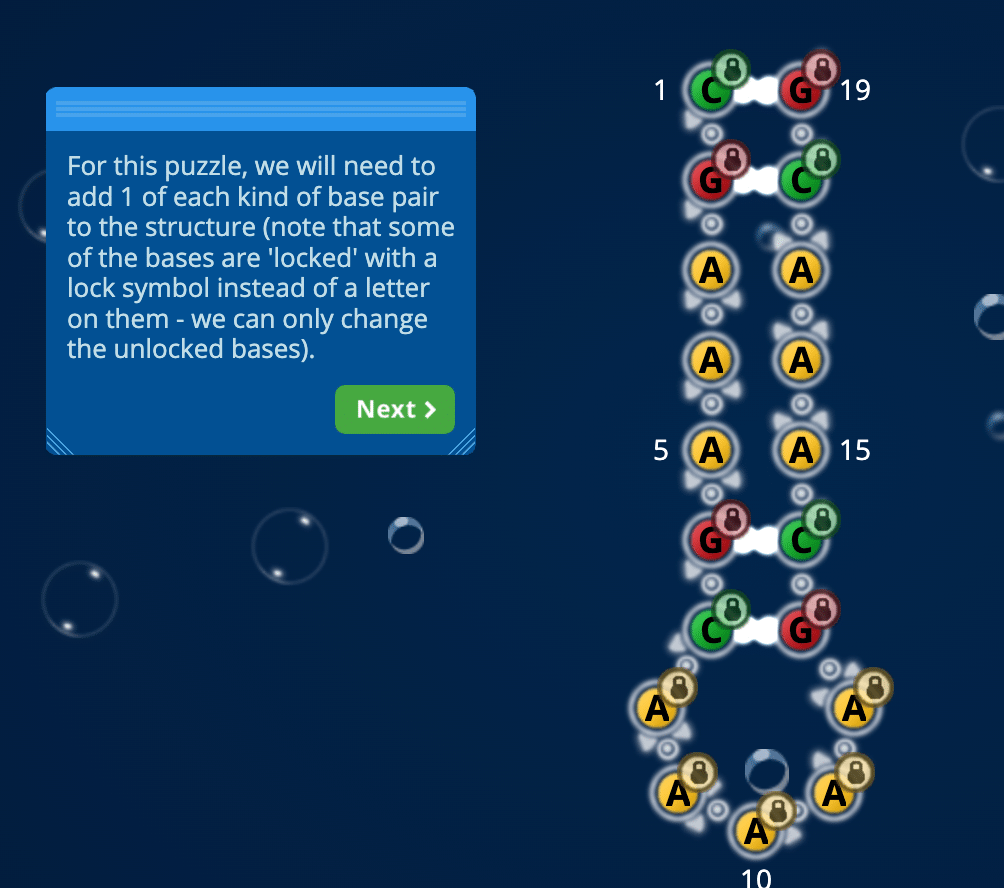
As the player continues, other mechanics are introduced, such as certain bonds being stronger than others (G-C bonds are the strongest), the alignment of the bonds creating more or less stable structures, and bonds impacting free energy. All of these mechanics are realistic and introduce important considerations into how RNA effectively folds. As the desired goal for each puzzle becomes more difficult, players must apply these other mechanics in order to pass the level. This creates the dynamic of trial and error, where the player must test different strategies, which helps the aesthetic of challenge and discovery, while reinforcing the outcomes through application. Players may discover the many different ways different bases interact with each other, while also having more potential solutions to a puzzle.
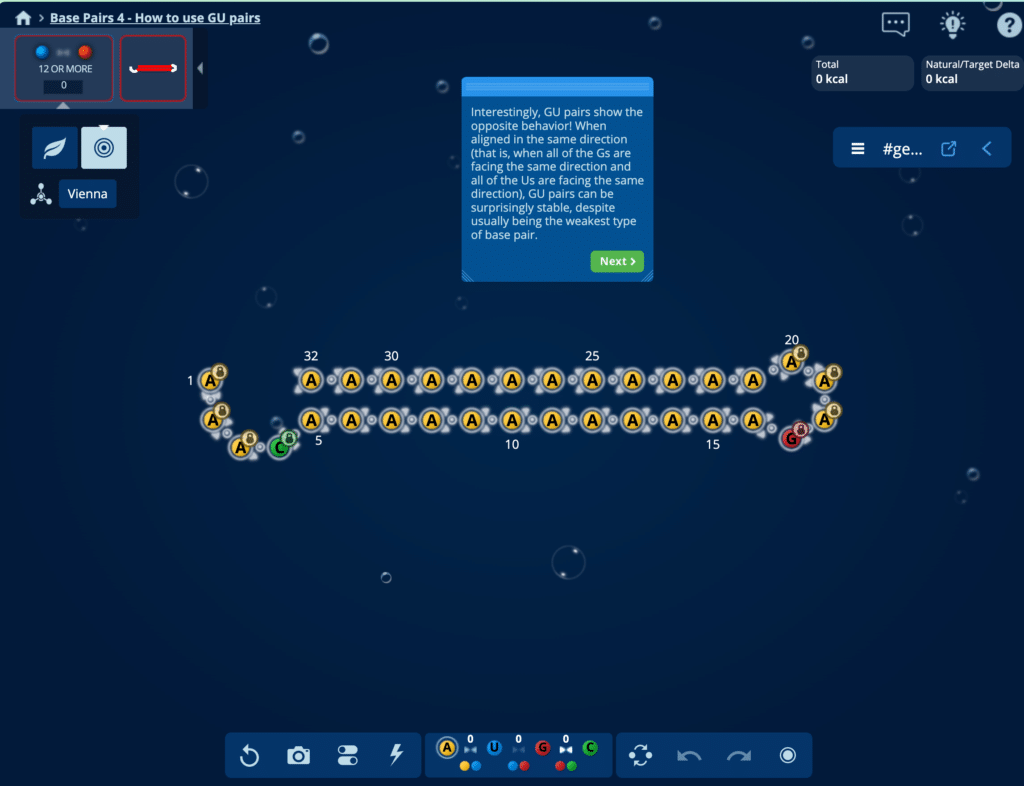
Additionally, because EteRNA is governed by the set of core mechanics that define how RNA form, certain shapes commonly appear in multiple puzzles. This creates the dynamic where players learn how to compose certain shapes, which they can them combine to create an overall structure, instead of focusing on only base pairs. In turn, players begin to abstract the process of creating structures, helping with the implicit skill of folding.
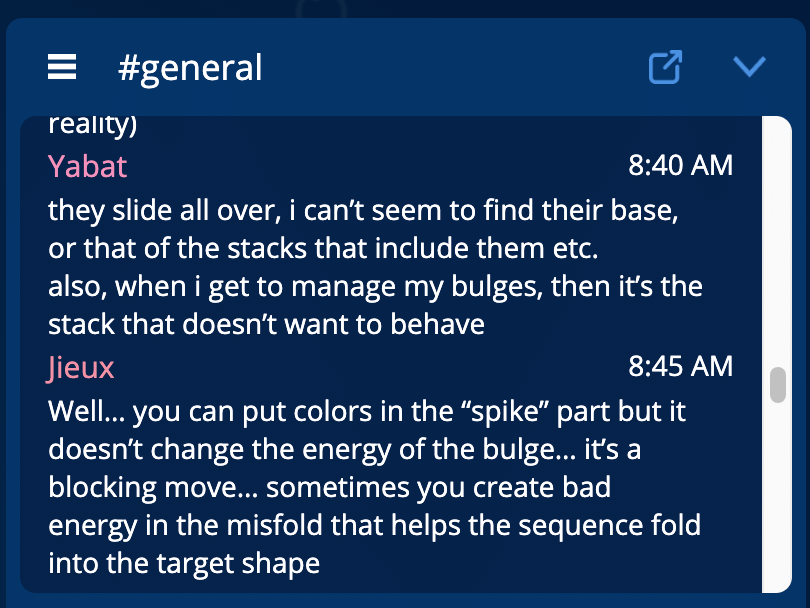
Finally, the game includes the mechanic of a public chat, which creates the dynamic of collaboration and teaching. Because there is no competition, and puzzles may not always have hints to the correct answers, players freely share what they’ve learned. Not only does this allow new players to learn more about RNA, veteran players reinforce their knowledge by teaching others.
Overall, EteRNA effectively teaching players how and why RNA folds though challenging players to fold RNA in a puzzle-like format.