

1. Identify the basic elements in a game of your choice (actions, goals, rules, objects, playspace, players).
Tennis!
actions: players hit the tennis ball with their rackets.
goals: there is a game-set-match rule for tennis. For a game (smallest unit), players need to win 4 points with a margin of at least 2. To win a set, a player needs to win 6 games with a margin of at least 2. At 6-6, they play a 7-point tiebreak until one player reaches 7 points first with a 2-point margin (If they keep tying over 7 points, the player who gets a 2-point advantage first wins). For match, the player needs to win best of 3 sets or best of 5 in men’s Grand Slams only.
rules: 1) serve: The server gets two attempts to serve a legal serve – they get a double fault and lose the point if they fail both. A serve that clips the net but lands in the correct box is a let and is replayed. Stepping on the baseline while serving is a foot fault. One player serves an entire game, and the serve alternates between players each game. The server switches between the right and left side of the court every point.
2) rallying: return of serve must bounce first, then the players can start volleying. You lose the point if: a. the ball bounces twice on your side; b.the ball didn’t make it over to the other side or it went outside the lines. c. you touch the net or reach over it to play the ball. d. if you get hit by the ball.
3) counting/scoring: in tennis points are counted in this order: love (0), 15, 30, 40, then game (winning the game). If players are at 40-40 (deuce), a player must win two points in a row. The first of those gives them advantage. In a tiebreak, points are counted normally (1, 2, 3…), and the first to 7 with a 2-point margin wins the set.
4) switching sides: players switch sides of the court after every odd-numbered game.
objects: rackets (one per player), tennis ball, net.
playspace: tennis courts are designed to be rectangular courts with lines that mark the boundaries of play. The inner vertical lines mark boundaries for singles play, while the outer vertical lines mark the boundaries for doubles play. The inner
players: there are singles (one against one; total 2) or doubles games (two against two; total 4) in tennis.


2. As a thought experiment, swap one element between two games: a single rule, one action, the goal, or the playspace. For example, what if you applied the playspace of chess to basketball? Imagine how the play experience would change based on this swap.
Designing a swap with Soccer’s clock/time constraints in tennis.
Tennis doesn’t have a clock system. So after the element swap, instead of winning a set number of sets, the player with the most points after 60 minutes wins.
I imagine this will change the game dynamic vastly because with the original system in tennis, where there is no time constraint, no lead is truly ever safe – there could be comebacks from match point. But with the clock, the leading player will likely stall and there will likely be urgency towards the end of the game. The players will need to strive hard for every game and set instead of strategically saving stamina and planning for important points. There will likely need to be time-wasting penalties added to tennis rules to prevent malicious time wasting.
3. Pick a simple game you played as a child. Try to map out its space of possibility, taking into account the goals, actions, objects, rules, and playspace as the parameters inside of which you played the game. The map might be a visual flowchart or a drawing trying to show the space of possibility on a single screen or a moment in the game.
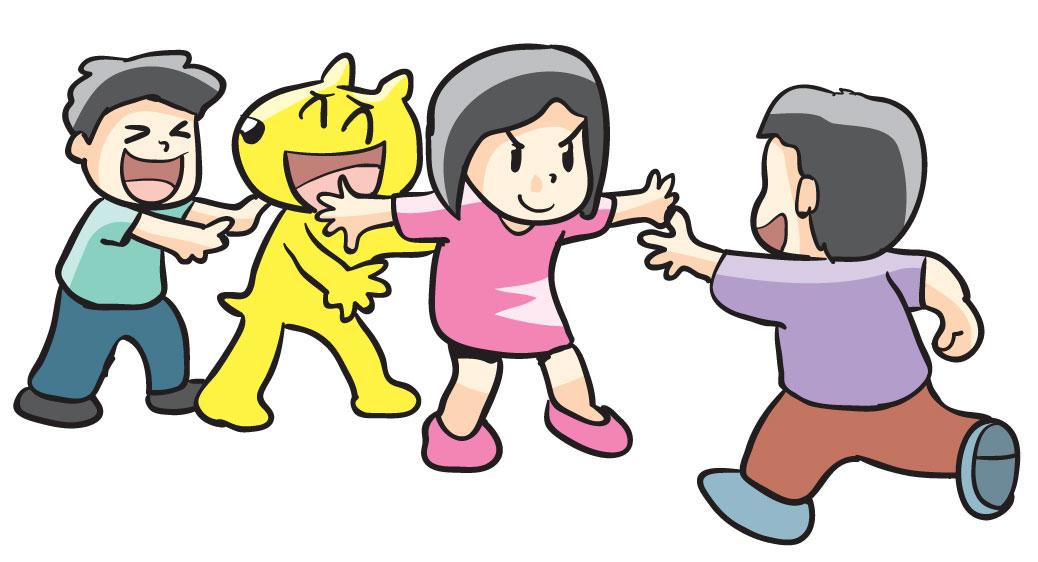
Eagle catches chick (老鹰抓小鸡) is a childhood game I used to play.
players: a group of children. One plays “the eagle”, one plays “the hen”, the other play “the chicks”.
goals: the eagle tags chicks until none are left. The hen protects her chicks by keeping her body between the eagle and her chicks. The chicks stay attached to one another and behind the hen.
actions: run, dodge, feint, and swing. The hen spreads her arms to block; each chick holds the waist or shoulders of the one in front.
object: none.
rules: the eagle can’t push through or grab the hen. The caught chick becomes the next eagle.
playspace: any open space/playground.
Dynamics: the more the hen turns, the more the tail swings, which makes the last chick both most exposed and most likely to lose its grip.
Also the smaller the playground is, the more the eagle benefits. (birds-eye view)
4. Pick a real-time game and a turn-based game. Observe people playing each. Make a log of all the game states for each game. After you have created the game state logs, review them to see how they show the game’s space of possibility and how the basic elements interact.
turn-based game: Monopoly.
| Turn | Player | Roll | Landed on | Decision point? | Choice made | Cash after | Property change | Notes |
|---|---|---|---|---|---|---|---|---|
| 1 | P1 | 3+5 | Vermont Ave | Buy? | Buys ($100) | 1,400 | +Vermont | No hesitation |
| 2 | P2 | 4+2 | Oriental Ave | Buy? | Buys ($100) | 1,400 | +Oriental | |
| 3 | P3 | 6+3 | Connecticut Ave | Buy? | Buys ($120) | 1,380 | +Connecticut | Light blues now split three ways |
| 4 | P4 | 2+3 | Reading RR | Buy? | Buys ($200) | 1,300 | +Reading RR | |
| 5 | P1 | 4+4 (doubles) | St. James Pl | Buy? | Buys ($180) | 1,220 | +St. James | Rolls again |
| 5b | P1 | 1+2 | New York Ave | Buy? | Buys ($200) | 1,020 | +New York | Pauses ~10 sec before buying |
| 6 | P2 | 5+6 | Community Chest | None | “Bank error”: +$200 | 1,600 | ||
| 7 | P3 | 3+4 | St. James (P1) | None | Pays $14 rent | 1,366 | P1: 1,034 | |
| 8 | P4 | 6+5 | St. James (P1) | None | Pays $14 rent | 1,286 | P1: 1,048 | |
| 9 | P1 | 2+1 | Chance → Illinois Ave | Buy? | Declines ($240) | 1,048 | Says they’re “keeping a cushion”; property goes to auction | |
| 9a | Auction | — | Illinois Ave | Bid? | P2 wins at $190 | 1,410 (P2) | P2 +Illinois | P3 drops out at $170; P4 never bids |
| 10 | P2 | 1+1 (doubles) | New York (P1) | None | Pays $16 rent | 1,394 | P1: 1,064 | |
| 10b | P2 | 3+3 (doubles) | B&O RR | Buy? | Buys ($200) | 1,194 | +B&O RR | |
| 10c | P2 | 2+2 (3rd doubles) | Go to Jail | None | Sent to jail | 1,194 | Table groans | |
| 11 | P3 | 4+6 | Atlantic Ave | Buy? | Buys ($260) | 1,106 | +Atlantic | |
| 12 | P4 | 2+6 | Illinois (P2) | None | Pays $20 rent | 1,266 | P2: 1,214 |
Full snapshot after Turn 12
| Player | Position | Cash | Properties | Status |
|---|---|---|---|---|
| P1 | Chance (22) | 1,064 | Vermont, St. James, New York | |
| P2 | Jail (10) | 1,214 | Oriental, Illinois, B&O RR | In jail, 1st turn |
| P3 | Atlantic (26) | 1,106 | Connecticut, Atlantic | |
| P4 | Illinois (24) | 1,266 | Reading RR |
real-time game: Halli Galli.
I used one of the online videos on YouTube for this log.
Setup: Two players (P1, P2) with 28 cards each. They alternate flips, starting with P1, and play has a 5-minute time limit. Fruit key: Ba = banana, St = strawberry, Li = lime, Pl = plum.
| Flip | Clock | Flipper | Card | Visible totals | Five? | Bell rung by | Flip to ring | Correct? | Face-down after (P1/P2) | Notes |
|---|---|---|---|---|---|---|---|---|---|---|
| 1 | 0:02 | P1 | 2 Ba | Ba2 | No | — | 27/28 | |||
| 2 | 0:04 | P2 | 3 Li | Ba2 Li3 | No | — | 27/27 | |||
| 3 | 0:06 | P1 | 3 Ba | Ba3 Li3 | No | — | 26/27 | |||
| 4 | 0:08 | P2 | 2 Ba | Ba5 | Yes | P1 | 0.7 s | ✓ | 30/26 | P1 takes 4 cards |
| 5 | 0:11 | P1 | 1 St | St1 | No | — | 29/26 | |||
| 6 | 0:13 | P2 | 4 Pl | St1 Pl4 | No | — | 29/25 | |||
| 7 | 0:15 | P1 | 1 Pl | Pl5 | Yes | P2 | 1.1 s | ✓ | 28/28 | P1 was still looking at their own card |
| 8 | 0:18 | P2 | 2 St | St2 | No | — | 28/27 | |||
| 9 | 0:20 | P1 | 4 St | St6 | No | P1 | 0.5 s | ✗ (six) | 26/28 | Wrong ring: P1 gives 1 card to P2 |
| 10 | 0:23 | P2 | 1 Li | St4 Li1 | No | — | 26/27 | |||
| 11 | 0:25 | P1 | 4 Li | Li5 | Yes | P2 | 0.9 s | ✓ | 25/31 | P1 hesitates, likely wary after the wrong ring |
| 12 | 0:28 | P2 | 5 Ba | Ba5 | Yes | P1 | 0.4 s | ✓ | 26/30 | Single card showing five |
Comparing two logs:
- space of possibility
For monopoly, it is easy to see that the space of possibility for buying is especially wide early on in the game, is quite open briefly at the trading phase, and then very little space of possibility is left. As the game proceeds, advantages will turn into more advantages – those who own more resources later on end up buying more lands and getting more rents.
For Halli Galli however, the one meaningful choice you can make in the game is to ring the bell or not, and this choice is live in every moment. And with card piling on the table, one ring can swing the card count dramatically for players even if it looks like they have had a big advantage just the moment before. Because having more cards doesn’t make you faster, so the leader holds no structural advantage in the next ring.
2. elements interaction
In Monopoly, the rules make rent jump when you own a complete color set, and the goal is to bankrupt everyone else. Together, those make trading the most consequential action in the game, even though no rule tells you to trade. The objects (such as dice, cards) and playspace (the board’s fixed loop) produce the randomness that sets up those trades.
For Halli Galli, the bell as a single shared object creates physical contention. The exact-five rule plus the wrong-ring penalty turns speed into a gamble. The number of players could also drastically shift the reaction time because of the different complexities of the math and thus game dynamics.


