Pokémon Pearl, a creature-collecting RPG by Game Freak/Nintendo (2007) available on Nintendo DS (played on online emulator), targets children and RPG players of all ages. Pokémon reduces friction at the door by world-building on fixed identity, but asymmetrically: In an environment that physically zones the world into human space and wild space, Pokémon are “other,” defined by fixed, inherent biology, while humans are defined by chosen social and cultural roles. Unlike D&D, however, which attaches essentialist traits to threatening races, Pokémon attaches them to lovable partners, making the essentialism feel wholesome and harder to notice.

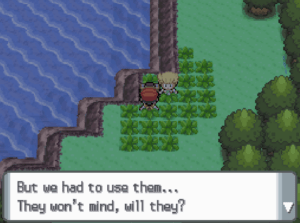
Sinnoh’s environment immediately shows the cultural premise: the world is zoned into human space and wild space. “Layer 3” from Bronfenbrenner’s ecological model in Pereira’s article, the surroundings, teach that human society and Pokémon wilderness are separate. As game architecture tends to, it tells “where [we] are and what might happen to [us] there” (Adams article). Environmental storytelling abounds: The level itself teaches, like Mario in lecture–Route 201 needs no tutorial text, and we’re automatically guided to the lake.
Pearl’s first characters we meet, humans, have cultural/societal traits based around social achievement: You are what you do, and that can change. Pereira’s “second layer,” the status-quo-setting cast (like Gale and Prim in Panem), is Mom, the rival, and Professor Rowan, who treat handing a ten-year-old a Pokédex as a normal rite of passage. Trainer classes like Youngster, Lass, and Hiker are occupations, not birth assignments, and Roark both runs Oreburgh’s gym and works at the mine–identity as job. Even class markers are meritocratic: Gym badges visibly rank humans, but any kid can earn eight of them, so rank is climbed, not issued. Per Pereira, the main character is the lens, so this worldview becomes the player’s by default.
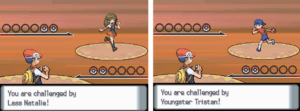
Pokémon, however, have inherent, biological, species-specific traits crucial to mechanics. When my Water starter faced Rock types, biology, not tactics, decided the match. Human classes carry no such weight: a Lass has no advantage against a Youngster, and trainer class changes nothing about how people interact–flavor with no function. Creature identity is mechanically crucial in the rules engine; human identity is decorative. Each Pokémon has a hard-coded Nature and evolutionary line assigned at birth. The Pokédex describes a whole species in one sentence–Pereira’s “world-building grid,” but published in-world as biological fact rather than a designer’s tool. The asymmetry is even monetized: every trainer battle pays the human winner, while the biology that won it earns nothing.

With this essentialism, Pokémon plays straight into its creature-collecting genre stereotypes, but deviates by turning the usual monsters into companions, which makes the stereotype harder to catch. Creature-collecting has always run on fixed kinds/species (e.g. D&D’s racial stats, Magic the Gathering, etc.), and the Pokédex isn’t different. This familiarity is low-friction evoked storytelling–of a genre, not a franchise. Pokémon ignores the genre’s other convention: that such creatures are usually monsters, evil, and to be killed, making them companions instead. In MDA terms, mechanics of catching and type-matching produce dynamics of trait-based team-building and aesthetics of companionship. This interaction loop (Cook’s sketchnote term) drills the takeaway home: essentialist mechanics that generate feelings of friendship.
Pokémon‘s essentialism is beneficial as design and troubling as ideology for the very same reason: The game teaches you to read inherent traits as destiny, rewards you every time you do, and, because the indexed species are companions rather than enemies, lets the lesson land without ever feeling like one. Pearl builds the type lesson into play: At the rival rematch I forgot types advantages and watched Grass drain my Water (a failure), then swept Roark’s water-weak Rock team for the badge (a success). The essentialist world means a child grasps “water beats rock” instantly and is rewarded for it. But the ethics here feel harmful: it trains you to rely on reading inherent traits as destiny. Beneath the wholesomeness, the Pokédex runs on colonial/taxonomy logic: capture beings, catalog them, profit from their labor, call it science and adventure. This ideology is absorbed as skill through repetition, once per loop.

Pearl’s world-building does lead to both flaws and clever moments. Cleverly, the rival’s starter is always the one that beats yours (you pick Piplup, he gets Turtwig/Grass), an elegant uphill-battle teaching mechanic. One flaw, however: The dedication to essentialism gives players no mechanic to push back with–no way to raise a Pokémon against its Nature. One suggestion would be to let a Pokémon’s Nature drift based on how it’s raised, or its type shift with the habitat it grows up in. Like D&D but with cute creatures, Pearl shows essentialism doesn’t need threatening races to work.
Pearl feels effortless to enter because its deepest claim (“what you are is fixed at birth”) comes via lovable creatures and obvious mechanics, which is itself a lesson that whatever friction a world removes at its door is probably where you should look for what it believes.