
“How do the mechanics of the puzzle(s) influence the experience of the game?”
Yellow – Bart Bonte on Ipad
For this week’s critical play, I chose to play yellow created by Bart Bonte. It is a simple puzzle game playable on mobile platforms and browser versions. The targeted audience seems to be people who enjoy solving puzzles with changing abstract/ intuitive logic that are followed by Eureka type of moments.
The mechanisms of the puzzle influence the experience of the game by making the puzzle-solving feel like experimentation at every level rather than mastering anything in particular since every level is very different. Although the goal to make the whole screen yellow remained constant, I didn’t really enjoy that past knowledge tended to not be useful, and I had to relearn and experiment at every level although it seems to help improve the skills of adaptability. In comparison, other puzzles that I’ve done in the past with levels seem to reuse past levels’ types of mechanism, which was something I enjoyed as a kid. In Yellow, the mechanisms included tapping ,dragging, holding, waiting, or remembering patterns.
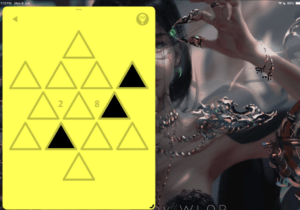
While playing the game, level 28 felt really intuitive to me since the triangle arrangement made what I had to do very visually readable, and I passed it really fast.
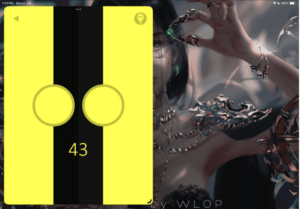
By contrast, level 43 almost drove me mad since although the goal of every level remains the same, I could not comprehend how to reach that goal at all for the longest time. The two circles with the vertical bars are shapes that had, by that point, appeared multiple times, so it seems I had like preconceived notions on how those work, and it took a long while for me to be able to adapt. I think that frustration is vital to the experience since if I didn’t get even a bit frustrated for any of the levels, then that means that the game is too easy, and would lose players.
Looking through the MDA framework, with the mechanisms changing each level, the dynamic was to make the players constantly reevaluate their own assumptions. For example, when I see vertical rows or columns and two circular shapes, I would have an assumption of how it would work and then I would always be shown thatmy assumption is wrong. Afterwards, I would try anything to everything until the screen would turn yellow. Therefore, looking at the formal elements, the conflict in this game is the changing assumptions rather than time or death like some other puzzle games might be.
Ethically, one assumption Yellow makes is that the players would be familiar with puzzle games and touch screens. Going into the game, it has no tutorial level nor any form of introduction. I think this could exclude people who did not grow up having tried puzzle games like these that require random actions. They do attempt to mitigate this by having a hints button at the top right of the screen. However, the hints are connected to watching ads, which could seem more like a format punishment for the players rather than assistance. To combat these, I believe they should include a tutorial or a few free hints (without ads.)