For this week, I played Sherlock Holmes: Consulting Detective, an analog mystery deduction game originally created by Raymond Edwards, Suzanne Goldberg and Gary Grady. It’s recommended for ages 13+ due to the heavy reading and sustained attention required, and is best suited for players who enjoy pouring over text and piecing together clues over an extended session. The game can be played solo or in groups of up to eight; I played in a group of three. The box includes ten cases, each serving as a self-contained narrative.
Sherlock Holmes: Consulting Detective uses its architecture to encourage slow and methodical exploration of leads. Its core mechanic, choosing which leads to pursue from a directory, immerses players by forcing them to actively construct the narrative rather than passively receive it. This design pushes them to consider character motivations, spatial relationships, and the reliability of information. However, this can make the mystery feel convoluted, especially for players expecting a more guided or succinct experience.
The game heavily relies on embedded narrative and evocative spaces. The primary gameplay loop begins with players reading an introduction to the case. Afterwards which players consult a directory of names and locations. Each entry corresponds to a numbered paragraph in a casebook which represents a lead. Reading a lead reveals new clues, characters and locations to visit which creates a branching structure of information. Importantly, the game never tells players which leads are essential and players must decide what is worth pursuing.
This mechanic tightly weaves narrative into play. Instead of progressing linearly, the story emerges through player choice. Mechanically, the directory and casebook provide discrete chunks of narrative. Dynamically, players debate which leads to follow and form interpretations of what unfolded. The act of choosing a lead is also an act of narrative authorship; players effectively edit the story by deciding which perspectives to include. Players are also given a map of Victorian London which acts as architecture that plays a crucial role in supporting the story. Players can reference distances between locations, infer travel times and test alibis. For example, if a suspect claims to have traveled across the city within a short window, the map allows players to challenge that claim. This transforms space into a narrative constraint: the city itself becomes a system that validates or invalidates story elements.


At the same time, the game leans heavily on evocative space. It assumes some familiarity with the Sherlock Holmes universe and the tropes of Victorian London. This works well in creating immersion quickly, but it can also introduce friction. Compared to other mystery games like Her Story or Return of the Obra Dinn, which scaffold player discovery more carefully, Sherlock Holmes is far more open-ended and text-dependent. It relies much more heavily on player-driven pacing and interpretation rather than system-driven progression.
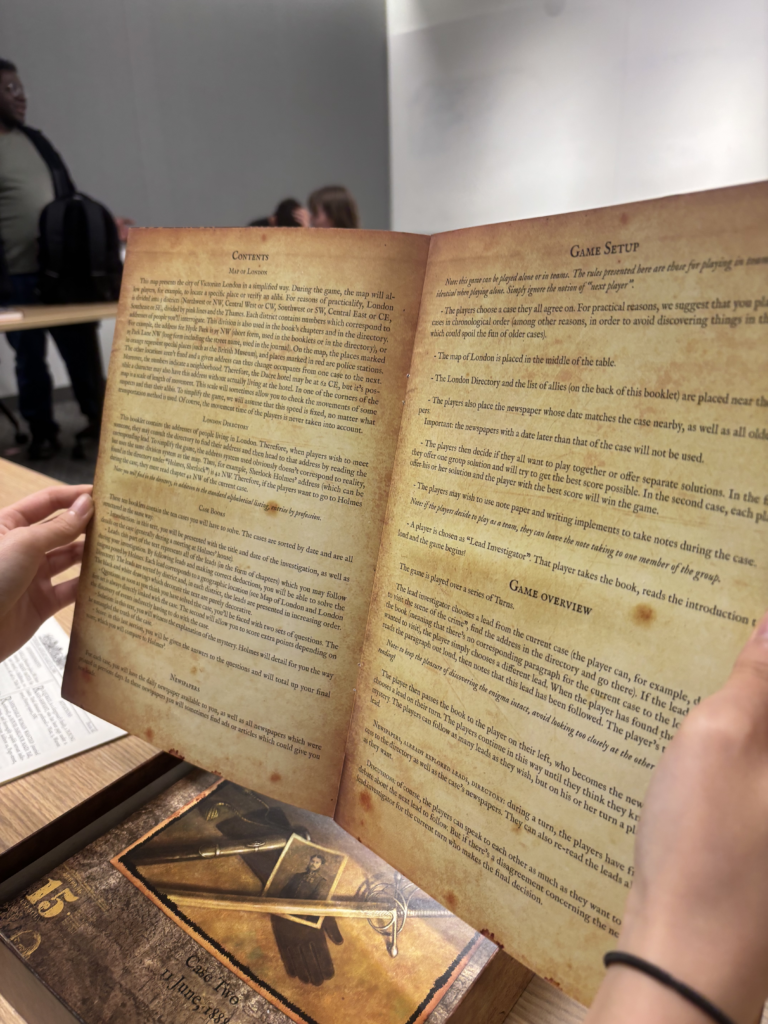
However, not all of these design choices worked smoothly in practice. Our group initially experienced confusion about the rules and structure of play. Because the game is so text-heavy, we rushed through the instructions and missed key details such as the fact that the directory includes both people and locations. This led to a significant delay in our investigation, as we didn’t visit the crime scene until halfway through the session. From a design perspective, this highlights a usability issue: critical mechanics are embedded in dense text rather than surfaced clearly through onboarding or examples.
Additionally, the game’s objective of beating Sherlock Holmes by using less leads then him can conflict with the natural desire to explore. This creates a tension between optimization and curiosity. A possible improvement would be rewarding thorough investigation rather than penalizing it or by offering multiple success conditions that validate different playstyles. Our group also felt the pressure of time, trying to complete the case in about an hour. This clashed with the intended pacing of the game, which clearly rewards slow, deliberate thought. In this sense, the design succeeds in creating a specific aesthetic experience, but only if players meet it on its own terms. Unlike escape rooms, where time pressure is integral to the design, Consulting Detective arguably works best without strict time constraints.
One significant accessibility barrier in Sherlock Holmes: Consulting Detective is its reliance on large amounts of reading. The core mechanics of gathering clues, interpreting evidence and navigating the directory are almost entirely text-based. This makes the game difficult to play for blind or visually impaired players, particularly in solo settings. However, group play can partially mitigate this by having one player read aloud. A more accessible design might be to include audio recordings of case text.