
For this week’s Critical Play, I played through Journey, created by thatgamecompany. Journey is available to play on Playstation 3, Playstation 4, Windows, and iOS, but I chose to play on my iPhone. The game was released in 2012 and is rated for ages 6+. Being a walking simulator, this game is intended for single players and especially those that are explorers. Although Journey is a simple game on the surface, it manages to tell a compelling story that reflects the stages and emotions of life and create an emotional dynamic through just the mechanic of walking.

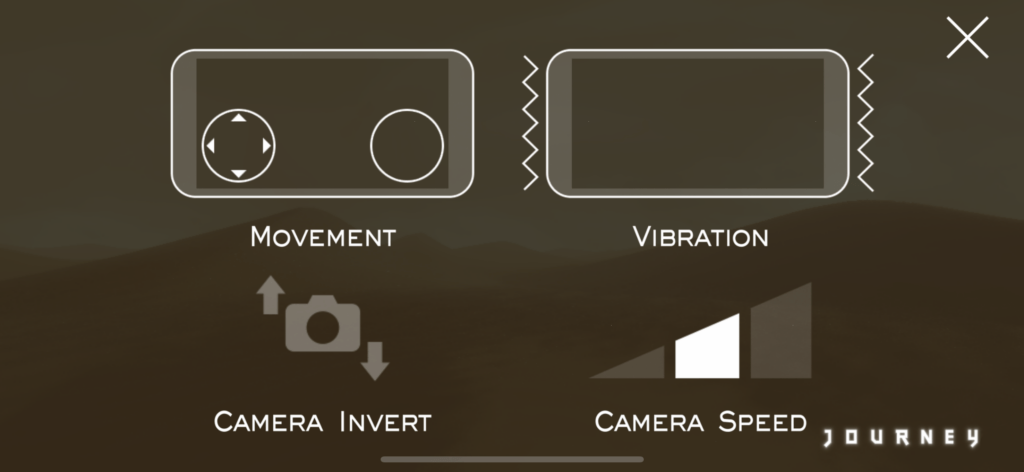
The game opened to a very minimalist screen, with just a desert and cloudy streaks in the sky. The gameplay mechanics were highly intuitive, with the only option after the opening sequence being a button that said “New Journey.” (Note that when I came back to play the game later, I could either “Continue Journey” or start a “New Journey”). This mechanic was simple, yet effective. I knew to click it and the lack of any other text or introduction really set the tone for the game. The screen shifted to the setting of the game, a visually stunning desert. The player is then introduced, which is just a hidden figure. At this point, I was left to play, with no other instruction other than a large structure in the distance I figured I should walk toward. The closest thing in the app to a tutorial was its settings, which just illustrated the controls and allowed you to move them around.
One way in which the game told a lifecycle narrative was through the early gameplay which introduced the explorative aspect of the game. It felt quite like infancy, just wandering with no purpose. It felt childlike and carefree, getting to wander and explore the terrain with no consequences. Once I passed the tombstones and reached the structure, the screen shifted to show a mountain glowing in the distance, indicating to the player that this is the goal to reach. I found this to be a unique mechanic design, because none of this was explicitly stated. Simply through walking around and exploring, the visuals were able to introduce the goals of the game. In the earliest parts of the game, the designers were able to use only a walking mechanic to introduce the goal of the game and show that the game is an exploration form of fun.

The game’s visual design also aids the walking mechanic in emphasizing mood and motion: sand shifts under your feet, scarves flutter in the wind, and architecture slowly erodes as you progress. These tactile, aesthetic choices guide players through a story arc that mirrors the hero’s journey, without ever telling you that directly. Instead of violent obstacles or boss fights, Journey relies on environmental storytelling. Each area feels sacred and intentional, from wind-swept cliffs that slow your progress to the soaring finale where you’re briefly freed from gravity itself. The walking is not filler—it is the game. You absorb the world, reflect on your path, and occasionally share your experience in silence with a companion. This quiet, cooperative connection becomes a powerful storytelling tool.

These experiences throughout the game effectively evoke emotion and satisfaction within the player. By only being able to walk, I felt like I gained a strong sense of exploration and discovery, rather than just being told what to do every step of the way. Walking as the sole mechanic was a strong design tool, as it truly allowed the setting of the game to shine, and allowed exploration to be the main dynamic of the game.
Ethics:
In many violent games, violence seems to be correlated with progress. Even when well-designed, these games often reinforce the idea that adversity must be overcome through domination or destruction. In Journey, the absence of violence reframes adversity as an internal and environmental challenge. Rather than defeating anything, I was enduring, exploring, and understanding.
This changes the ethical tone of the experience. Journey gently challenges the expectation that games must reward aggression. It’s a game that brought out awe and wonder, not adrenaline. The interations with other players weren’t competitive; they were quick and collaborative, reminding us that presence and empathy can also have a strong impact on player experience. The designers’ choice to remove violence was powerful because it pushes exploration over competition. It invites players to consider alternate models of progress and engagement, which is a valuable contribution to the ethics of game design.