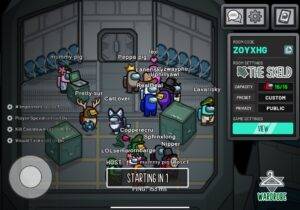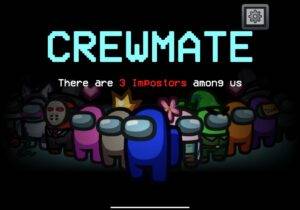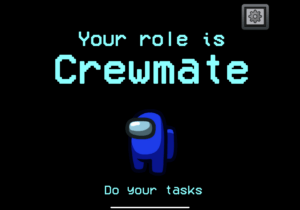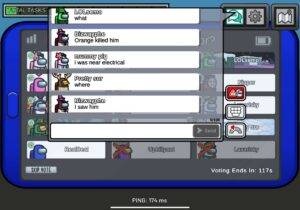

The game I’ll be choosing this week is Among Us. The target audience ranges from young kids to grown adults. The game’s creator is Innersloth LLC, and the platform of the game is digital. From mobile device to laptop to tablet to gaming device such as a Playstation, Nintendo Switch, or Xbox. A quick summary of Among Us is as follows: you’re a crewmate or an imposter on a spaceship. Crewmates try to finish tasks and vote out the imposter, while imposters sabotage tasks and try to kill crewmates without getting caught. The game ends when all tasks are completed or the imposters are voted off—or when the imposters kill enough people that they can’t be outvoted.
When I played, I realized just how much the game challenged my usual communication style. I’m someone who tends to hold back and listen before speaking. That kind of approach doesn’t always work in Among Us because of how the game is set up. You can’t talk during gameplay and only have a short discussion window after a body is found or an emergency meeting is called, it’s the people who speak first and with confidence that usually control the conversation. That reminds me of a concept I previously learned called anchoring bias—basically, people tend to believe the first thing they hear. So if someone lies early and convincingly, I have to work extra hard to break that perception later, even if I’m telling the truth. This made me realize that in a game like this, holding back isn’t always a smart move.
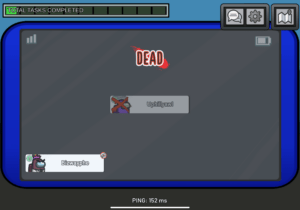
The design of the game makes communication hard and messy. You can’t talk while the game is running, and dead players can’t speak at all. So the people who are most informed—the dead crewmates—can’t help the rest of us. At the same time, the people left alive don’t know much but are the ones making all the decisions. In that kind of environment, if you talk too much, you seem suspicious, but if you’re too quiet, people think you’re trying to stay low. Either way, you can get voted out for any minor suspicion among the other participants. So naturally, this affects the way I make decisions too. I’m very careful with what I say and how I say it. I don’t want my story to contradict someone else’s, because then we both look suspicious. But if someone else’s story contradicts mine and I know I’m telling the truth, that’s when I get more vocal and start pointing fingers.
On the other hand, when I’m the imposter and someone contradicts me, I also go on the offensive. Either I kill them quickly before they can talk more, or I stay close to them and act innocent so they stop being suspicious of me. All of this is shaped by the game’s mechanics. You can’t build much credibility in the short time you get to talk, and there’s no way to prove anything. That means you have to read people, guess what’s true, and constantly manage how you’re being perceived. Whether I’m a crewmate or an imposter, the role I’m assigned completely changes how I talk, where I go, who I stick with, and how I think about the game. I’ve also realized that as my actions vary with different roles, people who know me well couldbeing to see how that role impacts my decisions.
On a different note, we were asked if lying in games wrong? I think lying within the game is fine as long as it falls within the bounds of the game. For example, if I say “I didn’t kill anyone, I was doing a task in Electrical,” that could be a total lie, but it’s part of the game. That’s not wrong. The problem is when people bring in things from real life—like saying “I swear on my mom’s life” or “I’m your roommate, I’d never lie to you.” That kind of stuff takes it too far. You’re no longer just playing—you’re trying to manipulate people on a personal level, and that’s where it becomes a problem.
That being said, games like Among Us are fun because they let you explore behaviors that would normally be stressful or harmful—like lying or accusing people—in a low-stakes setting. It’s like being able to use a different part of your brain. In real life, lying can ruin relationships or trust. But in a game, it’s a mechanic. It challenges your social intuition without real consequences, helping to make this experience fun and valuable.
The following images will show the sequence of the game: