

1. Title of game + author(s)
The title of game is Stop Disasters!: Learning Disaster Risk Through Decisions, developed by United Nations Office for Disaster Risk Reduction (UNDRR) and Playerthree.
2. What it’s about?
Stop Disasters! is a disaster-risk-reduction simulation in which players get a community prepared for hazards such as tsunamis and earthquakes. I played the Tsunami scenario on Easy mode, where my task was to protect a coastal community before the tsunami arrived.
3. What kind(s) of fun it uses?
The strongest type of fun for me was challenge. I started with a $50,000 budget, but housing, public facilities, defenses, training, and reinforcement all competed for the same limited resources. I therefore had to constantly ask: What should I prioritize?
A second important aesthetic was discovery. The risk map, “Key Facts,” building information, and post-disaster results, which is shockingly visual and terrible, gradually revealed nuanced relationships between people’s tendency, geography, construction, natural defenses, and survival.
4. How does the MDAO framework apply to this game?
✨Mechanics.
The game provides a grid-based map, fixed budget, different buildings and defenses, construction and reinforcement costs, risk levels, a Show Risk button, Key Facts, advisor messages, mission requirements, and a button that allows the player to trigger the disaster.
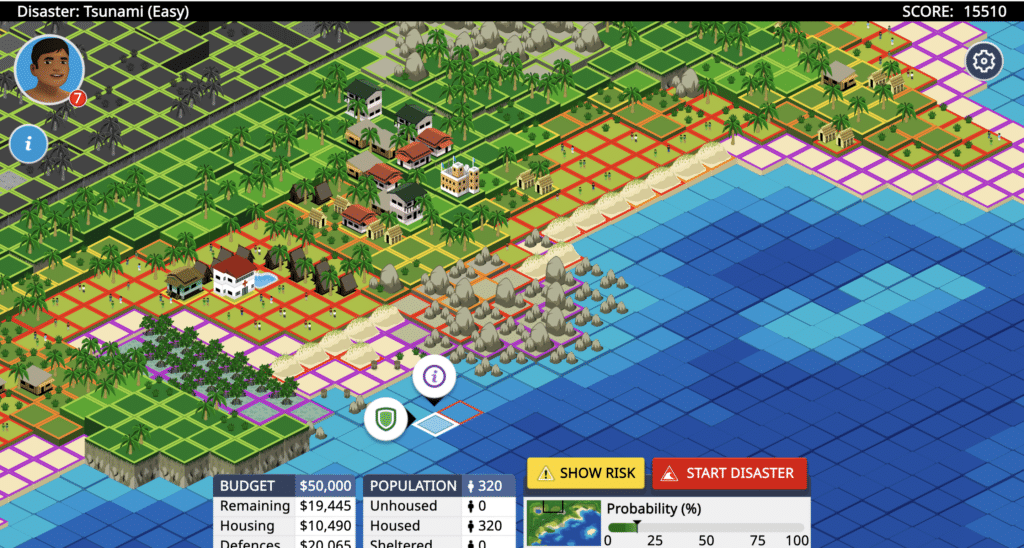
[Screenshot 1: risk map & budget] The risk map makes danger spatially visible while the limited budget turns risk reduction into a resource-allocation problem.
One mechanic I especially liked was sometimes, there are conflicting information with different priorities. For example, a Key Fact tells me that buildings farther from the ocean or on higher ground have a better chance of surviving. Meanwhile, an advisor asks whether I have considered building a hotel at the water’s edge. This creates a meaningful tension between economic development and disaster safety. I have to make a well-informed decision based on these trade-offs.
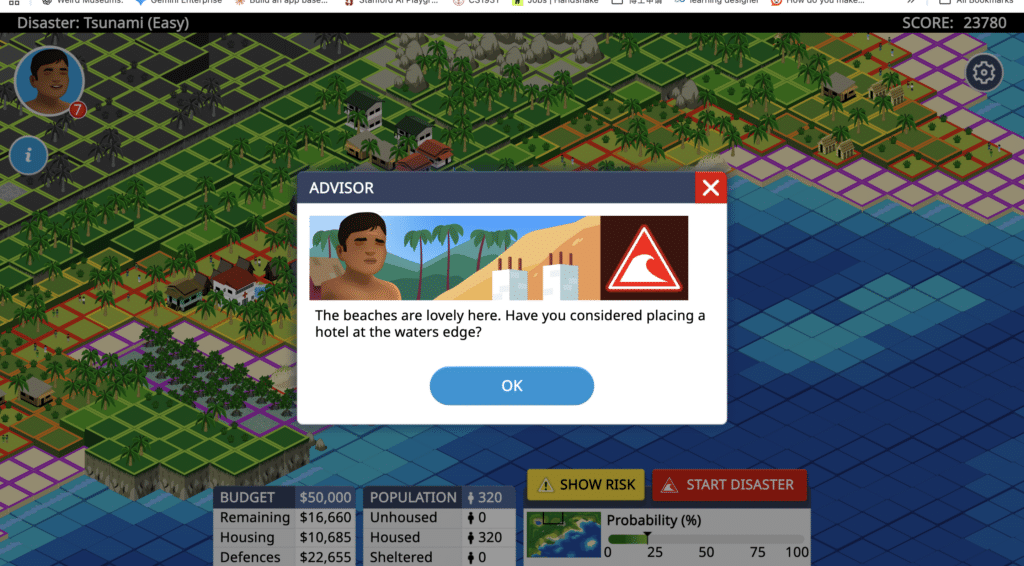
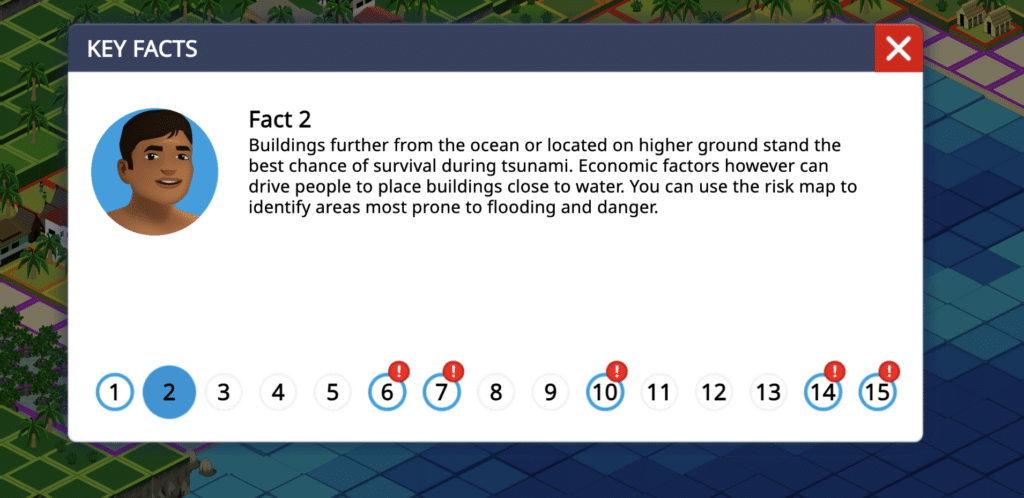
[Screenshot 2 & 3 : advisor suggesting hotel at water’s edge + Key Fact 2]
✨Dynamics.
These mechanics produced behaviors such as trade-offs, spatial planning, experimentation, and risk management. I began checking the risk map before building, placing important structures, comparing defenses, and deciding whether additional protection was worth its cost. This illustrates the MDAO idea that dynamics emerge from how players respond to the constraints created by mechanics.
✨Aesthetics.
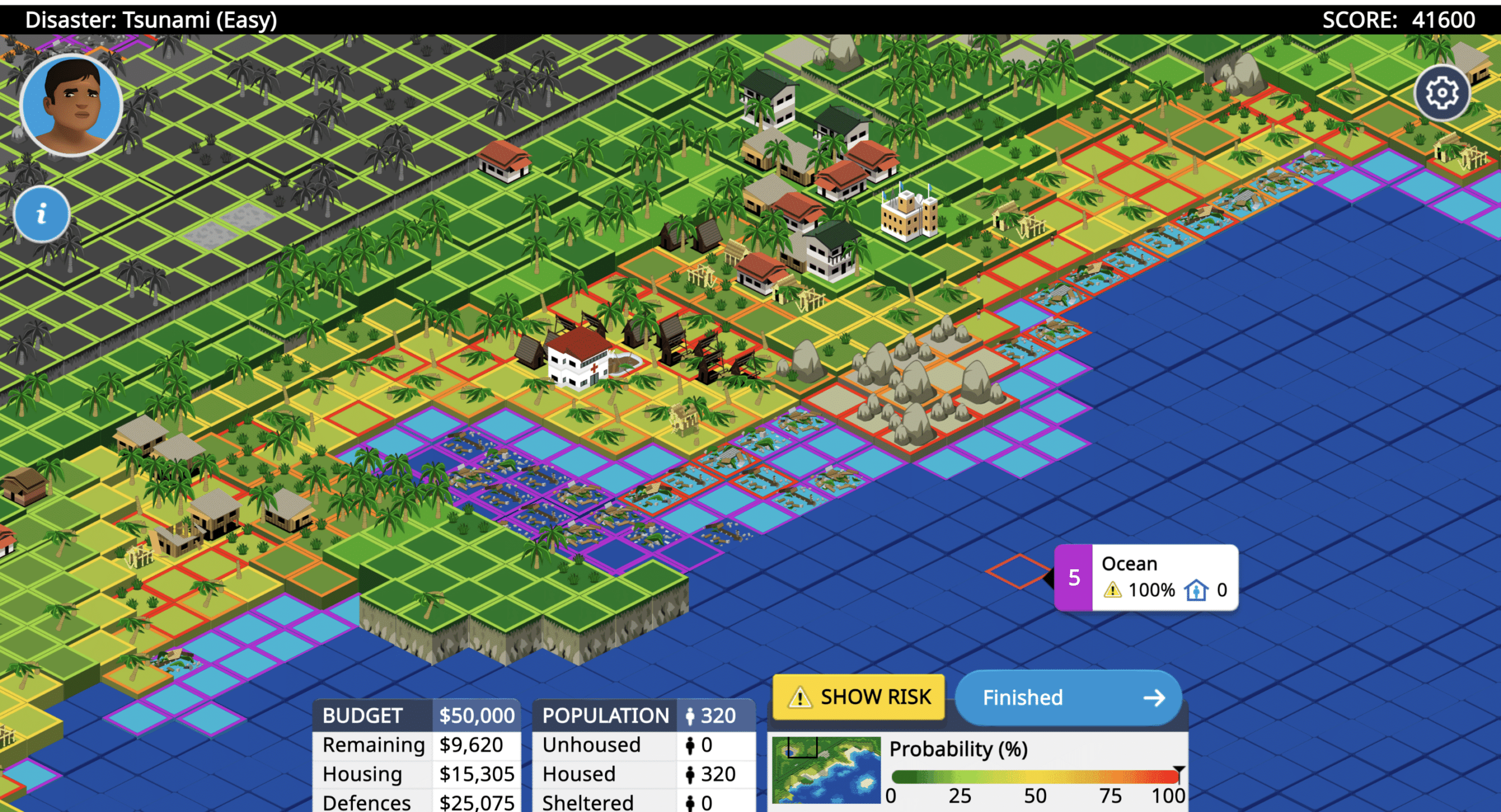
The game mainly uses sensation, discovery, challenge. Sensation comes from the shocking view after the tsunami hits and seeing how much damage has been caused. Discovery comes from finding out different ways to prepare for a tsunami and reduce risk. Challenge comes from trying to save as many people as possible with limited money and resources.
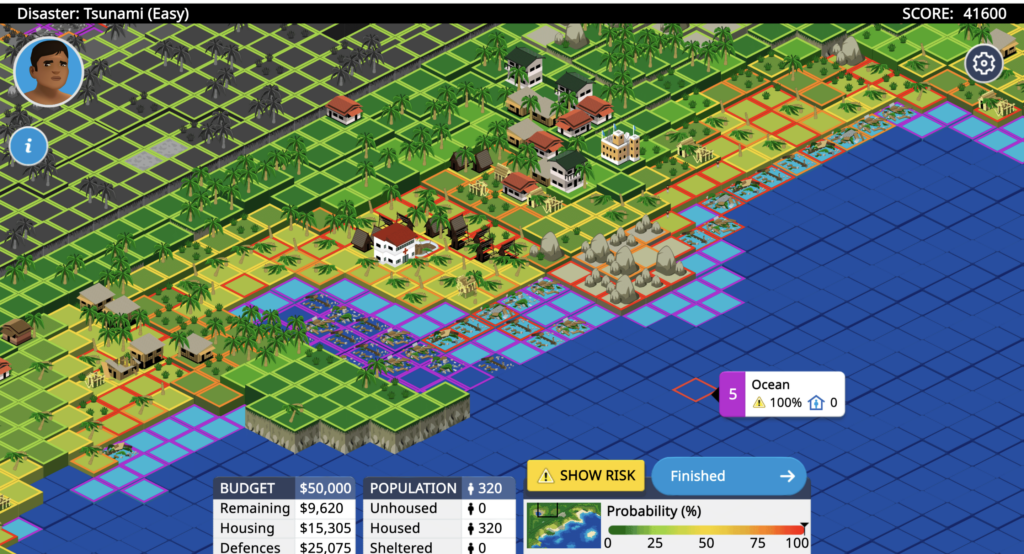
[Screenshot 4 : aftermath]
✨Outcomes.
The strongest outcomes are information, explicit and implicit skills, and attitude change. I learned concrete principles of tsunami preparedness, but I also practiced systems thinking, resource allocation, risk assessment, and decision-making under constraints. My final score was 41,600. I completed all objectives, yet 46 people died, 97 were injured, and 18 buildings were destroyed. This was probably the most effective feedback in the game. It immediately made me wonder what I could change on another attempt.
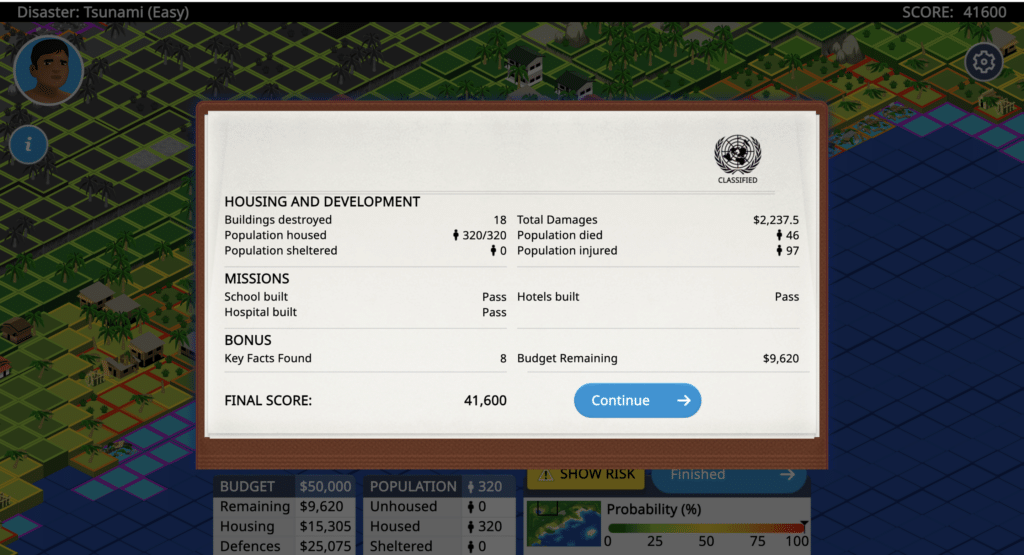
[Screenshot 5: final outcomes]
