


Team Quemisia : Zijie Zhou(Jason), Carl Liu, George(Zicheng_zhong), Mathias Becerra
Written by
Jack Yang, Zijie Zhou(Jason) and Mathias Becerra
ARTIST’S STATEMENT
Ever walked into a room and forgotten why you were there? Cute. Now try waking up with no name, no past, and no idea who any of your loved ones are.
Welcome to Butch’s morning, it only gets stranger from here.
Inspired by Mathias’s original sketch of the “Infinity Train” and games like Limbo, What Lies in the Multiverse, Celeste (shoutout to game nights!), and the unfinished TV series of “Infinity Train” (HIGHLY recommend watching in your leisure) as part of our group discussion and mood board assignments, we collaboratively decided to pursue the themes of an “ominous atmosphere,” providing challenges, and an intriguing narrative full of different puzzles.
In Nightfall, you take on the role of Butch, a young man who wakes up on an mysterious train and has no memory of how he got onto the train. Outside the windows, the world looks amazing and seemingly peaceful, but subtle inconsistencies suggest that this reality is not what it appears to be. Although Butch has lost most of his memories, he still remembers that he has a “sister” named Mara that he has to save.
He does not remember much about his sister or what he promised, but he knows that in order to find the truth about the train and the world surrounding him, he has to find Mara.
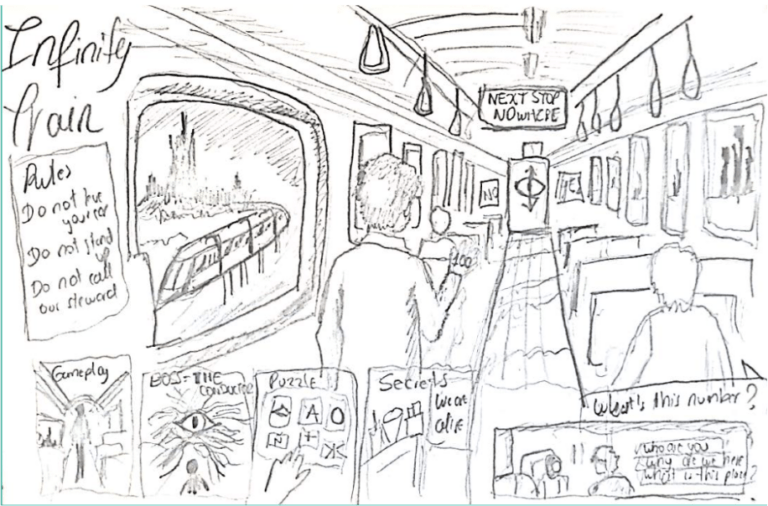
From solving small puzzles to switching between different worlds and seemingly unstable realities, every new place that the train leads you towards has its own rules, and every person you meet gives you another piece of information about the story. Just do not forget to keep moving; it seems you have already made this mistake.
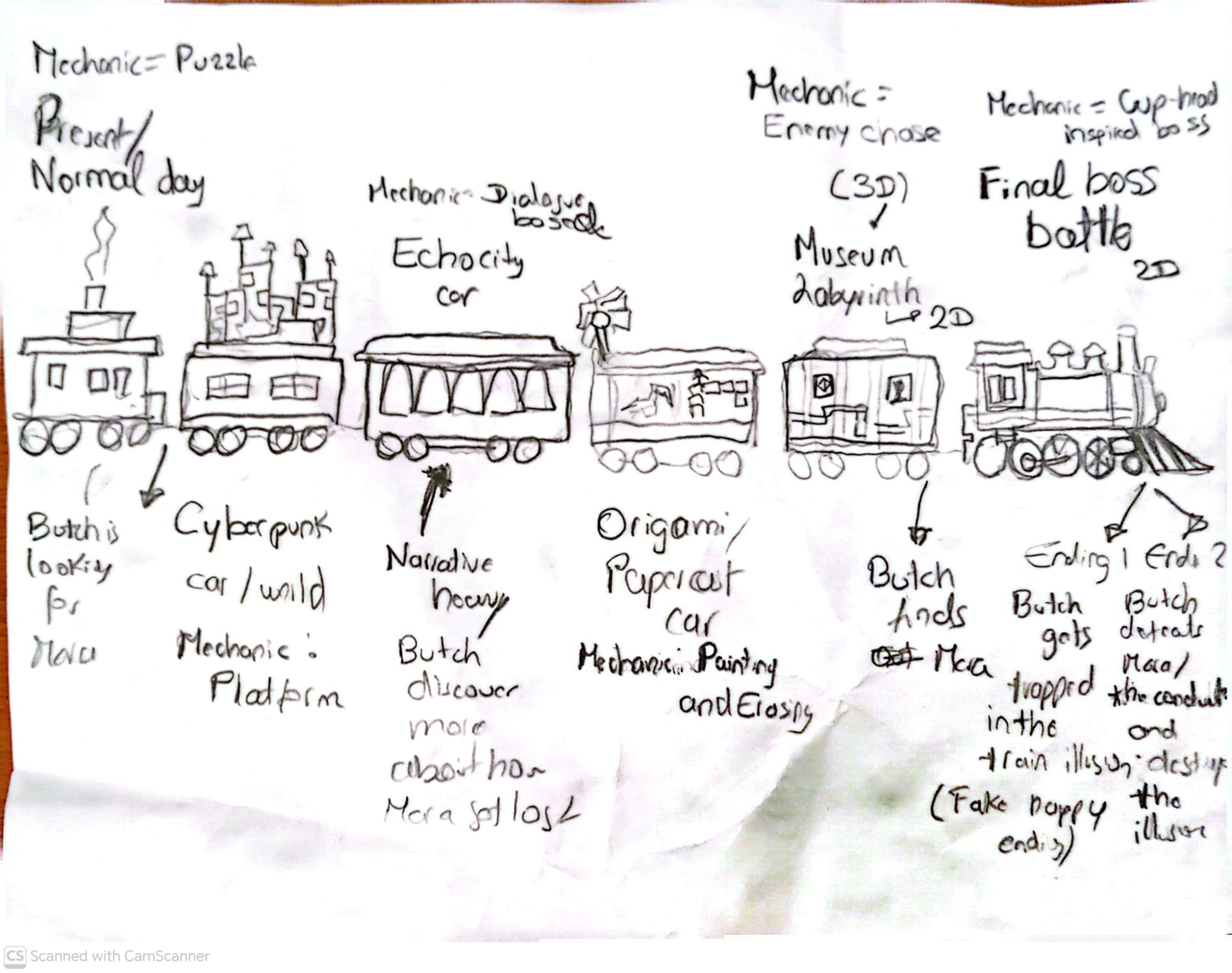
An early concept sketch showing the chronological order of the train cars, with each car representing a different world or destination inspired by the group’s shared interests from the mood board.
Nightfall offers a great experience to people who are not easily swayed by complex storytelling, enjoy platforming, environmental puzzles, and sometimes intense dialogue-based mysteries that become personal as they unfold over time.
By the end of the adventure, you might find out what happened to Butch, what promise he made, and perhaps the reason why he doesn’t remember anything about himself (?). But finding the truth is one thing; accepting it as a fact is a whole different challenge.
Would you cling to a comforting past, knowing it may be a lie, or confront the truth, even if what was broken can never be repaired?
Model of our game’s ecosystem
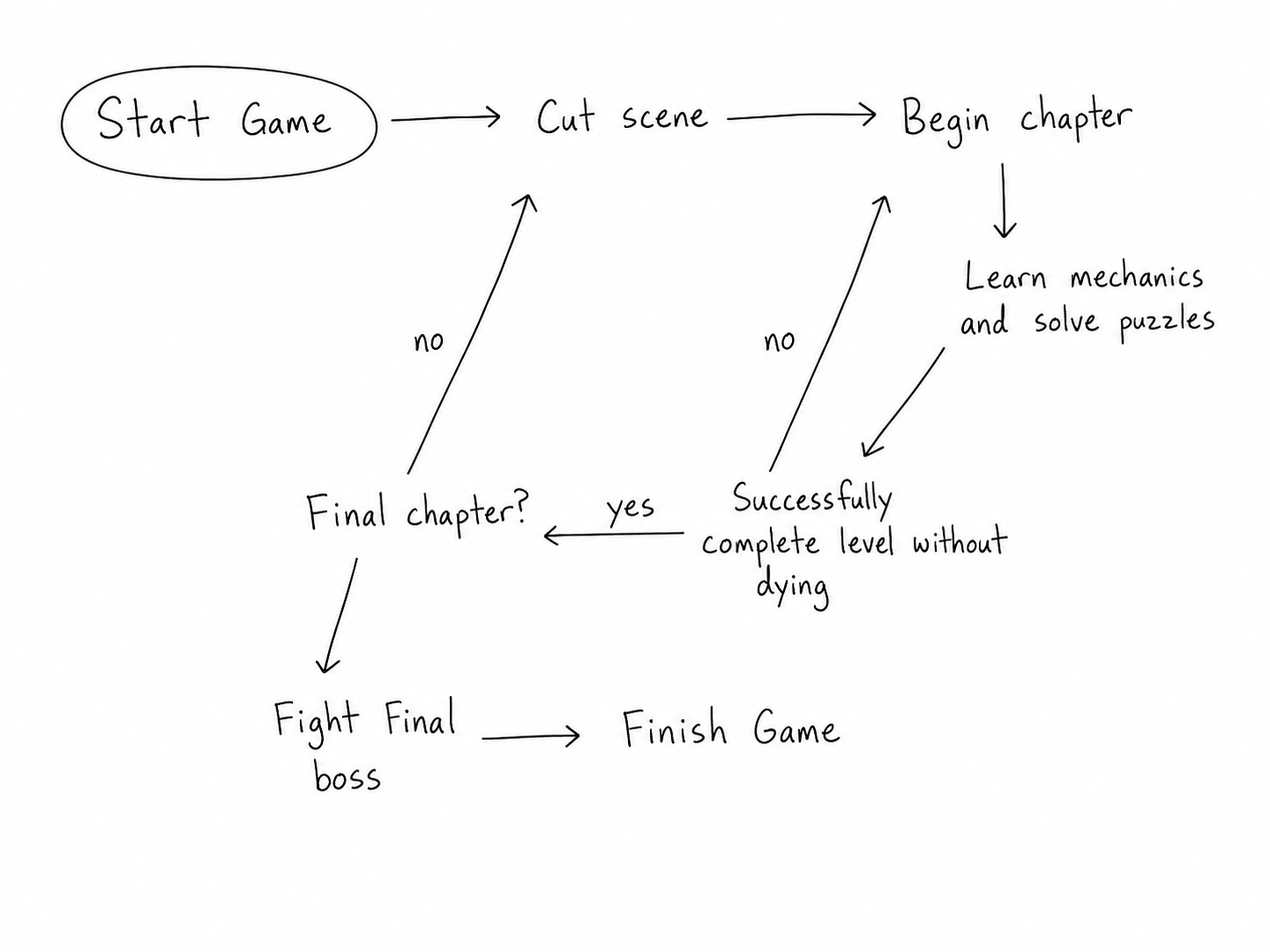
Our start was with Jack’s timeline system—the sort that involved a short summary of the game’s foundation.
In the end, we settled on a simpler model: a train consisting of many cars, each taking the player to a different realm. Depending on whether the player finds the Diamond of Truth in all of the cars or skips one and stays perfectly, perhaps dangerously, ignorant, the journey will have one of two conclusions.
Initial Decisions and Formal Elements:
Each member of our team had his own way into our project. Carl being a game developer in industry for many years before joining the Stanford GSE LDT program. George had his own game development startup and club. When we advertised in front of the class around Week 4-5, Jack and Jason being playtesters for demo competitions in the past, and Mathias,an Stanford undergrad familiar with the design process thanks to taking classes with Christina and CS42SI.
At the very beginning, we did not agree on something specific.
We desired to develop a full 2D game. Although there were times we were not fully sure if what we want to show to our players was fully represented using 2D as we had several ideas for our designs. However, someone had to start with something!
We were interested in making the “ infinite train” train. But we fell into the trap of asking what making the idea of an infinite train meant. Could it be that the train was an allegory for death—the purgatory? Does each car represent the stages of grief of losing someone? What is the point of including all of these different worlds, and how do they connect with each other at the end of the game? At some points, our meetings started to become more and more like a philosophical discussion than focusing of the game dev side of things.
However, we knew that we wanted to make a game for everyone: having a dialogue-based story for those who appreciated the narrative aspect of games, puzzles for those who liked tricky problems, and an exploratory element for those who would be searching for hidden corners in the game (easter eggs and secret/alternative endings). In theory, it was a good idea; in reality, perhaps it was a bit chaotic, but we did it !
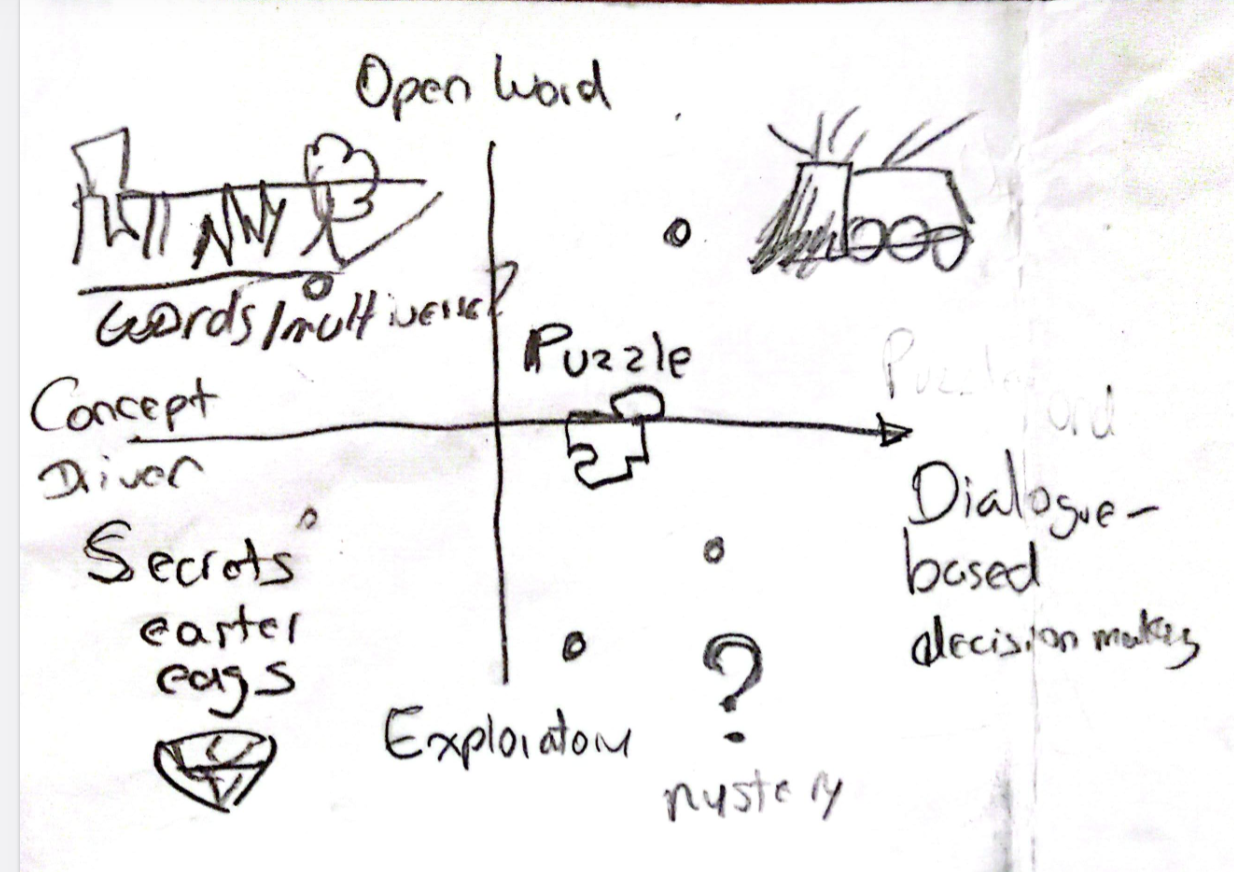
An early concept sketch in week 5 about how our ideas corresponded or mixed in regard to the theme for our game.
Character Design
BUTCH (inspired in butch)
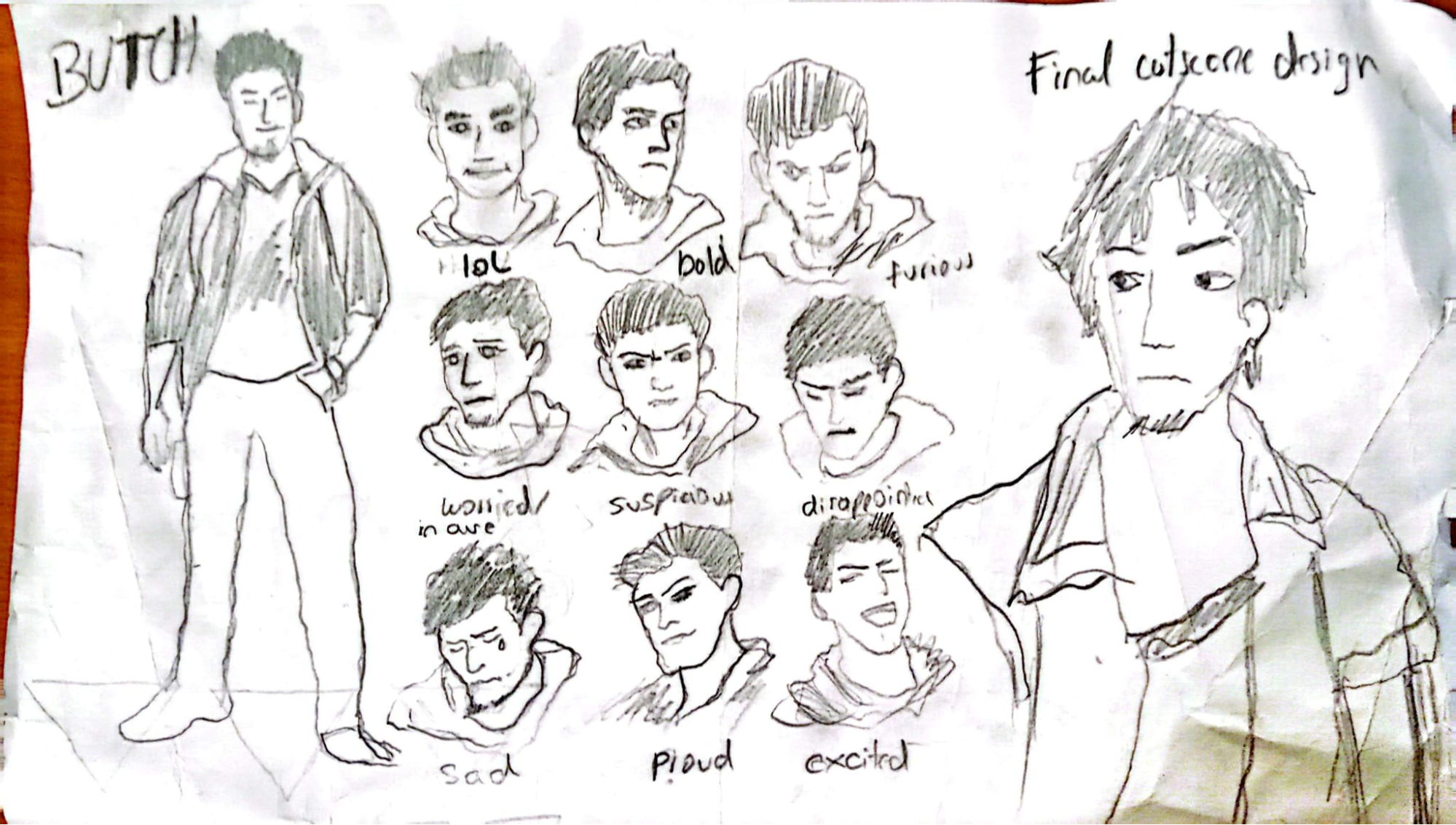
Early character sketches of Butch exploring his appearance, clothing, facial expressions, and final design for cutscenes.
MARA (inspired by Quinn)
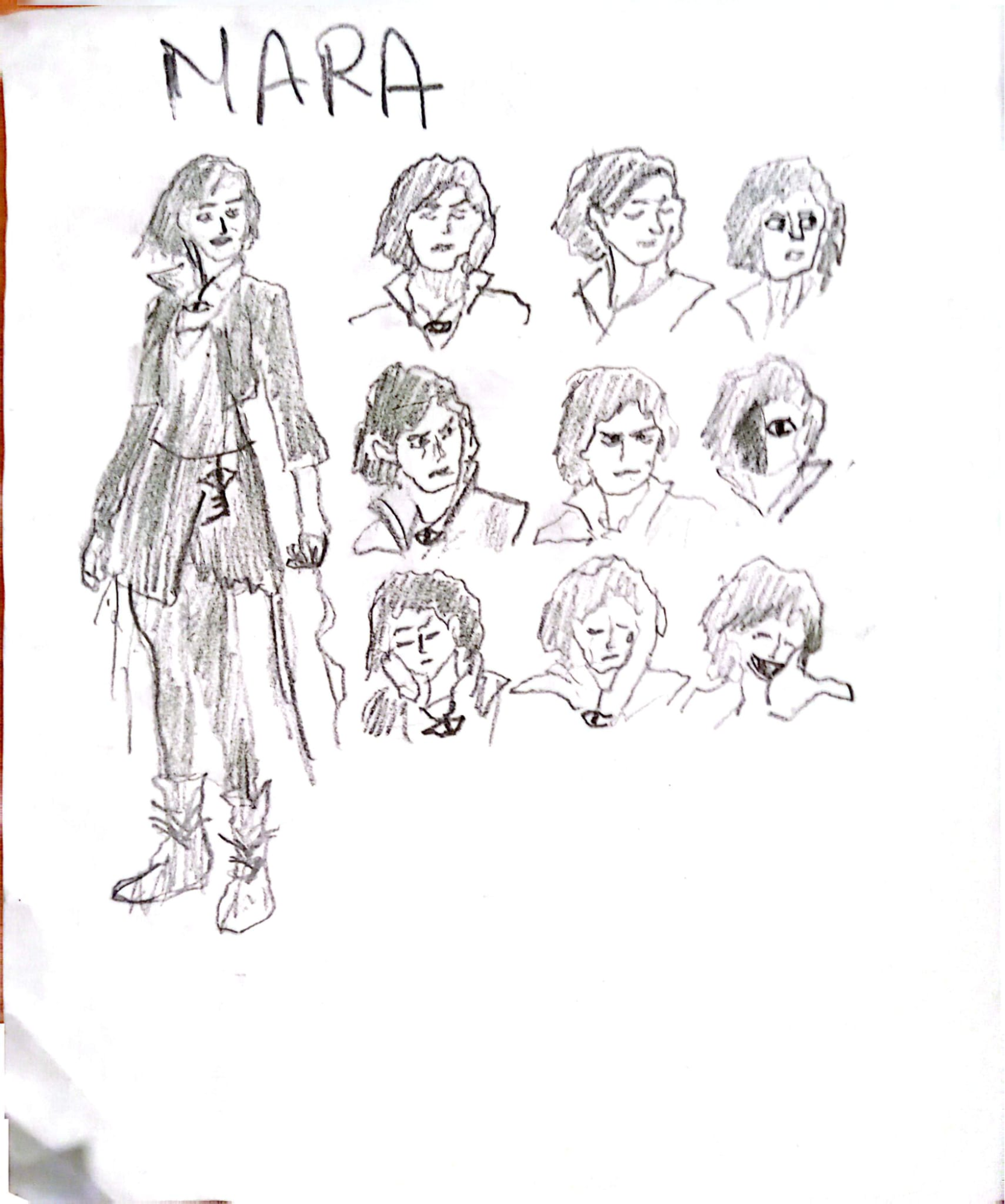
Mara’s concept art. We decided to go for a simpler route: a shadow for in-game cutscenes)
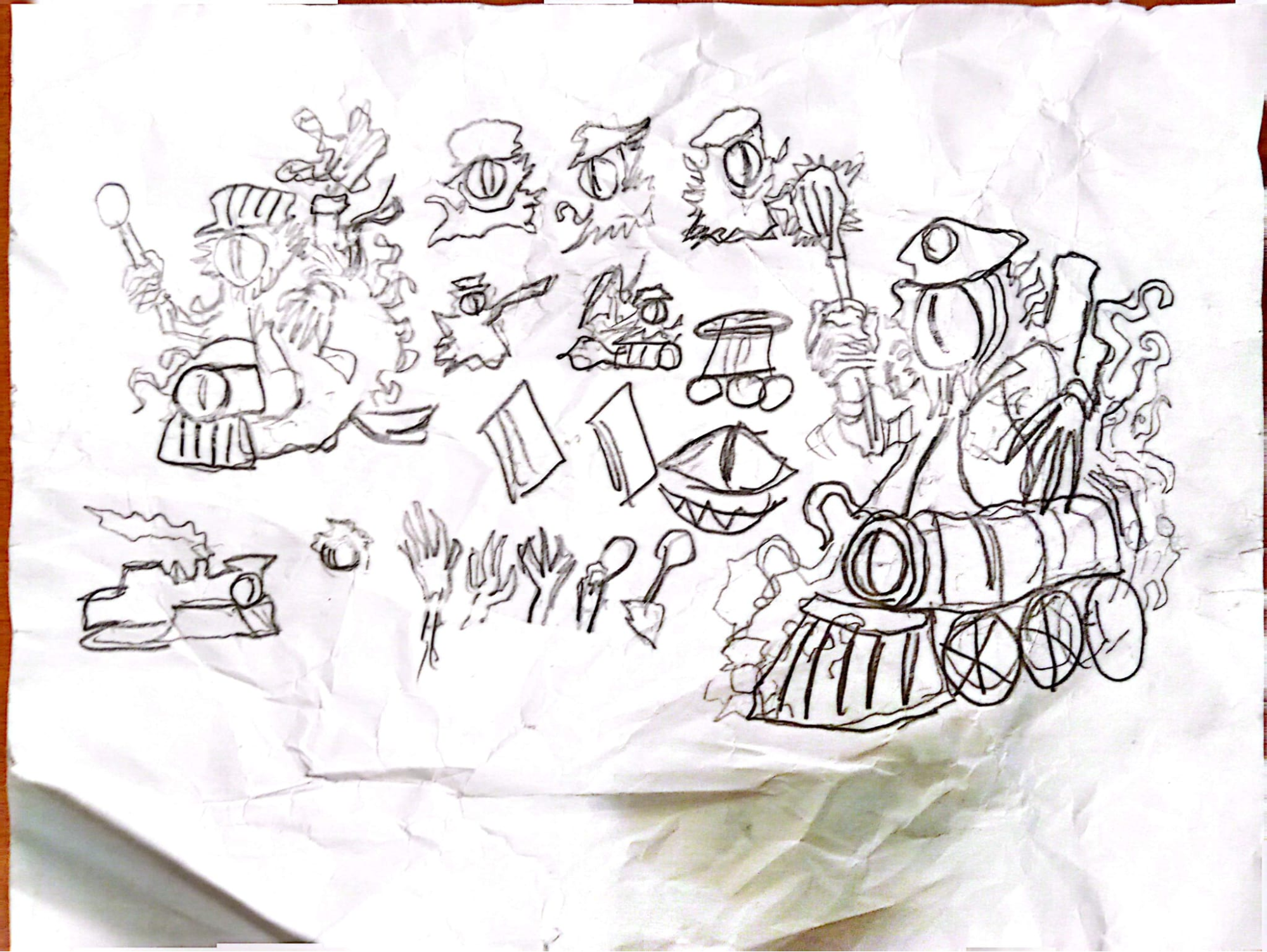
Mathias’s original sketches of the Conductor, which inspired the character assets and concepts developed for the (SPOILER ALERT) true-ending boss battle.
Game mechanics
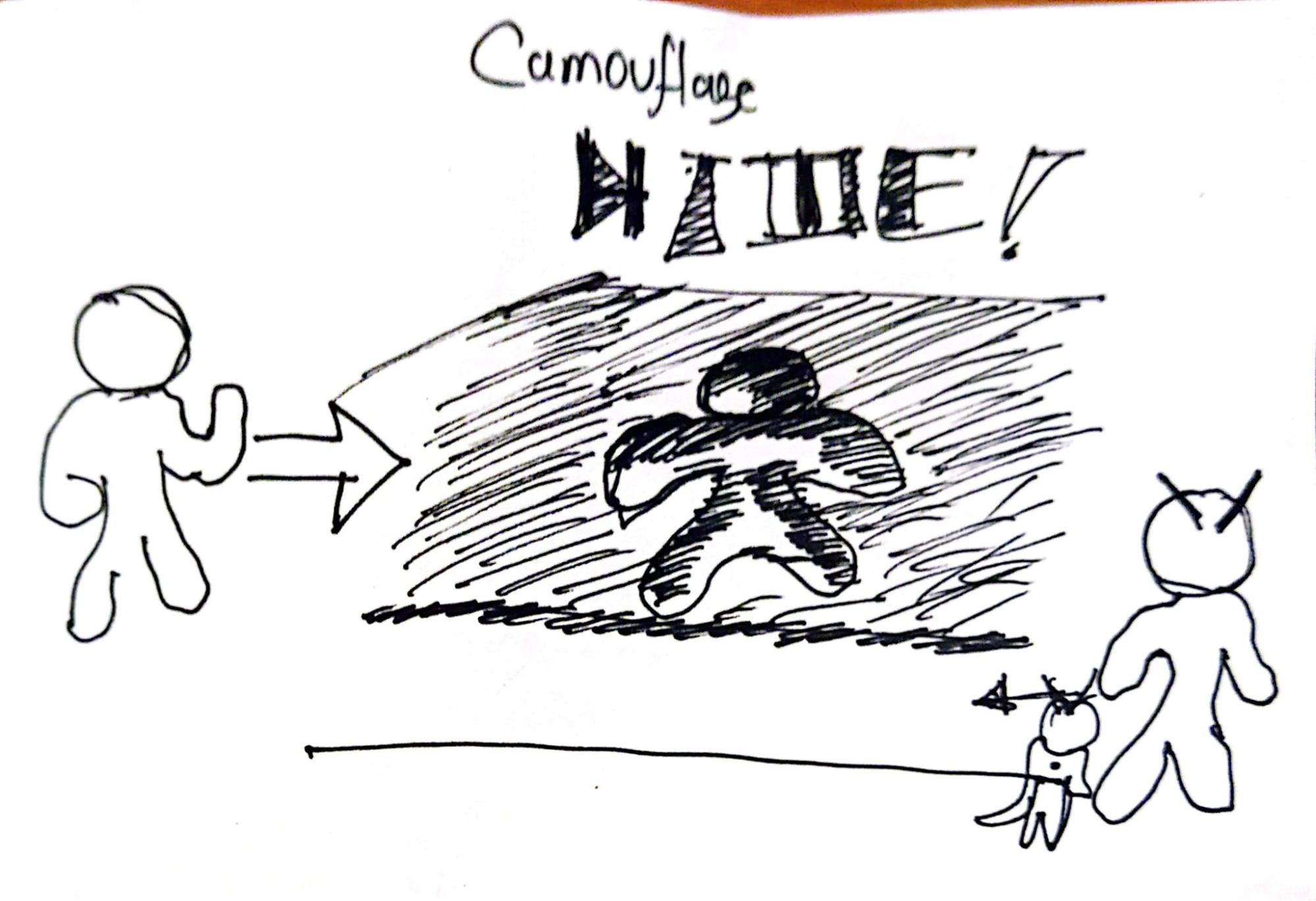
Early concept of what the ability of “shield” ended up to be in the final game (for chapter 4, in the museum labyrinth and in the final boss battle)
CONCEPT AND MECHANISM MAP
Our original concept was a single-player game set aboard an infinite train, with each car representing a different time period, memory, or reality. One car might contain a cyberpunk city, another a medieval kingdom, another a world reclaimed by nature, and another a distorted version of the protagonist’s memories. This structure allowed every train car to introduce its own visual style, characters, puzzles, conflicts, and mechanics.
The player’s objective was to travel through the train and eventually confront the Conductor, the final boss responsible for keeping them trapped. However, we wanted the journey to matter more than the final battle. Each car would tell its own story and present a unique conflict for the player to overcome through exploration and puzzle-solving. Our inspirations included Split Fiction for its variety of environments and mechanics, Limbo for its atmospheric 2D aesthetic, and Disco Elysium for elements of its character-driven narrative.
SCOPE OF THE GAME
We initially planned to build Nightfall in Unity but later switched to Phaser, a more accessible engine that better supported our primarily 2D design, occasional 3D elements, and team members with limited game-development experience. During production, we also realized that creating numerous independent train-car worlds—each with unique artwork, characters, puzzles, and mechanics—was too ambitious for our schedule. We therefore redesigned the cars as different revisions of the same unstable simulation. This allowed us to preserve environments such as the cyberpunk and nature-based worlds while connecting them through repeated locations, visual clues, and Butch’s missing memories. The change shifted our focus from adding as many ideas as possible to ensuring that every environment and mechanic contributed to one understandable narrative mystery: why does reality keep rewriting itself?
INITIAL DECISIONS
INITIAL TARGET AUDIENCE
Our initial target audience was teenagers and young adults who enjoy narrative platformers, atmospheric puzzle games, and stories that do not immediately explain every mystery. We expected players to be comfortable with basic keyboard controls and willing to explore optional objects or dialogue. Our inspirations included games that use environmental storytelling, strong atmosphere, changing worlds, and 2D silhouettes.
We initially designed primarily for players with some platforming experience. Early testing showed that this assumption was too narrow. Players who were interested in the story but less familiar with games sometimes understood the atmosphere while missing navigation cues or control expectations. This became an important reason to revise the onboarding and make the movement more forgiving.
INITIAL NARRATIVE AND WORLDBUILDING
Our original concept was an infinite train in which every car represented a different time period, memory, or reality. One car could be cyberpunk, another medieval, another connected to nature, and another based on the protagonist’s memories. The player’s objective was to travel through the cars and eventually confront the Conductor, who was keeping the protagonist trapped.
This version gave us freedom to invent many environments, characters, puzzles, and mechanics. However, the worlds risked feeling random because their only connection was that they existed inside the same train. During development, we changed the concept from unrelated cars to different revisions of one unstable simulation. In this simulation, the conductor has trapped the player within the simulation and by the end of the train, the player fights the conductor.
INITIAL PUZZLES AND LEVEL DESIGN
Our earliest level plan treated every train car as an independent puzzle box. Each car would introduce a new visual theme and one central mechanic. The player would move from left to right, solve the local challenge, and unlock the next door. We also planned combat and a final boss encounter with the Conductor.
The first playable train-car prototype was approximately one screen wide. It contained a small movement space, an upper route, and combat. This version helped us test movement and lane shifting, but it did not provide enough time for the player to learn the environment or understand why actions mattered. The upper lane also competed visually with the depth-lane system.
MECHANICS, DYNAMICS, AND AESTHETICS
The primary mechanics are horizontal movement, running, jumping, interaction, dialogue choices, environmental state changes, and limited combat. These mechanics create dynamics in which players explore, and solve puzzles.
The intended aesthetics are curiosity, isolation, uncertainty, tension,and discovery. Narrative and Discovery are the strongest kinds of fun in the experience. Challenge supports them through platforming and puzzles, while Fantasy and Sensation come from moving through visually distinct revisions of reality. We wanted tension to come mainly from atmosphere, instability, and incomplete knowledge rather than frequent jump scares.
FORMAL ELEMENTS
Players: Nightfall is designed for one player.
Objective: Move through the train and its connected simulations, solve environmental obstacles, reconstruct Butch’s missing history, and reach the final decision.
Procedures: The player moves, runs, jumps, interacts with objects and characters, attacks in selected sections, and makes dialogue choices.
Rules: Obstacles, lane boundaries, locked states, hazards, and chapter-specific systems limit where the player can move. Progress requires the correct sequence of movement or interaction. Some discoveries are optional, but puzzles must be completed to continue.
Resources: Position, health, checkpoints, interactable objects, and dialogue information
Conflict: The player must solve puzzles and avoid physical barriers to continue progressing in the train.
Outcome: The player completes the journey and chooses between two endings, one where the player defeats the conductor saving Mara, and another where the player discovers that Mara was not real, and fights the conductor to escape the simulation.
PLAYTEST AND ITERATION HISTORY
PLAYTEST 1 — Testable Core 7/28
Playtester: Yifan Xue
https://otter.ai/u/NuXUCEQwiwbSmBBJCSVs1wQ9jZE?utm_source=copy_url
Rather than a formal first playtest, this session was an early test conducted shortly after we combined Chapters One and Three. At this stage, the game was kind of unstable, ran through the terminal, and was visually very basic.
The prototype focused on basic movement, combat, and shifting between foreground and background lanes. Players quickly understood the left-to-right movement, but some interpreted the two lanes as separate platforms rather than two depths within the same environment. Movement on some ladders also felt unresponsive. Our tester reported that it was not always clear what to do in certain areas—for example, they did not realize that they needed to connect electrical wires to progress. Overall the playtester was very confused and also didn’t understand what the objective of the game was. They suggested better onboarding and some dialogue before the level to explain the context of the game.
ITERATION 1
We continued improving the game’s stability and overall performance. To make objectives and interactions easier to understand, we added contextual prompts in appropriate locations. These prompts appear automatically when the player approaches a relevant area or object.
We also removed or adjusted several sections that were unnecessarily difficult, frustrating, or confusing. In addition, we introduced narrative elements at key moments to give players more context and a clearer sense of purpose as they progressed through the game. Specifically in the first cart the puzzles were very confusing. The original puzzle was a combination of braking, speeding up, or holding the train at constant speed. For this puzzle there was no indication of what combination of these commands the player had to do to solve the puzzle. We tried to fix this by adding dials and more visual elements that would give the player a visual cue as to which combination to press. For the cyberpunk parkour chapter it felt too easy for the playtester. There were no dangerous obstacles that would cause the player to die or take damage and most of the jumps were too simple. To fix these issues we added spike jumps which could kill the player and flying cars that would move laterally to increase the difficulty of the chapter. We also removed the design of shifting between foreground and background as we thought it was too confusing and hard to demonstrate visually.
PLAYTEST 2 — PUZZLES AND NARRATIVE PRESENTATION
Xingi Lee
Otter.ai: https://otter.ai/u/TS8xtvCTejb0WmzelNTNo_8gXhQ?utm_source=copy_url
For this playtest, we had a relatively complete and playable version of the game. However, our playtester Xingi Lee could mainly experience the puzzles and problem-solving mechanics. Because the animations, transitions, and narrative sequences were not yet ready, we were unable to present the full story clearly and coherently.
The gameplay itself worked well overall, and the tester did not encounter any major problems or bugs. However, the amount of text was inconsistent. Xingi Lee especially mentioned that she had a lot of difficulty when reading as she struggle with attention, so it was her for the game to catch her attention at the very beginning. She expressed that some sections contained too much information at once, while other sections needed additional explanation to help players understand the story, objectives, or context. She expressed that this led to some parts not feeling like puzzles, but rather just simply following instructions without “much thought” and felt like it was unclear what objects should be interacted with. HOWEVER, she expressed relief and deep interest in how the story was going to develop, as well as huge admiration for the animations, the introduction of combined mechanics (using the clicker and the keyboard to progress in chapter 2) as well as how we were going to deal with bugs.
ITERATION 2 — ANIMATION AND DIALOGUE PACING
We began developing the missing animations and narrative transitions while integrating our completed script into the game. Large blocks of text were divided into shorter sections, allowing players to click through the dialogue at their own pace.
This made the story easier to follow and prevented players from being overwhelmed by too much information at once. It also gave players more control over the pacing of narrative scenes and helped us present the story in a clearer and more engaging way.
PLAYTEST 3 – 8/13
Recording https://www.youtube.com/watch?v=-I99Vpiuek0
For this playtest we had a complete and playable build covering Chapters 1 through 5 and the true ending boss battle, including the animations and combat sequences that were missing from the previous session. Our playtester was therefore able to experience the game close to end-to-end for the first time. She is an extremely heavy player, gravitates toward difficult and heavily narrative-driven games such as Inscryption and Cuphead, and is colorblind, which made her a valuable respondent for both difficulty and accessibility. One important caveat applies to the whole session: she had previously tested our physical prototype and already knew the combat system, and much of the remaining ruleset was explained to her verbally by the team rather than taught by the game. Her smooth onboarding should not be read as evidence that our tutorial works.
The core story landed well. Unprompted, she was able to recount the Chapter 3 mystery accurately and in detail, which confirmed that our dialogue and exposition are doing their job. However, the structure around that story did not hold together for her. She described the shift from the 2D platformer into the isometric investigation chapter as a “full 180” that she could not find a reason for, and felt that the chapters outside Chapter 3 read more like mini-games than parts of a single game. Her sharpest criticism was aimed at one deduction node, where a fifth option announced that the other four theories were all wrong, which made the choice feel like it did not matter. She also had trouble seeing the floor etchings that carry the mystery’s key clue, and only discovered the Tab highlight key because a developer told her about it. At the ending, she could not tell what the final scene actually meant and admitted her interpretation came mostly from the ending’s title rather than the cutscene itself, tracing this back to unclear cutscenes and to the fact that our lore is almost entirely front-loaded into Chapter 3.
On the boss fight, her feedback was concrete and immediately actionable. She judged the five phases to be roughly Cuphead-length each, where Cuphead itself uses only three, and recommended shortening each phase rather than cutting any. She also found the three one-time shields punishing, noting that spending one in stage two made the rest of the fight feel already lost, and suggested regenerating them each phase. HOWEVER, she was genuinely enthusiastic about several things: the boss music, which she said made it truly feel like fighting a train; the fact that nothing in the game is gated behind color, which she confirmed as an actual colorblind player; and the option to turn off flashing lights, which helped her focus and which she asked us to pair with a proper epilepsy warning. She closed by giving us a design principle of her own — that any new mechanic we add should have a reason inside the narrative, so that we don’t create contradictions with what the story has already established.
ITERATION 3 — CHECKPOINTS, ROUTE SAFETY, AND VISUAL CLARITY
Our playtester’s most structural criticism was that the chapters outside Chapter 3 read as mini-games rather than parts of a single game, and that Chapter 3 was carrying the whole experience. In response we expanded the cyberpunk chapter into a longer multi-stage route built around movable ladders and blocks, flying cars, and spike hazards, so that it now presents a sustained sequence of challenges rather than a short interlude. Because she is a player who actively seeks out difficult games and compared our platforming directly to Celeste, we treated her appetite for challenge as a design target rather than an outlier.
She also reached the end of a route having bypassed required content without realizing it, and reacted with genuine concern once we told her what she had missed. We traced similar problems in the cyberpunk chapter and repositioned the ladders that allowed players to skip required challenges, so that progression now passes through the intended encounters. Alongside this we repaired collision, top-height, and dismount behavior, which removes the class of movement failure that interrupted her session and required us to stop play and patch the build.
Her feedback on the boss fight gave us a principle we applied more broadly. She described spending one of her three single-use shields in the second phase and knowing immediately that the run was lost, and asked for shields that refill between phases. We took the underlying point to be that failure should cost progress without foreclosing it, and added recovery routes and a midpoint checkpoint to the cyberpunk chapter so that a mistake teaches the player without forcing a full restart, in addition to refilling shields at the start of each boss phase and shortening the individual phases she found overlong.
Finally, she had real difficulty seeing the floor etchings that carry the mystery’s key clue, describing them as dark brown against another shade of brown, and only found the highlight key because a developer told her about it. As an actually colorblind player she confirmed that our colors function as accents rather than as information, and we wanted to protect that. We therefore improved contrast using darker backplates and clearer visual separation rather than hue, continued refining chapter-specific visuals so mechanical objects stay readable against their environments, added an in-game prompt introducing the highlight key on first entry to an investigation area, and enlarged interface text by roughly 20–30 percent to extend the accessibility work she validated.
FINAL PLAYTEST 8/14
Playtester: Lucy
We used the final test to check whether a casual, story-oriented player could understand Nightfall’s first chapter and learn its mechanisms with limited moderator help. Lucy said she prefers to learn by playing while keeping a visual hint available, and she asked for additional time to read English text.
Success:
Lucy treated the investigation as part of the story rather than as a separate puzzle. She liked that conversations and clue collection were tied to reaching a conclusion, and said this felt more integrated with the story than games in which puzzles are separated from narrative (6:16–7:59). When asked whether she could eventually find the oil without being told, she said that she thought she could (11:37). Her comments also confirmed that the interaction invited active exploration.
Improvements:
The chapter still needs stronger readability and onboarding. Lucy said the text was small or disappeared before she could finish reading it, and at one point she could see that a word was present but could not read it (7:09, 9:25, 13:32). After Chapter 1, she could not clearly explain the protagonist’s immediate goal or what she was meant to do next (17:29–18:08).
The evidence-placement and balance interaction also needed clearer feedback. Lucy said she was playing “by feeling” and did not understand how she had moved through the puzzle (13:27–15:13). Future revisions should keep instructions visible during play, make important text and interactable labels larger and higher contrast, and use the first chapter to restate the player’s goal before the next mechanic appears.
FINAL DECISIONS
FINAL TARGET AUDIENCE
The final target audience still includes players who enjoy atmospheric narrative platformers, but the design is less dependent on prior gaming experience. Required interactions use progressive onboarding, readable cause and effect, and forgiving movement. Optional dialogue and environmental details provide additional depth for players who want to investigate the story.
The game is best suited to players who enjoy uncertainty that can be resolved through observation. We distinguish productive mystery from unusable ambiguity: the player may not immediately know why the simulation exists, but should understand how to move, what can be interacted with, and what changed after an action.
FINAL NARRATIVE AND WORLDBUILDING
The final narrative combines the original train frame with the stronger idea of simulation revisions. The train is not only transportation between unrelated worlds; it is a system that carries Butch through altered versions of reality. Repeated places, NPC memories, amber connections, and cyan traces become evidence that previous iterations existed.
Butch’s missing memories and repeated encounters suggest that he has passed through the simulation before. Mara represents the personal promise beneath the larger mystery. The phrases “KEEP MOVING,” “DON’T WAIT FOR ME,” and “YOU STOPPED HERE LAST TIME” connect emotional memory to the player’s basic forward movement.
We chose to reveal the story through optional conversations, environmental objects, repeated motifs, and contradictions rather than one long explanation. The two endings, “I remember” and “I forgive you,” give the player a final response to the recovered past. Remembering and forgiving are not presented as simple good and bad outcomes; they express different ways of carrying the truth forward.
FINAL PUZZLE AND LEVEL DESIGN
The final puzzle structure uses progressive gates and chapter-specific mechanics. In the prologue, the player learns a visual language of endpoints, connections, powered states, and doors. The first gates provide explicit cues, while later gates ask the player to transfer that knowledge. Amber feedback confirms a successful connection, and persistent room states prevent solved spaces from becoming ambiguous again.
The lane system remains the game’s main mechanical identity. Obstacles can block one depth while leaving another route open, and actions in one lane can affect the other. Visual depth cues help the player read both lanes as one place. Platforming sections use forgiving movement, checkpoints, and recovery paths so that failure supports learning rather than repetition.
The cyberpunk chapter develops longer parkour and object-manipulation sequences across a large route. Echo City asks players to observe behavior, gather testimony, and reconstruct what happened through environmental evidence. The Painted Country chapter uses paint, wash, drawing, and archive color relationships, while the Museum and Labyrinth combine archival investigation, navigation, gaze-based hazards, shields, and a collapse escape. The Conductor finale and hidden Black Knife route turn the accumulated evidence and collectible stones into two different final paths. Although these chapters differ in appearance and local mechanics, each asks the player to observe a system, test it, read feedback, and update a mental model.
FINAL FORMAL ELEMENTS
Players: One player.
Objective: Advance through the simulation revisions, recover enough context to understand Butch’s journey, and reach the final choice.
Procedures: Move, run, jump, shift lanes, interact, manipulate environmental objects, enter dialogue, choose responses, and use limited attacks where required.
Rules: Progression gates require understandable actions or sequences. Lane position affects routes and interactions. Hazards return the player to safe recovery points. Completed puzzle states persist when possible.
Resources: Movement space, health and safety, checkpoints, connected power states, movable objects, dialogue information, memory fragments, and player knowledge.
Conflict: Physical obstacles and enemies create immediate pressure, while erasure, contradiction, and incomplete memory create narrative pressure.
Outcome: The player reaches one of two endings based on a final choice informed by the journey. Completion includes both mechanical arrival and interpretation of the recovered story.
LEARNING AND DESIGN REFLECTION
The largest lesson from Nightfall was that game design becomes visible through iteration. Our first ideas were described mainly in terms of content: more train cars, more worlds, more mechanics, and a final boss. Building playable versions forced us to ask different questions. Could a new player read the lane structure? Did an interaction communicate its consequence? Did a puzzle reveal something, or merely delay progress? Did failure produce learning, or repetition?
The shift from unrelated train cars to revisions of one simulation improved both scope and meaning. It reduced the number of disconnected assets we needed while allowing repeated environments and mechanics to support the story. This was a practical production decision and a worldbuilding decision at the same time.
MDA helped us evaluate whether mechanics produced the experience we intended. Lane shifting alone is a mechanic. When players compare foreground and background routes, it creates a dynamic of spatial interpretation. When that interpretation makes the world feel layered and unstable, it supports the aesthetics of curiosity and uncertainty. The same analysis showed why random teleportation was weak: it changed player position, but did not reliably create understanding or satisfying challenge.
We also learned that purpose matters as much as functionality. A door can open correctly and still feel arbitrary. Stronger puzzles establish a goal, provide evidence, let the player act, and show a consequence. Connecting BRAKE to POWER is more meaningful when sound, light, door state, and story context all respond together.
Technically, Phaser 3 allowed us to build and revise a 2D browser game quickly. A modular chapter structure made it possible to work on environments separately while keeping shared controls and systems. GitHub supported version control and collaboration, while automated checks and repeated local testing helped catch regressions in movement, collisions, and chapter transitions.
Finally, we learned to separate designer knowledge from player knowledge. After working on a level for many hours, its route feels obvious. Playtesting revealed where that familiarity hid missing cues. The final design is stronger because it treats confusion as evidence to investigate rather than as a player failure.
FUTURE IMPROVEMENTS
With more time, we would strengthen transitions between chapters so that changes in mechanics and visual style feel more clearly caused by the simulation. We would also develop combat further or reduce its role; at present, movement and puzzles carry the experience more successfully.
We would make more narrative discoveries that affect later gameplay. Optional objects currently reward exploration with context, but future versions could allow remembered information to alter dialogue, routes, hazards, or the final decision. This would create a stronger connection between what the player learns and what the player can do.
The final version already includes an opening sequence and chapter transitions that establish the game’s visual language through motion, sound, the wrong reflection, amber connections, and cyan thread. Future work would refine their pacing and clarity through wider external testing with players of different experience levels.
ACCESSIBILITY
Accessibility changes already implemented include larger interface text, stronger contrast, dark text backplates, clearer interactive-state feedback, checkpoints, recovery routes, variable jump height, coyote time, and jump buffering. Important states are communicated through combinations of color, motion, text, position, and sound rather than color alone. The shared pause and settings menu also provides master, music, and sound-effect volume controls, text-size and subtitle settings, reduced-motion support, and a controls reference.
Future improvements would include full control remapping, gamepad support, adjustable dialogue speed, color-vision presets, and broader testing of subtitle size, reading time, flashing effects, and control accessibility with players of different experience levels.
TEAM CONTRIBUTIONS
I served as the project’s Creative and Integration Lead. I guided the overall gameplay and narrative direction, made scope and production decisions, integrated the individual chapters into one cohesive final build, coordinated shared systems, transitions, audio, and accessibility work, and led cross-chapter QA, playtesting, debugging, packaging, and final submission preparation.
Jack Yang led the implementation and iteration of the cyberpunk chapter, including its traversal, platforming, and object-manipulation challenges. He also contributed to design discussions, playtesting, and refinement of the chapter’s route safety and readability.
Jason Zhou led the visual packaging and all chapter-transition work, including motion and cinematic presentation, introduce the story and all the visual continuity, sounds effect and painterly finishing across the experience. He also contributed to narrative presentation, playtesting, and final polish.
Carl Liu led the Painted Country chapter and its paper-world mechanics, including the gallery, drawing, paint, wash, and color-link puzzle structure. He also contributed to product review and key technical design decisions.
Mathias Becerra developed the original Infinity Train concept, created key character and concept art, and led work on the Museum, Labyrinth, and hidden final-boss route. He also contributed to narrative development, playtesting, and final design discussion.All team members contributed to playtesting, design discussion, scope decisions, and final evaluation.
AI DISCLOSURE
AI-assisted tools were used as part of our production workflow for prototyping, programming support, debugging, documentation, and concept or asset exploration. They supported the work, but the team made the design decisions, wrote and revised the narrative and rules, selected what entered the final game, integrated the chapters, and tested the playable build.
Mathias’s hand-drawn concept art informed the visual direction for the train, characters, and final encounter. AI-assisted tools were also used to explore or produce selected cutscenes, NPCs, enemies, models, and background environments. All generated or assisted material was reviewed, selected, edited, and integrated by team members.
Tools used included Claude, Codex, Kimi, Qwen, MiniMax, Hunyuan 3D, and ComfyUI with MiniMax H3. We also used GitHub for version control and collaboration, Itch.io for distribution, and Epidemic Sound and Pixabay for licensed or copyright-free music and sound resources. Specific asset credits and licenses are available in the in-game Credits screen.
FINAL GAME
Online Version:https://design-for-play-p2.vercel.app/
GitHub Repository: https://github.com/gazcn007/design-for-play-p2
Downloadable Build (ZIP): Google drive link Or Github
Press “1111” can become dev mode(pick chapter)
Gameplay / Playtest Video (20 minutes): https://youtu.be/T065DaEL07w
Credits, Asset Licenses, and AI Use: The in-game Credits screen identifies the music, sound, asset, and AI-assisted production sources used in Nightfall. It also includes the relevant attribution and licensing information.


