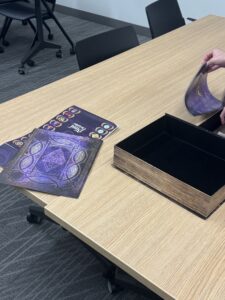
This week I played the game Blood on the Clocktower by Steven Medway which is a bluffing game. I have already heard about it for a long time but did not get a chance to play it myself. The target audience of the game includes both teenagers and adults, as long as they are able to analysis the logic. It is a board game and I played it on the Game Night on Monday.
In the game round I played, I got the role of undertaker which belonged to townsfolk. In the first round, Cam said he was the Fortune Teller and had verified that Gavin and I are both good. I chose not to reveal my identity immediately because I think it would be too early to expose information like this. Instead, I mentioned that I wished someone could be voted out in the daytime because the only probability to use my skill is that some was ruled out in the daytime. In the following part of the game, I tried to use logic to analysis identities of different players and I got to know who is the demon in the second day because the identity of the player who keeps accusing that I lied, is conflict with the identity of the player we voted out on the first day. However, I trusted another player who claimed herself as a monk because she acted like she was not familiar with the game. I made up decision based on both logic and emotional. Unfortunately, the trust based on emotional finally got me one vote to lose the game.
About the way of communication, I tried to use psychology to persuade people to believe me that I am not the demon. I also tried to use the logic based on the public information we got by sharing things we got. The reason I hid some information in the first round of the game is that I believed if I directly reveal my identity without sharing useful information, then it would give direct information to the demons team because they can value the worth of the players and perhaps my skill could not be used because I died. From the perspective of the MDA framework, the mechanic of hidden identities creates a dynamic in which players selectively reveal information instead of telling the complete truth. This eventually produces feelings of tension and uncertainty, which are central aesthetics of the game.
In the team, I think my view is actually the most clear one because I can directly tell the position of the demon. My role in this team is actually an information provider. As I cannot make everyone believe in me, the only way I could do is defending for myself and collecting all the information that everyone was aware of. If there was a enough number of people believed in me, I could act as a team leader as I was the only people of townsfolk who survived till the last day. I should tell them who they should vote if they belongs to the townsfolk team.
The reasons why I acted like this are as follows. Firstly, there is one rule in this game that the exact roles included in this game are not revealed. Hence, the demon team could claim themselves as roles in townsfolk team without creating a conflict which could increase the reliability of their words. Secondly, the game allows both public chat and private chats which make the information each player get various. Also, the demon team can also use this chance to discuss their strategies. Last but not least, the death players still got one vote, so I needed to persuade everyone instead of players that were still alive.
Compared with Werewolf, a similar game in this genre, Blood on the Clocktower allows the players who have already died speak in the daytime and offers them a extra vote. This highly increase the complexity of the game because the extra votes can influence the end of this game. Moreover, as the players do not know about the exact identities included in this round of game, there would be more situations that could be considered about.
For the improvement, I find the rules a little bit too complicated when I started to play it because I cannot memorize the skills of every roles. I would hope that the game could provide a simplified version which contains less roles. This could help the beginners find their ways to play the game quicker.
I do not think lying in this game is a wrong action because every player needs to respect their identity in order to make the game interesting. If someone insists on telling the complete truth no matter what identity they got, they are definitely not good players because they do not even respect the games. The special thing about the games that they permit us to lie to our fiends is that, we agree that all the lies only works in the game when the game starts. It is like a contract that do not needs to be spoken out.